❌

Reading view

There are new articles available, click to refresh the page.

GTA 6 preloads are live — there's still time to upgrade your NBN before launch day

You can feel the excitement in the air. Grand Theft Auto 6 will be available to play in less than two weeks, officially launching on November 19. We're fortunate here in Australia, as we'll be able to play the much-anticipated game before the rest of the world — our Kiwi cousins get it slightly earlier, but what's a few hours when we've had to wait 13 years.

That's only possible if you download the game ahead of time. And with preloading officially kicking off today, November 10, you'll want to make sure your NBN plan is ready to download the enormous 212GB file. If it isn't, there's still time to switch to one of the fastest NBN plans before launch day, so you can begin preloading and doing your bit to help avoid breaking the Australian internet.

And now is a great time to switch regardless, as several early Black Friday NBN deals have gone live, including an offer from Telstra that's almost too good to be true.

The telco is currently offering 50% off plan fees for four months across all of its plans, making it one of the cheapest providers for introductory pricing across several speed tiers. Yes, it happened — we got cheap Telstra NBN plans before GTA 6.

With the fastest NBN plans capable of downloading GTA 6 in as little as 14 minutes, compared with 56 minutes on slower connections, switching could make all the difference.

NBN plan

Download speed

Time to download

NBN 500

500Mbps

56m 32s

NBN 750

750Mbps

37m 41s

NBN 1000

1,000Mbps

28m 16s

NBN 2000

2,000 Mbps

14m 8s

I’ve selected my top choice for each of the four speed tiers, with prices starting at AU$69 a month for Spintel’s NBN 750 plan.

Exetel One | 500Mbps | AU$80/m

I’ve selected Exetel’s NBN 500 plan as the top choice for this tier, as it’s not only affordable, with fuss-free billing, but it’s possible to boost your speed to NBN 1000 for 24 hours for just AU$1, perfect for downloading GTA 6 faster. Plus, the telco recorded the quickest ping speeds in the most recent ACCC broadband performance data report of 6.9ms, which could be ideal if you intend to game online.

• AU$80 minimum cost
• AU$960 yearly cost

• View more of the best NBN 500 plansView Deal

Spintel Home Turbo Fast | 750Mbps | AU$69/m (first 6 months, then AU$94.95/m)

The most affordable NBN 750 plan that promises maximum plan speeds is this one from Spintel. The telco receives generally favourable reviews from customers, and even the ongoing cost is low for the tier, with the AU$94.95 monthly fee coming in well under the current AU$107 average.

• AU$69 total minimum cost
• AU$983.70 first year cost
• AU$1,139.40 ongoing yearly cost

• View more of the best NBN 750 plansView Deal

Superloop | 860Mbps | AU$89/m (first 6 months, then AU$114/m)

It’s definitely possible to spend less on an NBN 1000 plan (and if you do, make sure to check out my other recommendations), but this plan from Superloop is well-optimised for online gameplay and has been proven to overdeliver on its typical evening speed claims. Throw in near-universal acclaim, and you have yourself a fine choice for a gigabit internet plan.

• AU$89 minimum cost
• AU$1,218 first year cost
• AU$1,368 ongoing yearly cost

• View more of the best NBN 1000 plansView Deal

Superloop Hyperspeed plan | 1,700Mbps | AU$148/m (first 6 months, then AU$168/m)

If you want an NBN 2000 plan, then you’ll likely first need to have dedicated equipment installed at your premises, which could affect the time it takes to download GTA 6. Still, if it’s the plan for you, this option from Superloop gets my seal of approval. Only a handful of providers currently offer an NBN 2000 plan, and given Superloop’s track record and positive reviews, and below-average pricing, it’s an easy recommendation.

• AU$148 minimum cost
• AU$1,896 first year cost
• AU$2,016 ongoing yearly cost

• View more of the best NBN 2000 plansView Deal

Reddit Founder Says Building Social Media Apps Is 'Not Cool Anymore'

An anonymous reader quotes a report from Wired: Alexis Ohanian wants to figure out the future of user-generated content. According to the Reddit cofounder, building social media apps is "not cool anymore" and so much of the internet has been compromised. "I'm expecting some better version of the group chat to be that new version of UGC," Ohanian told WIRED senior correspondent Lauren Goode at the inaugural WIRED World Fair. [...] Ohanian is a proponent of the "Dead Internet Theory"—the idea that a lot of online activity and content is being generated by bots. Large language models have turbocharged this, with AI agents outrunning human users. "The internet that I grew up on that was really built for humans first; user interfaces and experiences are going to go away," said Ohanian, "because more of the internet is going to get created for these agents to use, [rather] than for people." In some ways, the advance in generative AI has been lucrative for sites like Reddit, which has licensed its vast archive of human conversations to companies including Google and OpenAI to train AI models. "Platforms like ours became very, very valuable to LLMs," Ohanian said. But the technology has also undermined the business. Reddit shares plunged 29 percent last week after the platform warned that Google's AI-powered search was hurting referral traffic. Ohanian also worries the commercialization of these conversations means they are full of "bullshit." "The internet has gotten so manipulated because it is so incredibly valuable to do so," he said. Reddit recently said it would require users to sign in to fight third-party scraping and keep up user engagement. While Ohanian declined to say whether he agrees with the move, "there has to be provable humanity on the internet without being creepy." An early Anthropic investor, Ohanian is nonetheless optimistic about the potential benefits of AI. He is especially excited to see medical breakthroughs from the technology. "There is still a very real chance that this technology can cause a lot of harm for sure," he said. "I think we have to be sober about how we're building and what we're doing, but I still can't help but see all of the things that can get so demonstrably better."

Read more of this story at Slashdot.

'Getting the job done should also be a natural thing': Zoom lays out its plans to use AI and context to be even more of a useful workplace assistant

Over the last few years, Zoom has probably had one of the most intriguing journeys in the business world.

After booming during the pandemic, the company has since expanded its offerings to cover a huge range of enterprise needs, with contact center services alongside traditional video conferencing and expanding AI tools.

As the company looks ahead to its new AI-enabled evolution, I went to the Zoom Experience Centre in London to find out more.

Refusal to compromise

“When we look at EMEA, we think the landscape is shifting in how organizations think about the technology they rely on,” Louise Newbury-Smith, Zoom’s Head of UKI, explains.

“For years, the pattern has been pretty similar, an organization would adopt a platform and then have to manipulate their own way of working around that platform - we really want to reverse that.”

“There is still some of that friction…(but) what’s changing is that organizations are starting to refuse to compromise - they want platforms to work the way they want to work.”

Zoom opened its UK data center in November 2025, greatly improving the situation for organizations in the region, as data residency choices which didn't exist before are now in place, meaning the likes of local councils, NHS trusts and financial services firms can store their data locally.

Newbury-Smith notes that the EMEA region is not a secondary market for Zoom, but high growth opportunity, a point echoed by Nick Tidd, Head of Global Channel GTM, who said the region offers, “a truly remarkable opportunity for our customers and for our partners, when you look across the product portfolio.”

This opportunity is hooked onto AI, particularly the growing importance of the context layer, a situation where Zoom is ideally placed, Tidd says.

“Think of how Zoom is positioned across the product portfolio - capturing all of those conversations…(and) putting them into the context to capture them in the workflow is where we are very different to others.”

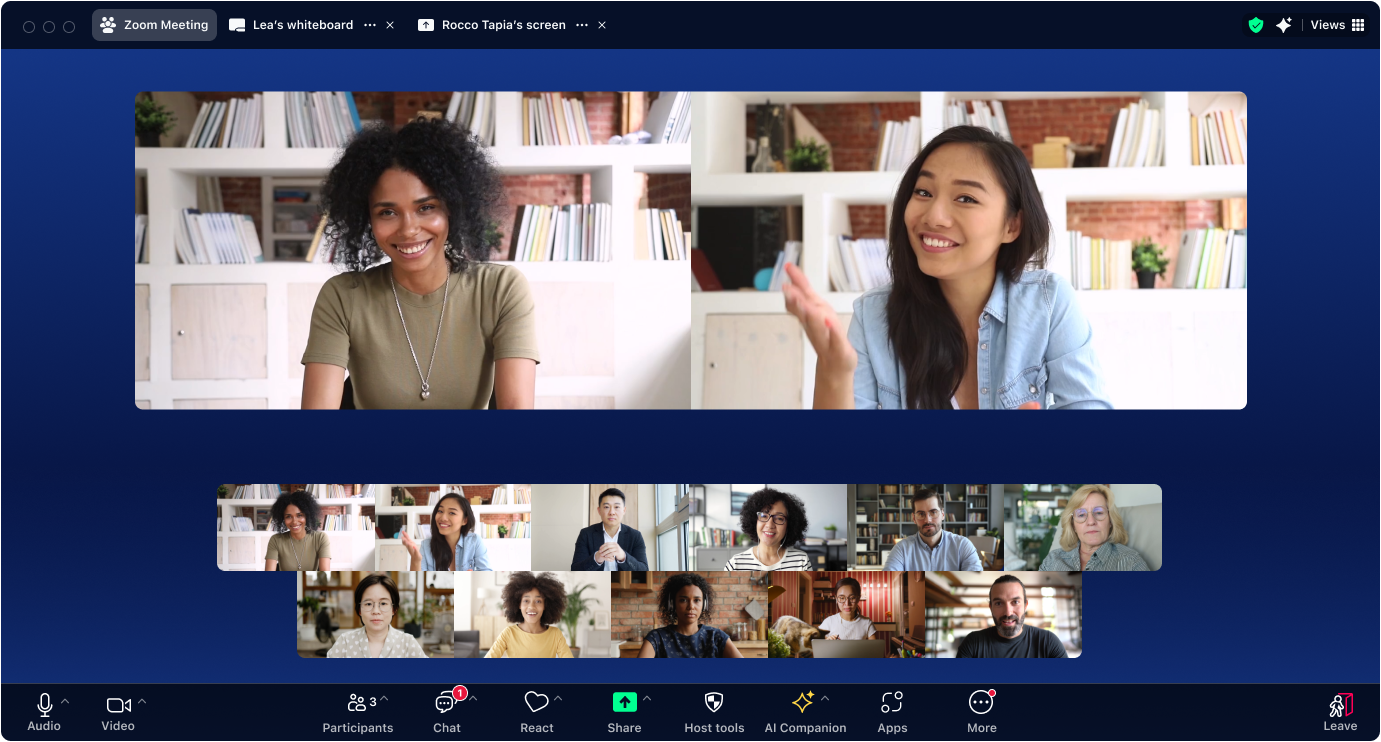
Zoom

(Image credit: Zoom)

This move was expanded by Leo Boulton, Zoom’s Head of Product, Solution and Industry Marketing, who ran us through the company’s recent releases and product announcements, highlighting the importance of context in Zoom’s concept of “conversation to completion” in its new Unified Context Layer.

“Conversations come natural to us - the way that we work is through conversations, it’s just a natural part of how humans are,” he noted, “so getting the job done should also be a natural thing - not something that requires a change in behavior, but something that should naturally just be part of our everyday work.”

If this doesn’t happen, workers will resist change, Boulton notes - particularly when it comes to AI, which is why Zoom is looking to embed intelligence into work itself.

Context has become a critical part of improving AI performance and usefulness in recent months, and Zoom wants to ensure its tools are as up to date as possible - but this requires some key elements.

“Before AI can truly understand how people work and operate, we have to guarantee it has the highest-quality raw materials,” Boulton points out. “The conversation must be crisp, clear and understood with genuine eye contact – because only with the best ingredients can AI deliver the most value.”

Zoom has been working hard to improve the quality and fidelity of its audio and video for calls and meetings, including the upcoming launch of a real-time “voice smoothing” tool known as “touch up my voice” and a pose correction tool enabling for greater eye-to-eye contact to boost interpersonal connections.

The better your agents understand your business, the more effectively they can work for you, Boulton notes, as he demonstrated how users will soon be able to benefit from a live assist feature which offers proactive suggestions during a call, such as telling you to speak slower or faster.

Zoom Chat is also getting a significant upgrade, making it what Boulton said should be a shared space where people and agents will interact and work together.

“We don’t expect our customers to live entirely inside Zoom,” he said. “True adoption only happens when tools feel natural, which is why our context layer is open by design – bringing the intelligence directly into whatever interface people already choose to work in.”

So it’s clear that Zoom wants to be so much more than your classic video conferencing and chat platform - and its ability to get the most out of your information could make it a very handy tech partner going forward.

“The direction is super clear,” Newbury-Smith concludes, “we're building and serving our customers where they are.”

Google logo on a black background next to text reading 'Click to follow TechRadar'

TP-Link Archer 8 Ultra: the future of Wi-Fi has just arrived, with TP-Link’s first Wi-Fi 8 router

TP-Link Archer 8 Ultra: One-minute review

It’s taken quite a while for Wi-Fi 7 to become a mainstream technology – even Apple hasn’t adopted it right across its product range yet – but TP-Link has just launched the first Wi-Fi 8 router in the somewhat imposing form of its new Archer 8 Ultra.

In fact, the final technical details for Wi-Fi 8 probably won’t be announced until 2028, but the key features of the new standard are well known, allowing TP-Link and other manufacturers to prepare new products that will introduce the new technology over the next couple of years. It’s also planning to release a number of mesh routers and range extenders that will use Wi-Fi 8 in 2027 as well.

It’s safe to say that a state-of-the-art router with Wi-Fi 8 will be massive overkill for most home users – after all, the Archer’s tri-band Wi-Fi and top speed of 19Gbps will leave most home broadband services trailing in its wake.

And, of course, it comes with a state-of-the art price tag too. However, the Archer 8 Ultra is a good opportunity to look at the new features that will shape the next generation of Wi-Fi technology.

TP-Link Archer 8 Ultra review: Price & release date

  • How much does it cost? Pre-order for £699 (around $950), then £899.99 (around $1,199)
  • When is it available? Released on November 15, 2026
  • Where can you get it? Available in US, EU, UK

The Archer 8 Ultra is currently available for pre-order from TP-Link’s website, and will be officially launched on November 15, 2026.

The US pricing hasn’t been confirmed at the time of writing, but there’s a special offer for pre-orders in the UK for £699 (around $950), with the price rising to £899.99 (approx. $1,199) following the launch in November. There are currently no rival Wi-Fi 8 routers to compare it with, but that pricing makes the Archer 8 Ultra twice as expensive as a high-end, current-gen Wi-Fi 7 model.

  • Value: 4/5

TP-Link Archer 8 Ultra review: Specs

Wi-Fi:

Wi-Fi 8 (2.4GHz, 5.0GHz, 6.0GHz)

Wi-Fi Speed:

Up to 19Gbps (using 6.0GHz)

Ports:

2x 10Gbps (WAN/LAN), 4x 2.5Gbps (LAN), 1x 1Gbps (LAN)

Processor:

Broadcomm SoC

Dimensions:

245 x 98 x 226mm

TP-Link Archer 8 Ultra router on wooden desk

(Image credit: Future)

TP-Link Archer 8 Ultra review: Design

  • Solid build quality
  • Very good selection of ports
  • App is easy to use

Wi-Fi 8 focuses on extending range and signal power in order to improve reliability.

This means that the Archer 8 Ultra needs to provide some pretty heavyweight hardware. It’s built like a tank, consisting of a matte-black obelisk that stands 245mm high, 98mm wide and 226mm deep, and it houses no less than 18 internal antennae to help beam the Wi-Fi signal far and wide.

It also provides an impressive set of ports and connectors, including two 10Gbps ports that can handle the latest high-speed fibre broadband, and also double up for a wired network connection (LAN) for devices such as a PC or gaming console that needs maximum performance.

There are also four additional 2.5Gbps ports for additional wired connections and, somewhat oddly, a single 1Gbps port as well.

TP-Link’s Tether app is also well designed, allowing you to scan a QR code in order to quickly connect to the router’s new network. By default, the app creates two separate networks, with one network reserved for the high-speed 6.0GHz band that is supported by newer computers and mobile devices.

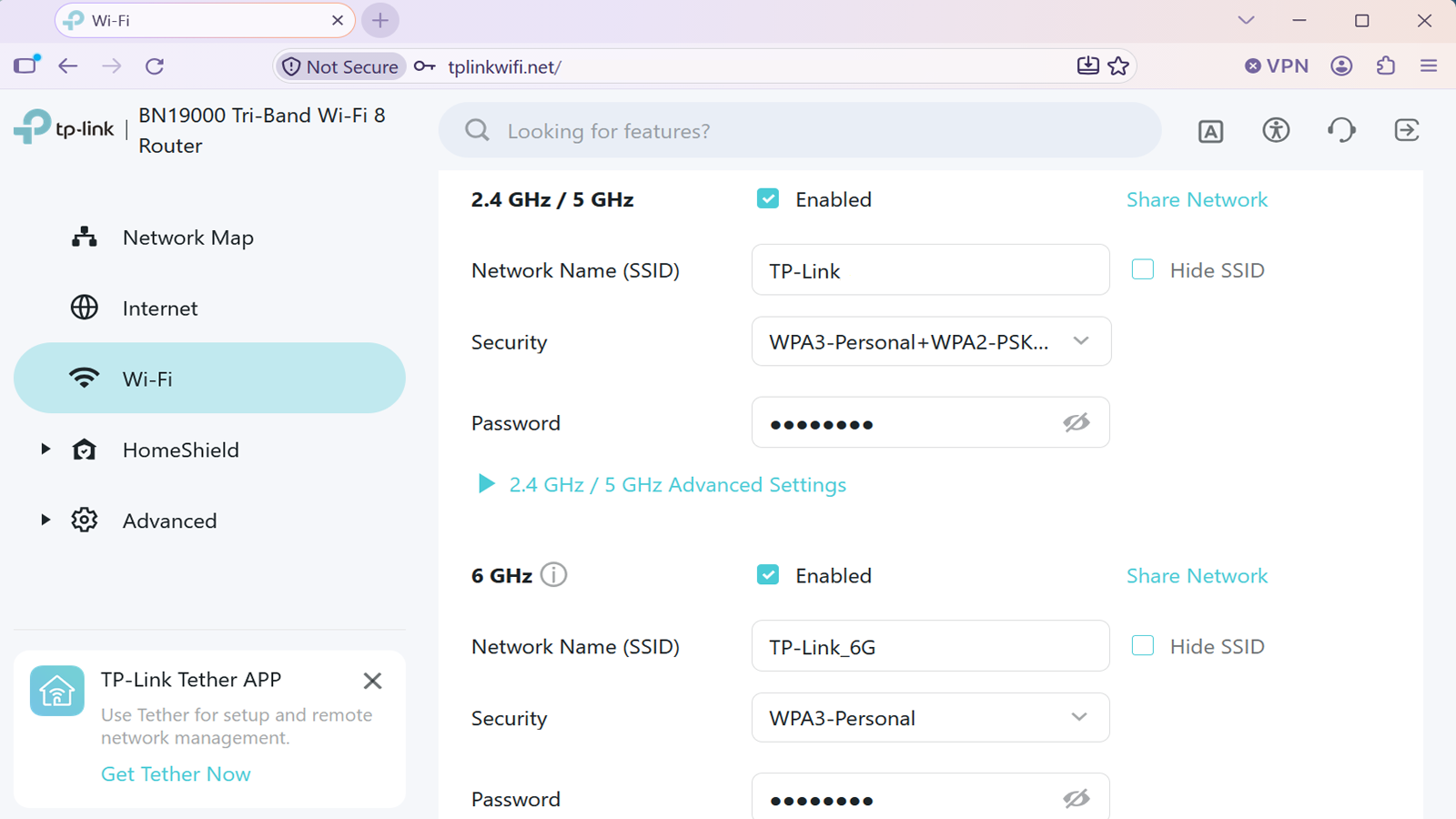
The second network combines the 2.4GHz and 5.0GHz bands in order to provide compatibility with older computers and mobile devices. That setup should suit most users, but more advanced users can connect to the Archer 8 Ultra via a web browser interface that provides greater control over your network settings.

  • Design: 5/5

TP-Link Archer 8 Ultra review: Features

The new Wi-Fi 8 standard is a big step forward, and is awash with jargon and buzzwords, such as MAPC (multi-access point co-ordination), ELR (enhanced long range), and DRU (distributed resource units), and you can find out more about these on the TP-Link website.

But the TLDR version is that Wi-Fi 8 shifts the focus away from sheer speed and instead concentrates on improving both range and reliability for larger homes and offices, as well as public and outdoor venues that may have dozens or even hundreds of connected devices spread over a very wide area.

Of course, the 19Gbps speed of the Archer 8 Ultra certainly sounds impressive, but it’s not actually any faster than the top speed of 46Gbps that is already possible with current-generation Wi-Fi 7 devices.

Wi-Fi 8 also uses the same frequency bands – 2.4GHz, 5.0GHz and 6.0GHz – that are available with Wi-Fi 7 as well. This ensures that the Archer 8 Ultra will be backwards-compatible with existing computers and mobile devices that use Wi-Fi 7.

However, those buzzwords that we just mentioned are designed to improve the range and reliability of the Archer 8 Ultra, so that a single router can cover an area of 3,600sq.ft (although some regions may quote this as 3,000sq.ft due to differences in local regulations).

TP-Link Archer 8 Ultra web interface

(Image credit: TP-Link)

It’s also designed to support up to 200 connected devices, and includes a Multi-Floor Mode that can automatically configure the Archer network to work efficiently within homes, offices, and other buildings where people and devices may be spread across multiple floors and levels. Suffice it to say that if you live in a modest two-bedroom house or apartment, then the Archer 8 Ultra will definitely be what The Sisters Of Mercy refer to as ‘a slight case of overbombing’.

  • Features: 5/5

TP-Link Archer 8 Ultra review: Performance

  • Tri-band Wi-Fi 8
  • Very few - if any - Wi-Fi 8 devices yet
  • Still fantastic performance with Wi-Fi 7 devices
Benchmarks

Ookla Speed Test – 2.4GHz/5.0GHz (download/upload)

Within 5ft, no obstructions: 150Mbps/150Mbps

Within 30ft, three partition walls: 150Mbps/150Mbps

20GB Steam Download – 2.4GHz/5.0GHz

Within 5ft, no obstructions: 150Mbps

Within 30ft, three partition walls: 150Mbps

Ookla Speed Test – 6.0GHz (download/upload)

Within 5ft, no obstructions: 150Mbps/150Mbps

Within 30ft, three partition walls: 150Mbps/150Mbps

20GB Steam Download - 6.0GHz

Within 5ft, no obstructions: 150Mbps

Within 30ft, three partition walls: 150Mbps

I’ve not come across any PCs or mobile devices that currently support Wi-Fi 8 but, as mentioned, Wi-Fi 8 does use the same frequency bands as Wi-Fi 7, so I was able to get some idea of the performance offered by the Archer 8 Ultra using an existing laptop with Wi-Fi 7.

The extended range and reliability of Wi-Fi 8 makes it a good option in my office, as I have a deadspot in one particular office at the back of the building. Unsurprisingly, both of the Wi-Fi networks set up by the Archer 8 Ultra were easily able to cruise along at the maximum 150Mbps provided by my office network when running the Ookla SpeedTest and for downloading large game files from Steam while connected to nearby devices in the same room.

And it didn’t bat an eyelid as I picked up my laptop and walked along the corridor to the Wi-Fi deadspot in the furthest back office.

The one disadvantage of the high-speed 6GHz band is that it has a shorter range than the 2.4GHz and 5.0GHz bands – which is why those bands are still used even on next-gen routers such as this.

However, the range and reliability of Wi-Fi 8 ensured that the 6.0GHz band was able to reach my back office and maintain full speed with no trouble at all.

Of course, it’s still early days for Wi-Fi 8, so the Archer 8 Ultra won’t be an essential purchase for many people right now, but it’s a fascinating look at a future world where we will be surrounded by Wi-Fi all around us, both at home and in the wider world outside (more so than we currently are).

  • Performance: 5/5

Should I buy the TP-Link Archer 8 Ultra?

Attribute

Notes

Score

Features

Wi-Fi 8 introduces many new features designed to improve range and reliability

5/5

Performance

It’s incredibly fast, but Wi-Fi 8 also provides big improvements in range and reliability

5/5

Design

It’s big and bulky, but packed with high-end hardware.

5/5

Value

A state-of-the-art price for a state-of-the-art router

4/5

Buy it if…

You’re an early adopter
Wi-Fi 8 won’t officially be launched until 2028, so there won’t be many PCs or mobile devices that support it before then.View Deal

You have an enormous home
Wi-Fi 8 is all about range and reliability, and the Archer 8 Ultra can cover areas of up to 3,600sq.ft. It’ll be great if you own your own football pitch.View Deal

You’re a business user
Public venues such as hotels or sports venues that need to provide reliable Wi-Fi for hundreds of visitors will find that Wi-Fi 8 is a big improvement over previous versions.View Deal

Don’t buy it if…

You’re on a budget
The Archer 8 Ultra is one of the most expensive routers we’ve ever come across, and there are plenty of Wi-Fi 7 routers that will provide good performance at half the price.View Deal

You have a modest home
Most smaller and medium-size homes simply won’t need the extended range of Wi-Fi 8, or its blazing Wi-Fi speeds.View Deal

You just want to watch Netflix
A top speed of 19Gbps means that the Archer 8 Ultra is dozens of times faster than most home broadband connections, so it’s massive overkill for simple streaming services.View Deal

Also consider

D-Link Aquila Pro AI R95
Few of us can actually use Wi-Fi 8 at the moment, so an affordable Wi-Fi 7 model such as the Aquila Pro is a more mainstream option, providing a top speed of 9.5Gbps at a competitive price.

Read our full D-Link Aquila Pro AI R95 reviewView Deal

Netgear Orbi 373
Its dual-band Wi-Fi 7 runs at a relatively modest 5Gbps, but the Orbi’s three mesh routers can easily cover very large areas up to 6,000sq.ft.

Read our full Netgear Orbi 373 reviewView Deal

I discovered my YouTube viewing stats with this handy hidden feature

Even as a tech journalist who spends all day, (almost) every day playing around with gadgets and apps, there's still plenty that I miss: like, for example, the ability to view how much time you've been spending on YouTube from inside the mobile app.

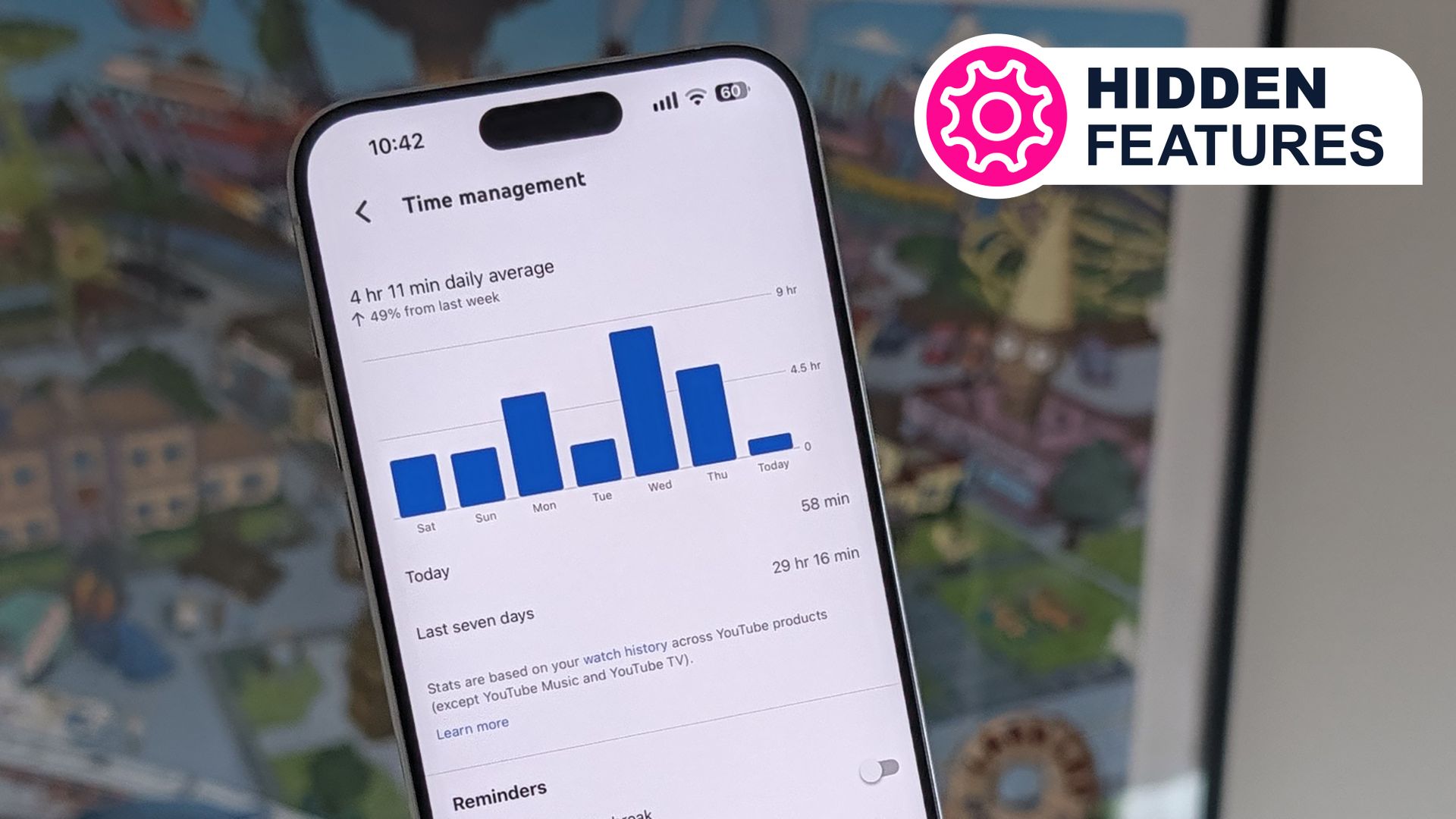
It works like Digital Wellbeing (on Android) or Screen Time (on iOS), but specifically for YouTube. You can dig into how much time you've spent on YouTube today and over the past week, with an average for the last seven days.

This has actually been around for years, and it's available whether or not you're signed up for YouTube Premium — though when I checked up on my stats, I was glad that I've been paying the monthly fee, if only to avoid hours and hours of ads.

First step — turning on Watch History

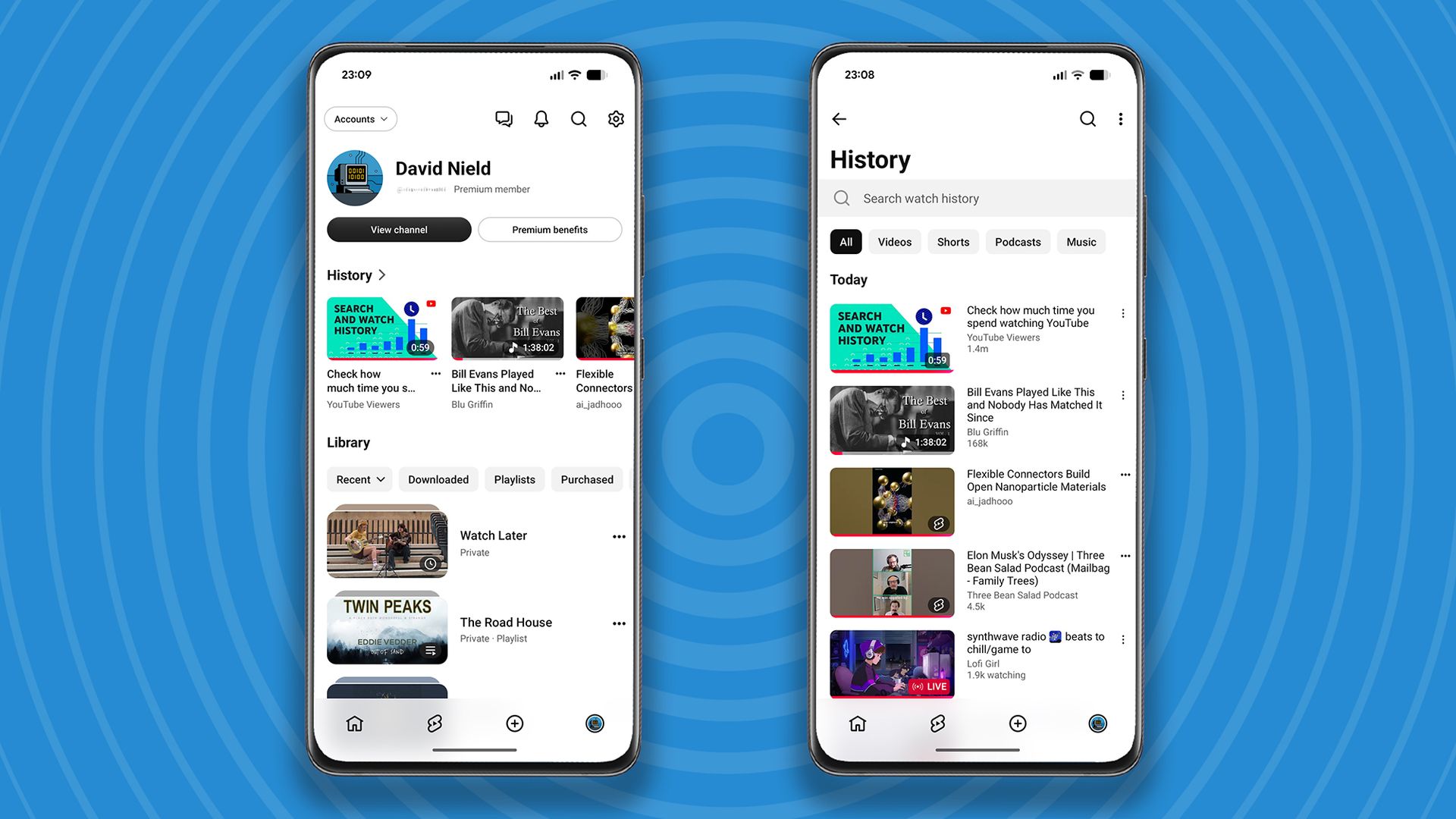
YouTube app stats

The Watch History feature in YouTube (Image credit: Future)

The 'time watched' statistics we're talking about here will only appear if you've got YouTube Watch History turned on. You can check this inside the mobile app by tapping your profile picture (bottom right), then the cog icon, then Manage all history (you can find the same settings on the web here).

To see what you've watched most recently, you can tap your profile picture then History in the mobile app, or choose History from the left-hand navigation menu on the web. There are tools here for searching through your history, deleting the entire record of everything you've ever watched, and putting your Watch History on pause.

It is of course entirely up to you whether or not you enable Watch History. The downsides are Google knows more about you, and it can be hard to get out of recommendation rabbit holes; on the plus side, you will get served videos to watch that might be at least vaguely related to your interests (it's great for discovering new music, for example).

More of your Watch History can be got at through the comprehensive Google Takeout service, which you can find on the web here. Select the YouTube entry, and Google will gladly give you a CSV file detailing every single video you've ever watched on the platform, as long as you've always had Watch History turned on.

Note that the 'time watched' stats don't include videos you've deleted from your Watch History, or that you've watched in incognito mode. However, they do include the YouTube viewing you've done across all your devices (as long as you were signed in), except for inside the YouTube Music apps and on the YouTube TV platform.

Finding your own stats

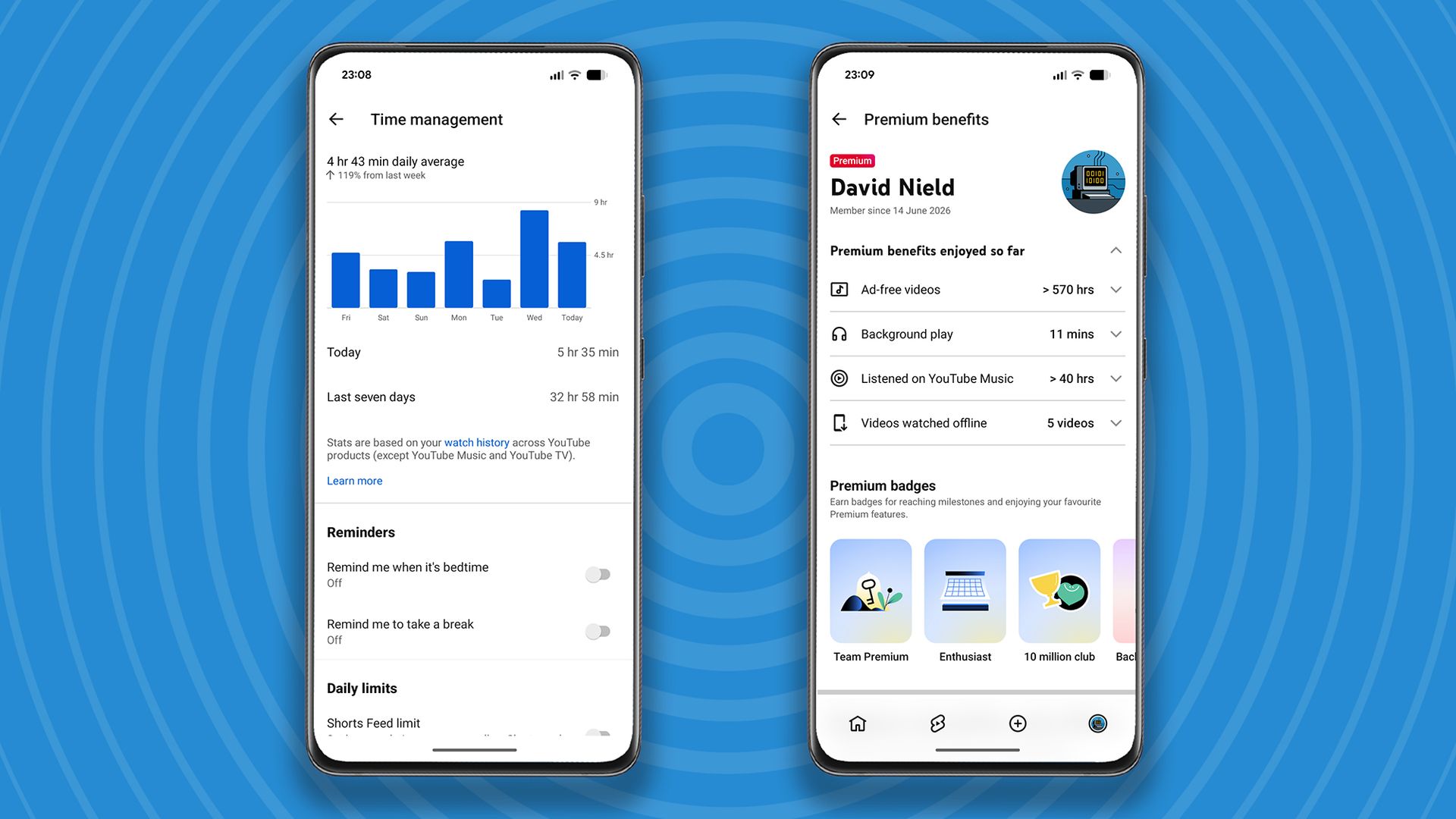
YouTube app stats

YouTube running stats (left) and Premium stats (right) (Image credit: Future)

You can find your viewing stats inside the YouTube mobile app for Android or iOS by tapping your profile avatar (bottom right), then tapping on the cog icon (top right), and choosing Time management. You can't get these stats through YouTube on the web at the moment, which seems a bit of an oversight.

There's not much in the way of a breakdown of what you've been watching, but you can see your running totals and average for the past seven days. There's also a stat about how your viewing compares to the week prior, so you can see if your spending more or less time on the platform week-to-week.

I was honestly surprised by my stats: almost five hours a day on average at the moment. Okay, I do play a lot of lo-fi music videos while I'm working, but that's still an awful lot of content compared to hours in the day — and it extends to tech reviews, explainer videos, and of course all the podcasts that have recently shifted to video.

I've written before about how essential I find YouTube Premium, and the revelation of how much time I actually spend on the site and in the app has more than justified the monthly outlay for me personally — I can't imagine the number of ads I'd have had to sit through otherwise. In fact, YouTube Premium tells you how many ad-free videos you've watched on this page (570 hours and counting for me).

You'll see the time management screen also gives you some controls if you want to limit the amount of clips you're watching day to day. There are toggle switches for setting up reminders around bedtime and taking breaks, and for putting a limit on how much time you spend watching YouTube Shorts each day.

Unlimited 5G mobile data for just AU$19/m is frankly a great reason to sign up for Dodo NBN

When I’m searching for the best NBN deals, the main factor I’m taking note of is the monthly price. Second to that come perks which, to be honest, are becoming rarer and rarer. So when Dodo announced it’s now offering its NBN customers totally unlimited mobile data via its postpaid SIM plans, I simply had to take notice.

This offer, available to new and existing customers, works as follows — sign up for any Dodo NBN plan, and you’re eligible for the new Infinity plan, a AU$19/m SIM-only offer that includes unlimited data, capped at 50Mbps.

Unlimited 5G mobile data on the Optus network for just AU$19/m is a standout deal in itself. But combine it with Dodo’s low-cost NBN plans — now on the receiving end of an AU$30/m discount for six months — and you've got a package that's hard to ignore.

Dodo NBN + unlimited SIM plan from AU$62.99/m

The unlimited data Infinity plan is available with any Dodo NBN plan. To order, you first need to complete the sign-up process for an NBN plan, including making a payment. Once that’s done, you’ll be able to sign up for the Infinity plan via the Dodo mobile app.View Deal

Unlimited mobile plans aren’t entirely new. While virtually all telcos will allow you to continue using data, if you exceed your monthly allowance, download speeds are usually throttled to around 2Mbps. However, Felix has been offering truly unlimited data SIM plans for some time, and while speeds are restricted, they're now available at up to 80Mbps.

Unlimited data at 80Mbps, of course, sounds great, but it'll cost you AU$50/m. Dodo's unlimited data plan, meanwhile, is capped at 50Mbps but costs just AU$19/m, making it arguably the better-value option.

Take my favourite NBN speed tier of all — NBN 500 — as an example. You'll pay just AU$62.99/m for the first six months for Dodo's plan (far less than the current AU$95/m average). Throw in the unlimited mobile data plan, and your monthly total comes to AU$81.99/m — that's cheaper than some NBN 25 plans! Once the six-month introductory period is up, your ongoing monthly total will be AU$111.99.

There's no end date to Dodo's unlimited mobile data offer, but the discounted NBN plans for Black Friday sales in Australia are time-sensitive. So, to secure the lowest possible price, you'll need to sign up before December 8.

Cops Bust Botnet of 1.3 Million Android TV Boxes

A coalition of security firms working with Japan's National Police Agency has disrupted a botnet of more than 1.3 million Android devices across 200+ countries. "We assess with high confidence that the backdoor and botnet were intentionally developed, deployed, and operated for financial gain by Videostrong Technology," the Google Threat Intelligence Group (GTIG) said in a blog post. The Register reports: Videostrong Technology is a hardware manufacturer based in Shenzhen, China. It builds Android devices, including home TV boxes and projectors. According to Google, Videostrong deliberately embedded the XCPE backdoor in device firmware and sold access to criminal affiliates, allowing them to install additional malware modules on devices shipped to unsuspecting customers. When buyers connected these devices to their home networks, the preinstalled backdoor allowed operators to create proxy networks and hide malicious traffic using the customers' internet connections without their knowledge. The firmware's pre-installed management agent purported to be a standard remote-management client, according to TrendAI. It pulled updates from a GitHub page, and connected to a Message Queuing Telemetry Transport (MQTT) server that gave the operator full remote control of each box, allowing them to install and remove apps, change settings, and push updates to the infected devices. Between June 3 and October 1, TrendAI documented more than 3.8 million distinct home and mobile IP addresses connected to the operation. The coalition also disrupted the command-and-control domains used to manage the affiliate modules. "Because these affiliates each have diversified distribution channels for their modules beyond XCPE, we assess that taking down their C2 domains will sever access to at least 10 million additional compromised devices," according to GTIG. Google said it had since cut ties with Videostrong, and banned the OEM from making devices with preloaded Google apps.

Read more of this story at Slashdot.

Tech Firms Dismantle Botnet That Turned 1.3M TV Boxes Into Proxies

Google said today it worked with industry partners to dismantle a botnet made up of more than 1.3 million Android TV set-top boxes that ship with malicious software which secretly rents the user’s Internet connection out to strangers and conducts advertising fraud. Experts involved in the takedown say the action is likely to sever the botnet’s access to more than 10 million additional compromised systems, including other Internet of Things (IoT) products such as Android-based healthcare devices and karaoke machines.

A report from the Google Threat Intelligence Group (GTIG) said Google has severed ties with Videostrong Technology Co., a TV box manufacturer in China that GTIG and other industry experts concluded was responsible for including malware that enrolled more than 1.3 million set-top boxes in a botnet dubbed “XCPE” (named after one of the malware’s core code components).

The global distribution of XCPE botnet infections. Image: Google Threat Intelligence Group.

The report said the XCPE botnet loaded the user’s device with software that makes their Internet address available for resale by multiple “residential proxy” services, which allow customers to rent Internet addresses as a way to anonymize their web traffic or spoof their true location. As detailed in several stories here over the past year, residential proxy services are a major source of unwanted and often malicious traffic, including account takeover activity, advertising fraud, and mass content scraping for AI projects.

“Videostrong monetized the backdoor by selling access to criminal affiliates and loading those affiliates’ malware modules onto infected devices,” the GTIG post reads, noting that Google took legal action to take down the domains and servers Videostrong used to control the botnet and install additional malware. “A device manufacturer intentionally infecting their users with malware is an unacceptable breach of trust, and represents a serious risk to those users. Without users’ knowledge or consent, infected devices were offered as a distribution mechanism for a wide array of criminal actors.”

The report notes that while TV boxes made up the the majority of the botnet, the same XCPE malware was found in other Android-based IoT products, including telehealth devices, karaoke machines, and even digital signage systems.

Google said it requires all Android device makers to pass compatibility and security tests to ensure their products don’t harm users, but that Videostrong nevertheless found a way to load their malicious software immediately after a user boots up one of these devices for the first time (Google says it has since addressed that weakness).

The GTIG report calls out a number of residential proxy providers whose software development kits were routinely downloaded by devices infected by the XCPE botnet. Those include AppSalt, also known as Honeygain, which was developed by the Vilnius, Lithuania-based Oxylabs. In October 2026, Oxylabs and Honeygain were reorganized as independent platforms under an umbrella entity called Source, which received $130 million in funding from private equity firm Warburg Pincus that reportedly valued the business at $3.6 billion.

Another provider linked to the botnet was NetNut, a once sprawling residential proxy company operated by the publicly-traded Israeli company Alarum Technologies. In July 2026, the FBI worked with industry partners to seize hundreds of domains associated with NetNut, saying the company was responsible for operating a separate botnet called Popa that enslaved TV boxes as residential proxies. Other proxy providers named in the GTIG report include EarnFM, Traffmonetizer, Jaguar, LINKFOG, BMW/IPWeb and GaGaNode.

Google’s announcement credits a number of industry partners, including Synthient, a startup that tracks proxy providers. In January 2026, Synthient published research into the rapid spread of the Kimwolf botnet, which at the time was hammering networks worldwide with record-smashing DDoS attacks. Synthient documented how Kimwolf infected millions of Android set-top boxes virtually overnight, using a widespread vulnerability in these residential proxy services to compromise other Android-based devices inside the local networks of unsuspecting TV box users.

Synthient’s research caused dozens of residential proxy providers to patch their networks, which helped to fragment the Kimwolf botnet into much smaller pieces that made its incessant and disruptive DDoS attacks far easier for network operators to manage. It also attracted the attention of the Motion Picture Association (MPA), a trade group representing the major Hollywood studios, which partnered with Synthient to purchase and tear apart a number of popular Android TV set-top boxes — including some that were being infected by Kimwolf and other IoT botnets.

In a report published today, Synthient examined a popular, pre-infected TV box sold under the brand MECOOL by a publicly traded company in China called Skyworth Technology, concluding that MECOOL also bundled the malware from Videostrong Technology Co. and likewise installed AppSalt/Honeygain and other proxy components.

The MECOOL storefront and marketing. Image: Synthient.com.

Synthient founder Ben Brundage told KrebsOnSecurity that Videostrong’s malware also distributed software for the proxy service Grass. In our November 2025 story, “Is Your Android TV Streaming Box Part of a Botnet?” we quoted a researcher from Censys who found the popular Superbox TV streaming device bundled Grass’s residential proxy software. We also quoted the Grass founder, who denied any affiliation with the TV box maker.

That November 2025 story noted that Superbox and similar Android TV set-top boxes gain new customers primarily by engaging influencers on Tiktok and other social networks who praise the product’s ability to offer hundreds of (pirated) pay TV streaming services for a one-time fee.

Likewise, Synthient’s report observes that the MECOOL set-top boxes exploded in popularity after the product was mentioned in 2023 by the Youtube channel Linus Tech Tips, which has an audience of nearly 17 million subscribers [Linus Tech Tips said in a statement shared with Synthient that it has since updated the video to explicitly frame the product as a scam and have removed all associated affiliate links].

The popular Youtube channel Linus Tech Tips discussing MECOOL TV streaming boxes.

The GTIG report estimates the XCPE botnet takedown should sever access to at least 10 million additional compromised devices, noting that the various proxy and ad fraud affiliates of Videostrong “each have diversified distribution channels for their modules beyond XCPE.”

Synthient’s Brundage echoed that conclusion, calling the 1.3 million number “highly conservative.”

“The scale of affected devices is likely way higher,” he said. “This is probably the largest operation against backdoored TV boxes that we’ve seen.”

Update, Nov. 5, 11:07 a.m. ET: In a statement shared post-publication, Oxylabs said that while its system is built so that a device can’t be used as a proxy exit node unless they receive a signal that it has consented, the developer faked these signals.

“We have been conducting regular audits of the applications provided by our partners,” the statement reads. “However, following this incident, we will improve the application and application’s build fingerprinting logic to better detect cases where the SDK is running on an unapproved build of an originally authorized application.”

The statement said Oxylabs has no record of any company called Videostrong Technology Co., but it did find between is suppliers the domain “com.abc[.]nexus,” mentioned in the GTIG report as an external malware loader.

“As soon as we saw that, we suspended the relationship and sent them a formal legal inquiry,” the statement reads. “This supplier accounts for less than 1% of our IP address pool. We had a signed contract with them, they assured our QA team that users had given consent, and we saw the consent flow ourselves.”

Further reading:
Plume Security Labs white paper on the XCPE botnet (PDF)
Black Lotus Labs writeup on LinkedIn
TrendAI’s analysis
Synthient’s list of affected devices, broken down by model number

Google shuts down global botnet running on certified Android devices

Google and an assortment of partners shut down a botnet that an approved Android device manufacturer purposefully deployed across more than 1.3 million TV set-top boxes, the company said Monday. 

Videostrong Technology Co., a China-based Android original equipment and device manufacturer, implanted a backdoor into multiple devices it sold. Those backdoors established XCPE, an expansive botnet that cybercriminals used to conduct ad fraud, steal data and route malicious traffic through residential proxy networks, according to a Google Threat Intelligence Group report.

Google took legal action to shut down the domains and servers Videostrong used to control the botnet. The company also took down command-and-control domains that more than a dozen malware families ran as modules through the XCPE backdoor, claiming it disrupted access to at least 10 million additional compromised devices from various manufacturers.

Videostrong sold Android devices with pre-installed malware for years, slipping by Google’s security tests by loading the malicious code after the device’s first boot. “The XCPE operators constantly evolved its configurations to evade Google’s pre and post-launch detections,” Charley Snyder, head of disruption operations at GTIG, told CyberScoop.

Snyder declined to say when or how Google first became aware of the approved vendor running a botnet on Android-powered devices. 

“We found this malicious software built directly into many different device models and brands over multiple years, supported by dedicated infrastructure and constantly evolving configurations to evade detection and manage their affiliates,” Google researchers wrote in the report. “We believe this campaign wasn’t an isolated rogue insider or a development oversight.”

Google banned Videostrong and any future subsidiaries from building or selling certified Android devices, and said it changed its review process to detect and stop similar activities in the future. Yet, Snyder said the company isn’t sharing specifics on these changes because it doesn’t want to provide threat actors insights that might help them circumvent these additional protections.

Most of the devices comprising the XCPE botnet were Android TV set-top boxes, but researchers also observed infected Android-based telehealth devices, karaoke machines and digital signs. 

“Without users’ knowledge or consent, infected devices were offered as a distribution mechanism for a wide array of criminal actors,” researchers wrote in the report. “This led to a variety of malicious activities being conducted on and through the devices, including ad-fraud, data exfiltration, and routing malicious network traffic through the devices.”

The botnet spanned more than 170 countries, with the largest concentration of infected devices based in Malaysia, Brazil, Iraq, Mexico and Taiwan, according to TrendAI researchers. Nearly 44,000 infected devices were based in the United States between June and October.

Google also partnered with Japan’s National Police Agency, Lumen Technologies, Human Security, Plume and Synthient to study and disrupt the botnet. 

The company said the dismantling of XCPE “seriously impacted over a dozen malicious actors,” yet it warned that the underlying market for backdoors, ad fraud and residential proxy networks are resilient and operating as an interconnected supply chain.

The post Google shuts down global botnet running on certified Android devices appeared first on CyberScoop.

Leaked DHS employee archive, Icepick, faces challenges to stay online

A company working on behalf of the Department of Homeland Security sought to cut off online access to information on more than 41,000 employees that hacktivists said they obtained from a database breached at DHS.

A search tool for the database, named Icepick, went offline for a spell before coming online again Thursday under a different registrar.

Icelandic hosting company FlokiNET said Thursday that it received a request from DHS contractor ZeroFox to remove the data, which it refused.

“By mid-morning, icepi.cx no longer resolved. Its registrar, CentralNic, had placed the domain on serverHold,” FlokiNET said in a blog post. “Our refusal kept nothing online. The request that decided the outcome to take the site down was not the one sent to us. A registrar reached the opposite conclusion the same morning, published nothing, and a global audience lost access to the site. In the meantime the site is online again under a domain from a different registrar.”

CentralNic and ZeroFox did not immediately respond to requests for comment Thursday.

DHS said late Wednesday that it was working to protect its employees against any breach.

“DHS is aware of a potential breach and is actively working to address the situation swiftly and effectively,” a spokesperson said. “We take all security threats against our employees and officers seriously and will work to ensure all are properly protected. We will update the public when more information is available.”

The social media site Bluesky was also blocking links to the archive because it shared people’s contact information without their permission, although a company official said changes were coming because the wording had identified it as a malicious link.

FlokiNET said it refused the ZeroFox request that mislabeled the archive as part of a doxxing campaign.

“Doxxing publishes private details about private people so that others can find them at home. Icepick publishes work identities of government employees,” it wrote. “Who they work for. What their role is. How they can be reached in that role. The information describes people in the exercise of public authority, not in their private lives. Federal officers carrying out an enforcement programme are not private individuals while they are carrying it out.”

“The public has a legitimate interest in knowing who is doing that work, under whose authority, and in which office,” it continued. “Journalists cannot report on an agency whose personnel are structurally unknowable.”

ZeroFox said that regardless of that, the data made it possible to locate people whose information was in the database.

“The request does not depend on who the listed individuals are or what their duties are,” ZeroFox wrote to FlokiNET. “It rests on two facts: the data was stolen, and it is personal data that identifies and locates real people.”

The post Leaked DHS employee archive, Icepick, faces challenges to stay online appeared first on CyberScoop.

'Please Let the Internet Die'

Slashdot reader fjo3 shares an article from Wired: The internet must be put out of its misery. Any rational observer can admit that the current iteration of the web -- and the social fabric woven there -- is not what they signed up for. Symptoms of advanced cultural decay can no longer be ignored. This thing is eating itself. Giants including Meta and Google have been forced to settle massive consumer lawsuits brought over privacy violations and mental health harms allegedly caused by the addictive mechanisms of their platforms. Schools are banning smartphones as multiple countries institute social media restrictions for under-16s. Parents are in a panic about their kids aspiring to careers as social media celebrities, losing themselves in a vast ecosystem of online casinos, or joining extremist movements. Generative AI, briefly considered an amusing novelty, is now a turbocharged slop engine for the web, filling feeds and comment sections with useless, grotesque content. As humans scroll past headlines about AI taking their jobs, confusing fantasy for reality, and contributing to cognitive decline, any consumer appeal the technology might have is turning to anguish. The data centers that power it have become increasingly unpopular, and politically radioactive. To be online, many now admit, is to be endlessly manipulated and exploited. In December, Oxford University Press declared rage bait to be the word of the year, noting that use of the term had tripled over the previous 12 months. The lexical spike represented a heightened awareness that monetized social accounts churn out bad-faith takes and extremist content, automating this abusive behavior with generative AI, simply to profit off hostile engagement. Billionaire oligarchs have opened the floodgates to such inauthentic activity, conspiracy-mongering, and hate speech by rolling back moderation. In short, when you hang around online in 2026, you see little worth saving. Perhaps a decade ago, you felt that the glimmers of community and joy, of artistic and intellectual exchange, were enough to balance out the toxic junk. No longer.

Read more of this story at Slashdot.

Researchers uncover Volt Typhoon’s covert, ephemeral network

Volt Typhoon, a China-government backed hacking group that has infiltrated America’s critical infrastructure networks for years, has consistently built and dismantled ephemeral malicious infrastructure to burrow into hundreds of sensitive systems undetected, Lumen Technologies’ Black Lotus Labs said in a Wednesday report.

The covert access operation that researchers call “Silent Train” isn’t a standalone network, but rather a series of compromised small office home office (SOHO) routers, internet of things (IoT) devices and enterprise infrastructure that Volt Typhoon has rapidly rotated through since late 2023. 

The Chinese threat group has used this chain of short-lived compromised infrastructure to exploit additional vulnerabilities, including zero-days, in network edge devices and gain deeper, persistent access into victim networks, researchers said. 

“Individual chains are assembled and dismantled every day, with infrastructure continually refreshed,” Michael Horka, principal information security engineer at Black Lotus Labs, told CyberScoop. “Volt Typhoon demonstrated a repeatable capability to rebuild a new chain with different infrastructure in less than two minutes, making the number of nodes at any one moment effectively close to zero.”

Black Lotus Labs has notified hundreds of victims since it first identified Silent Train activity, including telecom providers, government entities, defense contractors, communication services, universities and IT firms. Other victims spanning critical infrastructure include organizations in the water, energy, transportation, maritime, rail, aviation and emergency services sectors.

“The ephemeral nature of the framework means our observations should not be interpreted as a complete census of Volt Typhoon activity,” said Horka, who also was the lead researcher on the report.

The nation-state group’s investment in operational security and preserving access is remarkable, according to Black Lotus Labs.

“We observed infrastructure assembled in under two minutes, sessions averaging roughly four hours, extensive cleanup, compartmentalization and continued development of new access vectors,” Horka said. “That is considerable effort devoted not even to get into their end targets, but purely to making important operations difficult to discover and trace.”

Volt Typhoon relied more heavily on Silent Train after the FBI and Justice Department disrupted the KV Botnet in early 2024, researchers said. Earlier this year, U.S. and global authorities warned about a widespread shift in Chinese hacking groups’ use of covert networks riding on compromised common devices.

The reach of those efforts is extensive and ongoing. Volt Typhoon has exploited and abused more than 27 device classes in Silent Train operations, including edge devices, enterprise management tools, identity and access management systems, networking infrastructure and other technologies. 

“The diversity matters, but the discipline matters even more,” Horka said. “Specific device types were consistently reserved for particular positions in the chain. It operated less like a collection of randomly compromised devices and more like an organized inventory of capabilities.”

The threat group has successfully compromised devices and technologies from Fortinet, Cisco, ManageEngine, Ivanti, F5, Check Point, Palo Alto Networks, ServiceNow, TP-Link, Netgear and ArcGIS, researchers said. Black Lotus Labs also observed confirmed zero-day campaigns targeting Versa Director, N-Able N-Central, Cisco Catalyst SD-WAN and VeloCloud Orchestrator. 

“The exploitation patterns, victimology, and geographic targeting observed throughout our investigation point to a sustained focus on communications, defense, government, and critical infrastructure environments of enduring strategic value,” Black Lotus Labs researchers wrote in the report. “Through repeated targeting of centralized management platforms and control-plane technologies, Silent Train shows how Volt Typhoon systematically pursues and preserves access to some of the most consequential networks in the United States.”

Silent Train’s ephemerality and operational discipline means it can’t be measured in size. These attributes also make it “fundamentally difficult to disrupt because there isn’t one network to take down,” Horka said. 

“What exists today will be completely different tomorrow,” he added. “You can try to remove individual pieces, but removing the actor’s ability to continuously rebuild them is a much harder problem to solve.”

The post Researchers uncover Volt Typhoon’s covert, ephemeral network appeared first on CyberScoop.

The Browser Company Retires Its Arc Browser, Pushes Users to Dia

The Browser Company is shutting down its Arc browser on December 22 and encouraging users to migrate to Dia, its newer AI-powered browser for Apple Silicon Macs and Windows 11 PCs. Thurrott reports: In the message explaining why it was sunsetting Arc, The Browser Company explained that maintaining two separate browsers was difficult to justify, especially from a security perspective. "Dia was built from the ground up to meet today's security standards, so that's where our engineering and security teams will focus moving forward," the company wrote. The retirement of Arc will be gradual: While nothing changes for existing Arc users, it's no longer possible to create new Arc accounts as of today. On November 23, tab sync, Browse for Me, and other AI features will be disabled on the iOS and Android versions of Arc. Lastly, the desktop version of Arc will stop working on December 22, and Arc accounts will be deactivated.

Read more of this story at Slashdot.

Zoe Kleinman: PHP Is the Cyber Equivalent of an Unexploded Bomb

BBC technology editor Zoe Kleinman likens the recently discovered PHP security vulnerabilities to an unexploded bomb, writing, "The PHP story feels like the cyber equivalent of an unexploded bomb -- I have never seen such a dramatic, public and global response to a cyber event that hasn't happened yet." Although no successful attacks have been confirmed, the AI-assisted discovery of long-hidden flaws has triggered a worldwide security scramble, with websites taken offline as a precaution and administrators racing to deploy patches before attackers can exploit the vulnerabilities. From the report: The weaknesses found in the PHP programming language, which is used by millions of websites, had been quietly resting there for years and are not easy to exploit. One cyber security researcher told me he'd been up all night trying to do it as an experiment, but it was proving very difficult. [...] It was supposed to be kept quiet until everyone had a chance to fix their sites -- but the news was leaked. From that point the clock started ticking. As I write this, there are no reports that anyone or anything has succeeded in using the flaws to attack a site. "There's a real dilemma," said Prof Alan Woodward from Surrey University. "How do you alert people they need to be ready, and then that a patch is urgently required, whilst not alerting attackers? Basically you're telling everyone about the problem at the same time and hoping the defenders aren't awake enough to act as soon as the patch is out." But we do know from large web companies like Cloudflare and Palo Alto Networks that millions of attempts have been made. We probably won't know for a while whether it has worked for any criminals, because the companies affected might not be aware yet either. As far as we know the unexploded bomb remains intact for now, and for some experts this is a success. "We've seen how a team of people supported by the large AI company have used AI to find the problem, work for months together to solve it and get everybody ready to be safe and secure," Gina Neff, Professor of Responsible AI at Queen Mary University, told the Today Program on BBC Radio 4. "We have enormous capability to handle these risks."

Read more of this story at Slashdot.

PHP Warns It Plans To Release 2 Emergency Patches Imminently

An anonymous reader quotes a report from Ars Technica: Website admins, brace yourselves. Fixes for what are believed to be uncommonly severe vulnerabilities are scheduled to drop in a little more than 12 hours for PHP, a programming language that powers websites and Web applications everywhere. PHP maintainers said Monday that they planned to release patches for two vulnerabilities, both with severity ratings of 9.2 out of a possible 10. "All PHP users are encouraged to prepare now so they can upgrade as soon as the release is available," the advisory stated. "We reserve the right to release earlier should details of either vulnerability become public, or should evidence of active exploitation appear in the wild." The maintainers published the advisory following the leaking of purported details, which have yet to be confirmed. The report showed a video of an exploit tool dubbed PHP2Shell executing code on webservers running WordPress 7.1.3, MediaWiki 1.46.2, phpBB 3.3.17, Magento 2.4.9, Joomla 6.2.0, Laravel 13.36.0, Laravel 8.83.29, Symphony 8.1.9, Drupal 11.4.10, and WHMCS 9.0.9, all of which use PHP. A video depicting the tool has been reposted here. Attempts to locate the unconfirmed report were unsuccessful, but security firm watchTowr said it claimed to affect every PHP version from PHP 5, released in 2004, onward. The security firm went on to say it has confirmed that the vulnerabilities, tracked as CVE-2026-109618 and CVE-2026-109619, are real. Researchers from separate security firm Sansec said they "expect mass attacks to start within 15 minutes of the release." A third security firm, Webfence, also urged admins to prepare now. Huntress has also issued an advisory.

Read more of this story at Slashdot.

Microsoft Patches More Than 1,400 Security Flaws

Microsoft today issued updates to fix more than 1,400 security vulnerabilities in its Windows operating systems and other software. Today’s epic patch batch dwarfs September’s record of nearly 1,000 fixes, which was already about ten times the normal monthly patch load from Redmond.

Just one of the weaknesses patched this week is considered a “zero day,” or already exploited in the wild. CVE-2026-96951 is a security feature bypass in the Windows Shell that affects Windows 10 and 11 systems, as well as some Server versions.

Windows 10 users might be wondering if they can still expect security updates after this month. Microsoft had been slated to stop shipping updates for Windows 10 systems in October 2025, but ended up adding another year of free updates after considerable pushback. A few months ago, Microsoft quietly extended that support for another year (until October 2027).

At least 78 of the flaws fixed this month are rated “critical,” meaning they could be exploited with little or no action by the user, and most of those critical bugs allow an attacker to execute code of their choice on the vulnerable system.

While Microsoft said there are no signs anyone is exploiting it yet, a security feature bypass in the .NET Framework (CVE-2026-108398) was publicly disclosed prior to today, potentially giving attackers advance time to work out how to exploit the bug.

Satnam Narang at Tenable said the number of flaws fixed this month far surpasses the previous record-setting year 2020, when Microsoft patched 1,261 CVEs.

“We’ve now crossed the 4,000 CVE mark with two months left to go,” he said.

Microsoft credits large language models for the high volume of bug discovery, and presumably AI gets credit for many of the patches used to fix these flaw. Meanwhile, security experts have been warning that these unusually large patch volleys from Microsoft are placing extra strain on corporate security teams, which often have to test individual updates before deploying them across a network to ensure the fixes don’t cause problems for other software.

Tyler Reguly, associate director of security research and development at Fortra, notes that just 26 Microsoft vulnerabilities appeared in the “Known Exploited Vulnerabilities” (KEV) catalog maintained by the U.S. Cybersecurity & Infrastructure Security Agency (CISA) so far this year, and security teams would do well to prioritize patching those 26 vulnerabilities first.

“Security leaders should focus on exploitable risk, and ask whether their teams have the clarity, capacity and support to act,” Reguly said.

Which vulnerabilities deserve the most scrutiny in your organization? The folks at Cisco Talos have a useful roundup of the more noteworthy flaws that Microsoft fixed today, and of course the SANS Internet Storm Center has a reliable roundup that indexes vulnerabilities by severity, CVE number and affected software.

❌