
Reading view

There are new articles available, click to refresh the page.

Don’t just fight fraud, hunt it

Our nation has entered a new fraud arms race fueled by AI.

With billions of dollars in fraud losses mounting in both the private and public sectors, it’s clear the old ways of deterring fraud aren’t working. That’s why we need a new playbook that starts with understanding how fraudsters operate, evolving our defenses, and shifting to a proactive posture that doesn’t just fight fraud but actively hunts it down. 

In the AI era, treating fraud as just a front-door problem won’t work. This moment requires industry, government, and consumers to work together, reduce silos, and share real-time intelligence. The goal is to move beyond reactive detection by understanding the lifecycle of a threat—from its formation to its spread—so we can intervene before it establishes a foothold.

For decades, fraud has been treated like a series of isolated incidents. This false assumption has underpinned nearly every past effort to crack down on it. Those efforts, while well-intentioned, have missed the mark. 

Now, in light of the Trump Administration’s Cyber Strategy for America and accompanying executive order, it’s critical to understand the modern fraud landscape and the central role that digital identity exploitation plays within it.

New research from Socure reveals just how dramatically the landscape is evolving. 

Fraud has become industrialized, with organized crime syndicates running operations that are global, systemic, automated, and powered by AI. No organization, service, or program is safe. Fraudsters target government programs, banks, fintech platforms, telecom companies, and more, blurring the lines between public sector fraud, financial crime, and cybercrime.

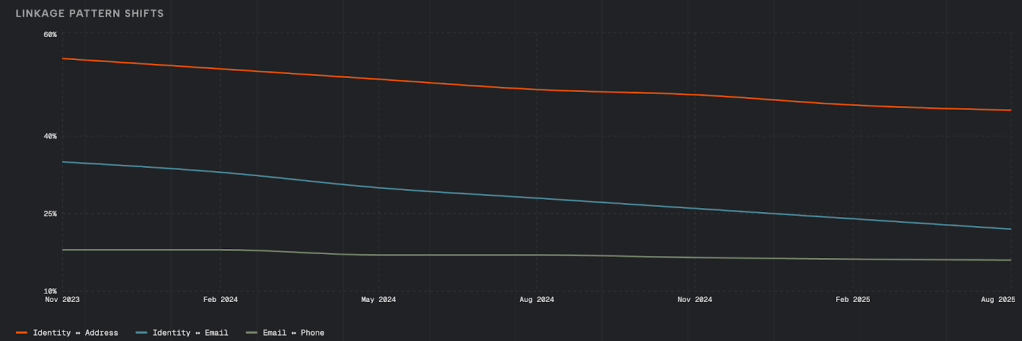
It used to be that fraud could be detected through the reuse of identity elements across multiple applications: the same email, device, phone number, or IP address used over and over. 

But the data is clear: these links are declining fast. Today’s sophisticated fraudsters are now engineering their attacks to avoid traditional fraud detection patterns. Our research demonstrates that emails will be completely unique within fraud populations as soon as 2027, so we won’t be able to rely on email to identify patterns.
Speed is another defining feature of modern identity fraud. Fraudsters use AI to create clean, durable, synthetic and stolen identities at scale. In one observed campaign, 24,148 synthetic identities were built and launched in under a month, with many attacks occurring within 48 hours. What once took weeks or even months can now be completed in days. 

The rapid rise of identity farms is another indicator of the industrialization of fraud. Identity farms are operated by crime rings to systematically create synthetic or stolen identities over time in order to closely resemble legitimate identities. Matured identities are used to open bank, credit, and money-movement accounts, siphon government benefits, launder funds, and more. These identity farms focus on durable identities that can bypass traditional verification controls.

So what should we do? Simply put, we must go on offense. 

This means treating identity as critical infrastructure and implementing strategies that track how identities were created before the moment of application; expanding signals monitoring to include elements like residential proxies, ISP behavior, and domain registration activity; evaluating velocity and orchestration in real-time; and treating continuous measurement, rapid model iteration, and cross-industry intelligence as core capabilities.

Additionally, given the rapid scaling of fraud, we need more analysis of the complete ecosystem, including dynamic factors like device information, digital footprints, and behavioral biometrics so organizations can effectively distinguish genuine humans from machines. Ultimately, this layered and interconnected approach makes it significantly harder for malicious actors to recreate or steal identities at scale.

Fraud is no longer a series of isolated acts. It is a coordinated, global enterprise built on the exploitation of identity. Until our efforts reflect this new reality, we will continue to fight an imminent and ongoing threat with outdated tools and fall further behind. 

Now is the time to make this strategic shift and finally put fraudsters on their heels. 

Mike Cook serves as head of fraud insights at Socure, the identity and risk platform for the AI age.

The post Don’t just fight fraud, hunt it appeared first on CyberScoop.

Experts insist Trump administration’s cyber strategy is already paying off

SAN FRANCISCO — The Trump administration’s two-week old cyber strategy that aims to promote more proactive, offensive actions while bolstering federal networks and critical infrastructure, is a significant shift that’s already materializing in meaningful ways, a group of experts said Monday at the RSAC 2026 Conference. 

Despite the federal government’s absence from the industry’s largest annual gathering, and the long-anticipated document’s brevity, representatives from a major cybersecurity vendor, consulting, venture capital and law firm were quick to defend and evangelize the administration’s strategic actions in cyberspace. 

The freshly-released strategy puts the federal government on firm footing to move beyond deterrence and into action, said David Lashway, partner and global leader of cybersecurity and national security at Sidley Austin. 

“We are going to take offensive and defensive action with the most powerful cyber capability that the world’s ever seen, and hopefully will ever know,” he said. 

This doesn’t mean, as some industry observers have suggested, that the Trump administration is pushing private companies to hack back

The scale and whole of government response is the key difference between the latest federal cyber strategy and what administrations have called for over the past decade, Lashway said. 

Instead of relying on private lawyers to get a nationwide injunction and collaborate with dozens of governments for massive takedowns, or government agencies collaborating with private security companies on a limited basis, the strategy aims to mobilize “the massive infrastructure and capability of the United States in a more coordinated way,” he added. 

This strategic pivot won’t achieve all of its objectives immediately, but it’s already showing signs of impact, according to Lashway. “It’s been different since they issued the strategy,” he said. “We’ve already noticed a difference.”

Wendi Whitmore, chief security intelligence officer at Palo Alto Networks, said she’s also seen more collaboration in the private sector.

“While there’s no doubt challenges related to current staffing and the dynamic environment going on with the government, I have never before seen as much action and cooperation as we are seeing today, and that’s from every government agency that we’re working with,” Whitmore said. 

“There is certainly a tremendous shift in the level of discussion that we get from the government today,” she added. “It’s a very proactive, kind of muscular dialogue that’s different from what I’ve previously seen.”

Experts said that earlier concerns about triggering backlash and worsening already fragile systems had kept the federal government from taking certain actions, but that caution is now being reconsidered.

“The government’s going to start punching people in the face,” said Jamil Jaffer, venture partner and strategic advisor at Paladin Capital Group. 

Trump administration officials have told the private sector it wants their help and they need to be well defended, he added. “If we do live in glass houses, well, everyone’s going to need to start putting more glass up.”

Jaffer expects the Trump administration to prevent and respond to intrusions aggressively and publicly. “Half the problem with deterrence today is we don’t actually practice real deterrence when it comes to the cyber domain. We don’t punch people back,” he said. 

The dynamic and proper response, to him, is akin to a child responding to a bully at school. 

“If you get hit in the face, punch them back in the face,” Jaffer said. “Do it publicly. Everyone sees it. Less people come after you.”

The post Experts insist Trump administration’s cyber strategy is already paying off appeared first on CyberScoop.

Washington is right: Cybercrime is organized crime. Now we need to shut down the business model

The recently released executive order targeting cybercrime, fraud, and predatory schemes uses language the federal government has often avoided. Now, for the first time, the Trump administration is echoing what the cybersecurity industry has been shouting for years: cyber-enabled fraud is a product of transnational organized crime.

That distinction matters because organized crime requires an organized response.

Cybercrime is now the world’s fastest-growing criminal economy, built on stealing from everyday people. It is no longer a loose collection of hoodie-wearing hackers in basements or misfits trading malware in online forums. It is a mature global industry operating at scale. In the entirety of human history, there has not been a transfer of wealth of this magnitude since the era of pillaging empires. We have just gotten so used to it that it feels like background noise.

Modern cybercrime groups look less like street gangs and more like corporations. They run structured operations, complete with HR departments, training pipelines, performance metrics, and technology stacks that rival most enterprise companies. Their attackers don’t rely on sophisticated exploits — they think like expert investigators, systematically probing for weaknesses, exploiting psychological pressure, manipulating insiders, and using deception to move through gaps that defenders left open. They operate around the clock, in every time zone, and increasingly use AI to automate attacks at a scale that once required highly skilled operators.

Worse yet is that many of these operations rely on forced labor. Scam compounds in Southeast Asia run like factory floors, with rows of trafficked workers carrying out romance scams, cryptocurrency fraud, and impersonation schemes under threat of violence.

Their goal is to make fraud faster and more profitable. The result is a global criminal ecosystem that extends far beyond online scams. It fuels human trafficking, weapons smuggling, political corruption, compromised organ systems, and even nuclear programs.

If the federal government is ready to recognize what the industry has known — that cybercrime truly operates like an organized global industry — then responding to it solely through traditional law enforcement is not enough. The question goes beyond how governments apply sanctions, coordinate investigations, or pressure jurisdictions that harbor these operations. The greater question is whether the private sector is willing to help dismantle the infrastructure that allows this industry to thrive.

One word changes everything

I want to be specific about why this executive order is different, because the language is not accidental.

The order doesn’t just call these groups “hackers” or “organized crime.” It calls them transnational criminal organizations (TCOs). That word carries legal and operational weight that most coverage has glossed over. Transnational is the jurisdictional framing that authorizes an entirely different class of response. It is the same threshold that moves a case from local law enforcement to federal jurisdiction and beyond.

Pair that with what follows – “law enforcement, diplomacy, and potential offensive actions” – and you are reading something that goes well beyond a policy memo. Notice the sequence: diplomacy before offensive action is proportionality doctrine. But the administration did not rule out offensive action. The document also calls for deploying the “full suite of U.S. government defensive and offensive cyber operations” and uses the word “shape” as its first pillar of action. In military doctrine, shaping an adversary’s behavior does not mean gentle persuasion. It means force is part of the calculus.

This is not the language of a consumer protection policy. Whoever wrote this has studied the opposition.

An organized threat demands an organized response

The executive order draws a line in the sand: cybercrime has outgrown its origins as a consumer protection issue. It’s now a fundamental threat to economic stability and national security. But tackling an industry operating at this scale requires more than government action alone. The order’s answer is to mobilize the private sector – giving companies the green light to identify and disrupt adversary networks.

That framing matters.

The private sector sees the machinery of cybercrime every day. Security vendors, major platforms, and infrastructure providers spot the command-and-control servers, malicious domains, and payment pipelines that keep these operations moving. Too often, that intelligence is used only to defend commercial interests, when in reality, it should also be used to disrupt the networks behind the attacks. When criminal groups lose core infrastructure, they have to rebuild. That costs time. That costs money. That creates pressure.

At the same time, the order puts a question squarely before the private sector: How far is it willing to go, and under what terms? I spent my career believing “minimal force” matters. Precise, proportionate action prevents escalation and avoids creating cascading problems. As we move beyond a defense-only approach, those principles matter more than ever.

There is another question that sits underneath all of this: How far does “potential offensive actions” actually go? Does it stop at cyberspace? Financial sanctions? Asked bluntly, “Will leaders and shareholders know whether providing threat intelligence ends with a measured network take-down or an all-out drone strike on the fraudulent call center?”

Organizations need to fix the security weaknesses criminals are exploiting for profit. Most attacks in 2026 do not succeed because criminals are brilliant. They succeed because the basics are missing. No multifactor authentication. Weak Identity controls. Unpatched vulnerabilities sit open for months. Criminals don’t care about your industry or company size. They go where it’s easiest.

When organizations ignore basic security controls, they are doing more than accepting risk. They’re subsidizing the criminal infrastructure that exploits those gaps.

Governments must keep pressure on nations that harbor these operations. Large-scale cybercrime thrives where enforcement is weak or non-existent. The order specifically calls out “nations that tolerate predatory activity”—a signal that safe havens won’t be ignored. Stronger coordination across governments, law enforcement, and private industry can make it much harder for criminals to operate at scale.

The order also targets “foreign TCOs and associated networks,” with “associated networks” being a deliberately broad phrase. Defining who qualifies will be critical. Draw the lines too narrowly and the policy won’t work. Too broadly and you risk dangerous escalation.

Simply put, cybercriminal groups are disciplined because discipline pays. Disrupting them will require the same. It will demand pressure on countries that act as safe havens. It will take dismantling the infrastructure behind these schemes. It will require better basic security across every organization that criminals target.

The executive order is right – Cybercrime is organized. It is industrial. It is ruthless. For the first time in a long time, the response looks like it might be, too. Whether the government, private sector, and public can align around what this actually demands, and what it risks, are still unanswered questions.

After years of watching policy documents gather dust while victim numbers grow, I will take action over perfection every time.

Kyle Hanslovan is a former NSA cyberwarfare operator and CEO of Huntress Labs.

The post Washington is right: Cybercrime is organized crime. Now we need to shut down the business model appeared first on CyberScoop.

We’ve seen ransomware cost American lives. Here’s what it will actually take to stop it.

Flights canceled. Emergency rooms shut down. Centuries-old companies shuttered.

Ransomware and other similar cyberattacks have become so routine that even those serious human and economic consequences are often overlooked or easily forgotten.

This lack of focus is dangerous.

As former leaders of FBI and CISA cyber units, we’ve seen cybercrime ripple through communities – disrupting critical services, destroying jobs, and sometimes costing lives. Today’s ransomware numbers tell a stark story. The Department of Homeland Security reported more than 5,600 publicly-disclosed ransomware attacks worldwide in 2024, nearly half of them in the United States. The FBI found that ransomware incidents increased nearly nine percent year over year, with almost half targeting critical infrastructure. Attacks on these organizations pose the greatest threat to national security and public safety.

Despite this trend, we’re cautiously optimistic about the administration’s new National Cyber Strategy. It focuses on protecting critical infrastructure and stopping ransomware and cybercrime—threats it correctly elevates to top-tier national security threats.

But success requires sustained action across government and industry. Adversaries are evolving faster than defenses: ransomware attacks now average $2.73 million per incident, driving annual losses into the billions. Attackers have compressed their operations from weeks to hours, disabling Endpoint Detection and Response (EDR) tools and leaving defenders almost no time to stop an attack.

Basic cyber hygiene still matters. But it’s no longer sufficient. Attackers steal valid credentials, exploit known vulnerabilities, disable tools, and move laterally at machine speed, now accelerated by AI. They need a stunningly low level of technical expertise to do so, and AI tools are increasing the speed and scale of their actions.

Our defenses must keep pace with evolving threats. Protecting national security requires immediate action. Automating cyber threat information sharing offers clear benefits, but government agencies need significant structural and technological upgrades before they can effectively share data. This requires sustained investment and oversight.

The government does not have to do this alone. Industry and academia possess tools that could mean the difference between progress and revisiting this same conversation four, eight, or twelve years from now. Forums like CISA’s Joint Cyber Defense Collaborative (JCDC), the National Cyber Investigative Joint Task Force (NCIJTF), and NSA’s Cyber Collaboration Center (CCC) have demonstrated that information fusion and joint operational planning can work. But overlapping missions and unclear playbooks leave companies guessing what to share, when to share it, and with whom. These forums and underlying collaboration mechanisms must be resourced, deconflicted, and made predictable.

Despite the noble efforts of government agencies to share behind-the-scenes and interact with industry with one voice, the current structure remains fragile and dependent on personal relationships. We simply cannot afford this fragility or inefficiency, particularly in an era of constrained government cyber resources and escalating threats.

Effective protection of critical infrastructure requires focused collaboration. The administration’s strategy rightly emphasizes this, but narrowing this focus will not be easy. For years, the government has tried to cover sixteen sectors and hundreds of thousands of entities equally—an impossible task. Equal attention for all is unrealistic. Looking back, we wish we had prioritized more strategically during our time in government.

Prioritization is politically difficult, but operationally necessary. When everything is critical, nothing truly is. For the most important critical infrastructure, we must focus on resilience—ensuring systems can withstand attacks and recover quickly—rather than assuming we can prevent every breach.

The government can take concrete steps now to disrupt the ransomware ecosystem. Ransomware has cost American lives; designating certain ransomware actors and their enablers as Foreign Terrorist Organizations could unlock more powerful sanctions, diplomatic action, and intelligence operations. Sensible regulation holding cryptocurrency exchanges accountable for knowingly laundering ransomware proceeds could weaken criminal business models while strengthening legitimate digital asset markets in the U.S. and allied nations.

The technology and cybersecurity industry has responsibilities, as well. Industry must share actionable intelligence where legally permitted, pressure-test government programs with candid feedback, and support reauthorization of the Cybersecurity Information Sharing Act of 2015.

We all must do our part. Every day that passes without us confronting these critical questions is a gift to our adversaries. This will only be exacerbated by advancements in AI. We are hopeful that the release of this administration’s National Cyber Strategy will spark much-needed debate and decisions about the role of the government and industry in advancing our nation’s cybersecurity and resilience.

Cynthia Kaiser is senior vice president of Halcyon’s Ransomware Research Center. She was formerly Deputy Director of the FBI’s cyber division.

Matt Hartman serves as chief strategy officer at Merlin Group, where he is focused on identifying, accelerating, and scaling the delivery of transformative cyber technologies to the public sector and critical industries. Prior to this role, Matt spent the last five years serving as the senior career cybersecurity official at the Cybersecurity and Infrastructure Security Agency (CISA) within the Department of Homeland Security.

The post We’ve seen ransomware cost American lives. Here’s what it will actually take to stop it. appeared first on CyberScoop.

❌