❌

Reading view

There are new articles available, click to refresh the page.

100-plus companies call for ‘global surge’ in AI-powered cyber defense

More than 100 companies and organizations, including OpenAI, Anthropic, Google, Microsoft and Amazon Web Services, have signed an open letter calling for a global effort to improve cybersecurity defenses as artificial intelligence capabilities advance.

The letter, published Thursday, argues that the timeframe to strengthen defenses before AI-enabled attacks become more widespread and complex is rapidly dwindling. Conversely, the letter says the same advances can give defenders new ways to find and fix vulnerabilities that have accumulated over years, a period the signatories call a “defenders’ window.”

“Each of us can reduce risk now,” the letter reads. “All organizations, cybersecurity companies, technology partners, governments, and AI frontier companies have an important role: accelerate defenders’ priorities with tools, funding, and hands-on support, especially for critical infrastructure organizations with limited budgets.”

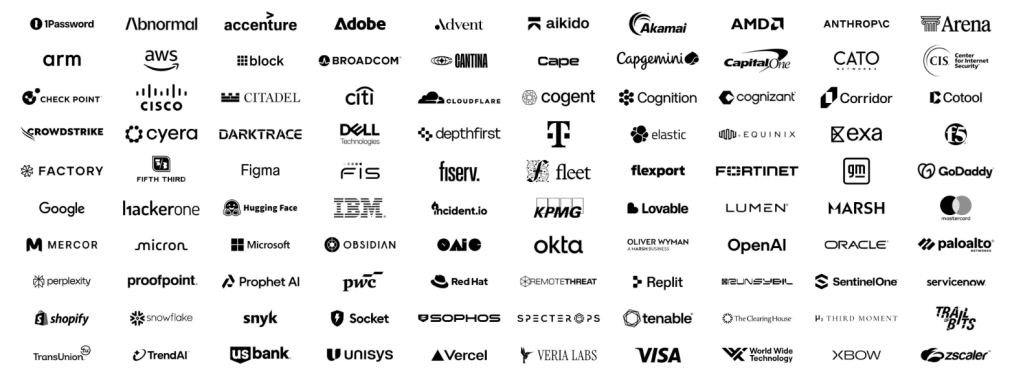
Aside from AI-centric companies, financial institutions like Capital One, Mastercard and Visa, and cybersecurity firms like CrowdStrike, Palo Alto Networks, and Proofpoint, also signed the letter. Organizers describe the effort as ongoing, with more organizations expected to join over time.

An image of company logos depicting the signatories of a letter calling for enhanced AI defenses.

The letter states that “status quo security won’t be enough.” It cites longstanding bugs, excessive permissions, misconfigurations, unpatched software, weak authentication and technical debt in legacy systems as sources of exposure. Security teams, particularly those protecting critical infrastructure, have been historically under-resourced, the letter says, and need what it describes as a surge in tools, resources and hands-on support.

In a conversation with CyberScoop Wednesday, top brass from Palo Alto Networks said they had seen enough from internal frontier AI model testing and malicious in-the-wild use of commercially available AI tools to be genuinely concerned.

“I can tell you without exaggeration that we believe that this is a generational shift in cybersecurity,” Sam Rubin, senior vice president of Palo Alto Networks’ threat intelligence arm, said Wednesday. 

John Doyle, CEO of Cape, a privacy-first mobile network operator and whose company signed the letter, echoed the warning about status-quo security.

“It was already failing us in telecom–critical infrastructure that’s been breached time and again with serious consequences for both our military and regular people,” Doyle told CyberScoop. “It’s going to get immeasurably worse without collective action and leaning into innovative cyber defense.”

The letter further asks every organization to make cybersecurity an immediate leadership priority, fix the highest-risk weaknesses and raise security standards for technology they buy, build and deploy, including AI-generated code. Cybersecurity companies and technology partners are asked to test defenses against frontier AI capabilities and make AI-powered defense accessible to critical infrastructure operators. 

Governments are urged to coordinate defense across borders, fund protection for essential services that lack staff or budget, and impose costs on attackers. Frontier AI companies are asked to provide responsible model access, funding, training and support, and to ensure that AI systems acting autonomously remain traceable and accountable.

The letter frames AI as both a threat and a remedy throughout the document. It mirrors what security experts have been saying for months, positioning the industry as entering an unprecedented two- to three-year period of upheaval, driven by AI systems that are discovering vulnerabilities exponentially faster than defenders can respond and threatening to render decades of security practices obsolete.

The U.S. government has taken steps to stay ahead of AI-enabled cyberthreats. As part of an executive order issued by President Donald Trump in June, a federal clearinghouse known as Gold Eagle was stood up for sharing AI cyber threat information between the government and private sector.

You can read the full letter here.

The post 100-plus companies call for ‘global surge’ in AI-powered cyber defense appeared first on CyberScoop.

The GTA VI leaks are breaking the internet. Security researchers have seen this before.

Grand Theft Auto VI, widely heralded as the game event of the decade, took a significant hit last week after a cybercriminal sent much of the internet into pandemonium after publishing gameplay footage a week before the game’s publisher planned to reveal core portions of the game to the public.  

The files posted by the online persona “CyberLeek” indicate either a hacker had direct access to Rockstar Games’ most sensitive systems or was given proprietary data by an insider, eventually becoming one of the highest-profile data extortion attacks of the year — a vexing, almost-daily occurrence hitting industries of all types.

While most data extortion attacks rattle companies due to regulatory or privacy concerns, this particular incident has caused an outsized response from Rockstar’s parent company, Take-Two Interactive Software, because it has an audience. While no lives are at risk, as they would be in an attack on critical infrastructure, the financial and reputational stakes are magnified precisely because people are watching every drip of stolen footage become a news story or a trending topic. 

“IP theft — whether it’s conducted by a cybercriminal, an insider, or even potentially [an artificial intelligence] model — rips away the hard work, passion, and livelihood among employees and companies that created the product in the first place,” Cynthia Kaiser, senior vice president of Halycon’s ransomware research center, told CyberScoop.

The game’s prior release, GTA V, along with its online component, has sold over 230 million copies and earned Take-Two over $11 billion since its release in 2013. Industry analysts say GTA VI is on pace to make between $3.3 billion to $5.2 billion in cumulative global sales by the end of its launch week in November. 

“The crown jewels of a company are whatever makes it differentiated and special,” said Kaiser, the former deputy assistant director of the FBI’s cyber division. “For some, that means customer data or source. For a studio in the final stretch before launch, the crown jewel is the surprise.”

While Take-Two hasn’t said anything publicly about the leaks, it has responded feverishly via its legal team. The company petitioned a federal court for subpoenas under the Digital Millennium Copyright Act against Discord, Google, Microsoft and X, seeking the identity of CyberLeeks and other user accounts it accuses of copyright infringement.

Federal judges granted the subpoenas against Discord, Microsoft and X, but the petition against Google remained unapproved as of Monday. Take-Two’s legal representatives also sent copyright notices to the four companies, informing them of the copyrighted material published on their platforms, but it’s unclear if any of the tech companies have been formally served with the signed subpoenas. 

Take-Two and Rockstar did not respond to a request for comment.

The subpoenas may have been enough to spook those responsible for the leaked footage. As of Monday, the websites where those behind CyberLeek were posting leaked information and links to a memecoin were offline.

Zach Edwards, staff threat researcher at Infoblox and a self-proclaimed fan of the series, initially thought the leaks were part of a Rockstar guerrilla marketing campaign. But the company’s response “confirms that this is a real investigation, and the content being shared is likely real to some degree,” he said. 

Take-Two’s actions thus far indicate the company is approaching the breach and leaks like an insider threat investigation, Edwards said. Whoever leaked the footage may have had access to an actual build of the game, he added. That could point to an insider, someone who could have saved a copy to a cloud service, uploaded it to a file-hosting site, or walked out with it on an external drive.

CyberLeek’s conflicting motivations

The hacker or group behind CyberLeek claim they are releasing the gameplay videos to protest Rockstar’s decision to not release physical copies of the game. Yet, watermarks on the leaked videos include addresses to crypto wallets, which indicate CyberLeek is also, and perhaps primarily, seeking a payout. 

“The persona behind the leaks, CyberLeek, published an anti-corporate manifesto targeting digital pre-orders and disc-less releases to frame the breach as hacktivism,” Ben Bernstein, manager of Huntress’ cybersecurity advisors team, told CyberScoop. “Yet behind the political posturing, there’s clear financial monetization and clout-chasing.”

Kaiser draws the same conclusion. “Let’s separate stated motive from observed behavior,” she said. “Threat actors who talk about principle while running a monetization channel are usually only telling you what they think will land with an audience, not actually what is driving them.”

Katie Moussouris said “this is what the alternative vulnerability economy looks like.” The founder and CEO at Luta Security has spent decades building legitimate channels for people who find security problems to get paid without turning to crime.

“The leaker launched a cryptocurrency token, watermarked stolen footage with a buy link, and offered to sell ad space on future leaks. Each of those pays out in proportion to how many people are watching. The manifesto is what keeps them watching,” Moussouris said. 

“That is a genuinely new monetization model for stolen pre-release content, and it means the usual playbook of negotiating a ransom payment quietly or paying to make it stop won’t work,” she added.

Different flavor, same crime

Despite its unique characteristics, the rhythm of the attack and its fallout is familiar territory for cybersecurity experts. 

“Steal, publish a sample, promise more, deliver, repeat. Just like ransomware attacks, in cases like these criminals use every lever of pressure they can against a company — including the fear of what is coming next — to profit from their actions,” Kaiser said. 

“The attackers are crowdsourcing their pressure tactics. A meaningful share of the player base is treating the leaks as free content and amplifying them,” she added.

Kaiser also sees some clear parallels with previous attacks targeting major entertainment companies, including the 2014 attack on Sony Pictures and the HBO hack in 2017. 

“The Sony comparison is useful for how these things escalate, but this incident reminds me more of the Iranian hackers’ leak of ‘Game of Thrones’ episodes a few years back,” she said. “North Korea attacked Sony for political purposes, destroying its data along the way; Iranian threat actors compromised HBO, along with hundreds of universities and over forty other companies, in a hacking-for-hire scheme stealing American intellectual property.”

Federal authorities earlier this month unsealed a second wave of indictments against 17 Iranians affiliated with the tech firm Mabna Institute who allegedly stole troves of data from government agencies and dozens of companies, including HBO.

This isn’t the first time Rockstar has been hit with a security incident. In 2022, an 18-year old British man who was a member of the Lapsus$ cybercriminal gang was sentenced to an indefinite hospital order after leaking gameplay footage. According to the BBC, the incident cost Rockstar, along with ridehauling company Uber and chipmaker Nvidia, over $10 million. 

The subpoena that worries security experts

Security professionals expect the situation to escalate on all sides. Leaks have hit the internet daily for the past eight days, including a series of leaks Tuesday morning. Meanwhile, Take-Two has not relented on its subpoenas. Its broadest move was a subpoena against Discord, seeking identifying data on CyberLeek, two other users and every member of three Discord servers where the copyrighted material was posted.  

Moussouris said the scope of that inquiry should worry people well beyond this case. 

“Take-Two asked for Windows device identifiers, login records, and cloud storage contents for every person who spoke in three Discord servers going back to June,” she said. “The people with the best chance of uncovering the culprits are those doing the unglamorous investigation forensics work of figuring out how the build may have leaked.”

Discord would not say whether it had been formally served or what it has done in response. A company spokesperson said it reviews and complies with valid subpoenas when they are received. 

While the breach and leak of ‘GTA VI’ material is a serious matter, Edwards noted that Take-Two is also benefiting from greater interest in the unreleased game on a daily basis. 

“The threat actor leaking these videos has failed by essentially creating a successful underground marketing campaign for the game while also putting themselves at serious risk of being eventually caught,” he said. 

“This incident is playing out like a classic insider threat exploitation scheme. Someone got access to sensitive data, they had a political agenda which clashed with the owner of the sensitive data, and they decided to do something stupid to try and force a change,” Edwards added. “This attack has done nothing but spread ‘GTA VI’ content further than it would have otherwise, and it’s creating ripples across other industries like cybersecurity who would have never covered ‘GTA 6’ issues previously.”

The post The GTA VI leaks are breaking the internet. Security researchers have seen this before. appeared first on CyberScoop.

Apollo discloses data breach from ongoing wave of attacks hitting financial sector

Apollo Global Management confirmed it was among several financial institutions impacted by a string of social engineering attacks that hit the sector last month, the company said Friday. 

Attackers gained unauthorized access to some of the private equity firm’s cloud platforms between July 6 and July 10, the company said in a data breach notification filed in California. Apollo did not say when or how it became aware of the intrusion and did not respond to a request for comment.

Apollo is the first victim to formally disclose that sensitive personal data under its care was compromised by a wave of attacks that have hit large private equity firms, law firms, financial rating agencies and medical technology companies. 

The company did not name the group responsible for the attack. Yet, Google earlier this month attributed the ongoing campaign to BlackFile, a threat group affiliated with The Com, that recently split its extortion operations across four brands with shared infrastructure: Redact, Pink, Helix and Falcon. 

“Upon detecting the incident, we promptly notified law enforcement, engaged leading outside cybersecurity and forensic experts, enhanced our security protocols, and launched an investigation,” Matthew Breitfelder, global head of human capital at Apollo, wrote in the disclosure notice. 

As part of its ongoing investigation, Apollo said it determined on Aug. 12 that personal data including names, dates of birth, contact information, home addresses and Social Security numbers were compromised. The company did not say how many people were impacted, but noted it’s thus far found no evidence any data was posted online or used for identity theft or fraud.

Apollo is one of the world’s largest private equity firms, with $1.05 trillion in assets under its management at the end of June, according to a regulatory filing.

Researchers previously told CyberScoop some of Apollo’s largest competitors, including Blackstone and Bain Capital, were also targeted with malicious infrastructure, but it’s unclear if those firms were compromised.

BlackFile and its various affiliates have impacted organizations in multiple industries, including healthcare, technology, transportation, logistics, wholesale, and retail and hospitality since the beginning of this year.

The extortion group shifts from one sector to the next, impersonating IT support in voice-phishing and social-engineering attacks before threatening its alleged victims with extortion demands, which often start around $3 million and are typically negotiated down to less than $1 million.

Google researchers also previously said some of the group’s recent victims have been subject to threatening messages and other forms of escalation, including swatting incidents, a tactic adopted by several subsets of The Com.

The post Apollo discloses data breach from ongoing wave of attacks hitting financial sector appeared first on CyberScoop.

Details emerge on BlackFile’s recent attacks on financial companies

A cybercrime group responsible for a string of recent attacks against private equity firms, law firms and financial rating agencies remains active and continued to target new victims as of late last week, according to researchers.

BlackFile, which Google Threat Intelligence Group tracks as UNC6671 and associates more broadly with The Com, has been active since the start of the year, shifting its focus from one sector to the next. 

“We have seen continued targeting against the financial sector with additional targeting of other organizations including in the med tech space,” Austin Larsen, principal threat analyst at GTIG, told CyberScoop.

The extortion group impersonates IT support in voice-phishing and social engineering attacks, and recently split its extortion operations across four brands with shared infrastructure: Redact, Pink, Helix and Falcon.

Several organizations received new extortion demands from Redact in the last week, according to Google. 

BlackFile and its various affiliates have impacted organizations in multiple industries, including healthcare, technology, transportation, logistics, wholesale, retail and hospitality.

“BlackFile does go after some of the largest organizations in the sectors that they go for. They’re not going after small companies,” Larsen said. “This is big-game hunting.”

The group’s extortion demands often start around $3 million and payments, including several in the past few weeks, have typically been negotiated down to less than $1 million, according to Google.

Flashpoint researchers told CyberScoop they have observed malicious infrastructure targeting Blackstone, Bain Capital, Moody’s, CME and Apollo, but it’s unclear if any of those firms were compromised. 

BlackFile’s steady pace of activity underscores the persistent threat it poses, as it targets an average of 1.5 new victims daily, researchers said.

Some of the group’s recent victims have been subject to threatening messages and other forms of escalation, including swatting incidents, a tactic adopted by several subsets of The Com, according to Google. 

The attackers use hundreds of callers, often lower-level people that are recruited for a small fee or an opportunity to earn goodwill with the group, who make the voice phishing calls to obtain initial access. Larsen estimates less than a dozen core operators run the different brands under the BlackFile umbrella.

“From the intrusion data that we’re seeing, this does appear to be essentially the same group,” he said, adding that different people may be operating the various brands, but they’re all linked back to the same threat cluster using shared infrastructure.

Mandiant incident responders encounter BlackFile often, having been engaged by more than two dozen organizations successfully compromised by the threat group since January. New victims in the financial sector were calling Mandiant in for help earlier this month.

Voice-based phishing attacks for data theft extortion aren’t sophisticated or novel, but BlackFile and other cybercrime groups consistently prove their continued effectiveness across virtually any sector or organization. “They’re really hitting on the human weakness element here,” Larsen said.

The post Details emerge on BlackFile’s recent attacks on financial companies appeared first on CyberScoop.

Google’s solution to hacker name confusion? Yet another naming system

If you are a CISO, here is a new problem for the pile: Do I worry more about Sandworm Relic or Strawberry Tempest?

Last week, Google Threat Intelligence Group joined a list of rivals in changing how it names hackers, replacing years of split naming systems with a single set of code names built around memorable word pairs.

The company said in a blog post that the change merges two systems that had grown apart for years inside Google: Mandiant, the security firm Google bought in 2022, and its in-house Threat Analysis Group. Combining those units left Google with overlapping names for the same hacking groups, a problem the new system aims to fix.

“Threat tracking shouldn’t be an exercise in memorization, but rather one of intuition,” the post reads.

Each tracked group will now get a two-word name. The first word is a distinct term meant to be easy to recall, often pulled from names already used in past reporting on a specific group. When no such name exists, researchers will generate one at random and have analysts check it before use. The second word sorts each group by category, such as country of origin or motive. In Google’s published examples, CASTLE pairs with groups tied to China, ION with Iran, NEPTUNE with North Korea, RELIC with Russia, and COMET with financially motivated threat actors not tied to a nation-state.

The approach echoes one CrowdStrike has long been known for. CrowdStrike pairs a specific term with an animal tied to a country or motive: PANDA for China, BEAR for Russia, SPIDER for cybercriminals, JACKAL for hacktivists. Google’s system swaps the animals for words like CASTLE and NEPTUNE but follows the same basic structure, down to the argument for why it works: A two-part name carries more information than a bare country label or number, and it can change as attribution is fine-tuned.

Microsoft took its own turn at a naming overhaul in April 2023, dropping a system built on chemical elements, trees and volcanoes in favor of weather terms. Under that system, Typhoon marked China, Blizzard marked Russia, Sandstorm marked Iran, and Tempest marked financially motivated cybercriminals. The switch produced names that drew as much attention for their sound as their substance, among them Strawberry Tempest, Pumpkin Sandstorm and Pistachio Tempest. Industry experts bristled over the change, saying the names compared the groups to ice cream flavors or cocktails.

By 2025, the industry’s naming sprawl had become enough of a shared headache that two of the biggest players in it agreed to try to sort it out together. Microsoft and CrowdStrike announced a joint mapping effort in June of that year, pairing Microsoft’s weather names with CrowdStrike’s animal names for the same tracked groups, with Google, Mandiant and Palo Alto Networks Unit 42 also signed on to contribute. Both companies were careful to say the project was not an attempt to force the industry onto one naming system, just to make the existing ones easier to translate between.

Google‘s rollout starts with several dozen of the most actively tracked hacking groups, with more to follow over time. Older names will stay searchable within Google’s threat intelligence platform, alongside mappings to the MITRE ATT&CK framework and to the naming systems used by other vendors. 

The company says groups will keep carrying “UNC,” for uncategorized, if it is still too early to identify exactly where a group fits in this taxonomy.

The post Google’s solution to hacker name confusion? Yet another naming system appeared first on CyberScoop.

Security researchers find stalkers abusing Chrome’s sync feature

Cyberstalkers are increasingly exploiting a feature in Google Chrome meant for mobile phone user convenience, but can give intruders broad access to a device owner’s private information, according to researchers.

Certo Software said in a blog post Tuesday that stalkers are making use of Chrome’s sync capability — meant to make it so signing into Chrome on one device makes it easier to do so on other devices, too — to spy on a phone owner’s browsing history and gain access to their stored passwords.

As an illustration, Certo used the case of a pseudonymous victim, Emma, who had searched for a family lawyer and visited a domestic violence support website while her partner was sleeping, only for him to bring up to her two days later.

“Emma had been careful to only ever use her own device, and she hadn’t noticed any new apps appear on her phone,” wrote Certo co-founder Russell Kent-Payne. “What she didn’t know was that weeks earlier, during a few unattended minutes with her phone, he had opened the Chrome app and quietly signed it into a Google account of his own. From that moment on, every site she visited was being copied straight to his account, viewable from any device, anywhere in the world.”

The surveillance is as easy as that: brief access to a phone, signing into a Google account and making sure sync is turned on for that account.

Eva Galperin, director of cybersecurity at the Electronic Frontier Foundation, said on the Bluesky social media app that Certo’s research serves as “an important reminder that tech-enabled abuse isn’t just limited to stalkerware.”

Certo said that Google could do a couple things, such as providing a temporary notification whenever a new account is added or sync is turned on or offering a regular marker to indicate when sync is active and which account it’s syncing to, to protect users.

Google did not respond to multiple requests for comment about Certo’s findings.

But the uptick in usage of that stalking method could be a byproduct of security successes elsewhere in the fight against spyware, Certo said.

“Modern smartphones are harder to compromise than ever. Regular security updates, stricter app store rules, and on-device threat detection have made traditional spyware a much riskier bet for a cyberstalker than it used to be,” Kent-Payne wrote. “As a result, we’re increasingly seeing abusers turn to something far simpler: the legitimate apps already sitting on their victim’s phone. No installation, no suspicious permissions, no telltale battery drain — just a quiet misuse of a feature the victim never knew existed.”

At the same time, Chrome is the world’s most popular browser, and this isn’t the first time security concerns have popped up about its sync feature, among other worries.

The post Security researchers find stalkers abusing Chrome’s sync feature appeared first on CyberScoop.

❌