
Reading view

There are new articles available, click to refresh the page.

Pressure mounts on Canvas as data leak extortion deadline looms

Pressure is mounting on Instructure, the company behind Canvas, as cybercriminals threaten to leak a trove of sensitive data they claim was stolen during a prolonged cyberattack on the widely used education tech platform.

Widespread outages left schools, students and teachers temporarily unable to access critical data late last week after the company took Canvas offline following additional malicious activity, including a defacement of the platform’s login page. By Friday, the company said Canvas — a central hub for K-12 and university coursework, exams, grades and communication — was back online and fully operational. 

ShinyHunters, a decentralized crew of prolific cybercriminals affiliated with The Com, claimed responsibility for the attack on its data leak site and is attempting to extort the company for an unknown ransom amount. Instructure hasn’t confirmed the existence of a ransom demand and declined to answer questions about its response.

The threat group initially set a deadline of May 6 — four days after Instructure previously said the incident was contained soon after it disclosed the attack — claiming it stole 3.65 terabytes of data spanning 275 million records across 8,809 school systems. 

When that deadline passed without payment, ShinyHunters escalated its pressure on the company by “injecting an extortion message directly into the Canvas login pages of roughly 330 institutions, and pivoted to school-by-school extortion with a current deadline of May 12,” Cynthia Kaiser, senior vice president of Halcyon’s Ransomware Research Center, told CyberScoop.

“The scope makes this one of the largest single education-sector exposures we’ve tracked,” she added.

The additional public pressure prompted Infrastructure to take Canvas offline, disrupting schoolwork and access to critical systems nationwide. 

Instructure CEO Steve Daly apologized over the weekend for the company’s inconsistent communication and deficient public response to the cyberattack. 

“Over the past few days, many of you dealt with real disruption. Stress on your teams. Missed moments in the classroom. Questions you couldn’t get answered. You deserved more consistent communication from us, and we didn’t deliver it. I’m sorry for that,” he said in a statement.

Daly acknowledged that the attack, which remains under investigation aided by CrowdStrike, exposed usernames, email addresses, course names, enrollment information and messages. He insisted that course content, submissions and credentials were not compromised.

The temporary but widespread disruption caused has spurred broad concern across the education sector as ransomware experts and threat hunters continue to track developments. The cyberattack also caught the attention of lawmakers on Capitol Hill. 

The House Homeland Security Committee on Monday published a letter to Daly seeking a briefing with him or a senior leader at Instructure by May 21. 

“The recurrence of an intrusion within days of an initial breach disclosure, and Instructure’s apparent failure to fully remediate the underlying vulnerabilities during that window, raise serious questions about the company’s incident response capabilities and its obligations to the institutions and individuals whose data it holds,” House Homeland Security Chairman Andrew Garbarino, R-N.Y., wrote in the letter to Daly.

The committee wants to learn more about the “circumstances of both intrusions, the the nature and volume of data accessed, the steps Instructure has taken and is taking to contain the threat and notify affected institutions, and the adequacy of the company’s coordination with federal law enforcement and the Cybersecurity and Infrastructure Security Agency,” he added. 

CISA did not describe the extent of its involvement in Instructure’s response. “CISA is aware of a potential cyber incident affecting Canvas. As the nation’s cyber defense agency, we provide voluntary support and cybersecurity services to organizations in responding to and recovering from incidents,” Chris Butera, the agency’s acting executive assistant director for cybersecurity, said in a statement.

Instructure’s timeline of the attack has changed and remains incomplete. The company said it first detected unauthorized activity in Canvas on April 29 and immediately revoked the attacker’s access and initiated an incident response. Researchers not directly involved with the formal investigation said ShinyHunters gained access to Canvas at least a few days earlier.

The follow-on malicious activity on May 7 — the defacement of public login pages — was tied to the same incident, the company said. 

“We have since confirmed that the unauthorized actor carried out this activity by exploiting an issue related to our Free-For-Teacher accounts. This is the same issue that led to the unauthorized access the prior week. As a result, we have made the difficult decision to temporarily shut down Free-For-Teacher accounts,” the company said in an updated post about the incident.

Instructure did not answer questions about the vulnerability or explain how attackers intruded its systems. The company said it also revoked privileged credentials and access tokens for affected systems, rotated internal keys, restricted token creation pathways, and deployed additional security controls and monitoring.

Canvas is fully operational and safe to use, the company said, adding that CrowdStrike has reviewed known indicators of compromise and “found no evidence that the threat actor currently has access to the platform.”

Access still remains spotty and unavailable for some Canvas users as school districts restore the platform in phases after conducting their own internal checks.

Halcyon published an alert about the attack Friday, including a screenshot of the message that some school staff, guardians and students encountered before Instructure took the learning management system offline.

ShinyHunters threatened Instructure and all affected schools to contact the threat group and reach a resolution by end of day Tuesday. The cybercrime group, which has a “known pattern of removing victim entries once communications and negotiations have started,” removed Instructure from its data leak site after it defaced the Canvas login pages, Halcyon said. 

ShinyHunters is a notorious data theft extortion group that previously hit major cloud platforms, including Salesforce and Snowflake, via voice phishing, credential theft and supply-chain attacks. 

“Historically, their claims of compromise typically hold up, but they often exaggerate the impact, scale, and type of data stolen,” Kaiser said.

Education is a recurring and consistent target for cybercriminals. Researchers at Halcyon tracked more than 250 ransomware attacks on education institutions globally last year. Yet, the attack on Canvas stands apart from most of these attacks because of its widespread use and downstream impact.

“This is student, parent, and staff data, including minors, which creates downstream phishing and impersonation risk that will outlast the immediate incident,” Kaiser said. 

“By compromising a shared platform used across thousands of schools, ShinyHunters hit the entire education sector in one move, which is the same playbook Clop ran against Oracle EBS customers last fall,” she added. “Among 2026 incidents against critical infrastructure, this is at or near the top for education-sector impact, and it highlights a trend of third-party software vendors now being part of an attack surface, and causing cascading effects across an entire sector.”

Cybersecurity professionals focused on ransomware and data theft extortion consistently encourage victims to not pay ransoms, but they also often acknowledge that companies have to make tough decisions based on their own interests and the security of their customers or users caught up in the aftermath.

Allison Nixon, chief research officer at Unit 221B, said the threat group claiming responsibility for the attack should not be trusted. 

“They are claiming they will delete the data after they are paid, and if they are not paid that they will leak the data,” she told CyberScoop. “This is in line with the past data extortion scams run by the same and related Com actors, who have made false statements to victims and to the public in the past.”

Instructure hasn’t indicated what it plans to do as part of any effort to prevent the leak of stolen data. 

Daly — a longtime security executive who was previously CEO at Ivanti — ended his mea culpa with a pledge to improve communications and provide a summary of a forensics report soon.

“Last week, we made a call to get the facts right before speaking publicly. That instinct isn’t wrong, but we got the balance wrong. We focused on fact-finding and went quiet when you needed consistent updates. You’ve been clear about that, and it’s fair feedback. We will change that moving forward,” he said. 

“Rebuilding trust takes time,” Daly added. “We’re going to earn it back through consistent action and honest communication.”

The post Pressure mounts on Canvas as data leak extortion deadline looms appeared first on CyberScoop.
Google spotted an AI-developed zero-day before attackers could use it

Google researchers found a zero-day exploit developed by artificial intelligence and alerted the susceptible vendor to the imminent threat before a well-known cybercrime group initiated a mass-exploitation campaign, the company said in a report released Monday.

The averted disaster probably isn’t the first time attackers used AI to build a zero-day, but it is the first time Google Threat Intelligence Group found compelling evidence that this long-predicted and worrying escalation in vulnerability-exploit development is underway.

“We finally uncovered some evidence this is happening,” John Hultquist, chief analyst at GTIG, told CyberScoop. “This is probably the tip of the iceberg and it’s certainly not going to be the last.”

Google declined to identify the specific vulnerability, which has been patched, or name the “popular open-source, web-based administration tool” it affected. It did, however, note that the defect impacted a Python script that allows attackers to bypass two-factor authentication for the service.

Researchers also withheld details about how they discovered the zero-day exploit or the cybercrime group that was preparing to use it for a large-scale attack spree.

The threat group has a “strong record of high-profile incidents and mass exploitation,” Hultquist said, suggesting the attackers are prominent and well-known among cybersecurity practitioners. 

GTIG is fairly confident the threat group was using AI in a meaningful way throughout the entire process, but it has yet to determine if the technology also discovered the vulnerability it ultimately developed into an exploit.

Whichever AI model the attackers used — Google is confident it wasn’t Gemini or Anthropic’s Mythos — left artifacts throughout the exploit code that are inconsistent with human developers. This evidence, which included documentation strings in Python, highly annotated code and a hallucinated but non-existent CVSS score, tipped Google off to the fact AI was heavily involved, Hultquist said. 

GTIG has been warning about and expecting AI-developed exploits to hit systems in the wild, especially after its Big Sleep AI agent found a zero-day vulnerability in late 2024.

“I think the watershed moment was two years ago when we proved this was possible,” Hultquist said, adding that there are probably several other AI developed zero-days in play now. 

Yet, to him, the discovery of a zero-day exploit developed by AI is less concerning than what this single instance forebodes even further.

“The game’s already begun and we expect the capability trajectory is pretty sharp,” Hultquist said. “We do expect that this will be a much bigger problem, that there will be more devastating zero-day attacks done over this, especially as capabilities grow.”

The post Google spotted an AI-developed zero-day before attackers could use it appeared first on CyberScoop.

The missing cybersecurity leader in small business

The average cyberattack costs for a small- or medium-size business is more than $250,000. The salary for a chief information security officer (CISO) is about the same, pulling in between $250,000 and $400,000, according to the annual 2026 CISO Report from Sophos and Cybersecurity Ventures. Small- and medium-size businesses (SMBs) know they cannot afford the salary, so they roll the dice, hoping they will not be attacked. This is a dangerous gamble that these businesses, which make up the backbone of the American economy, should not have to take. A virtual (vCISO) or fractional CISO (fCISO) can provide a practical solution.

As the American economy goes digital, SMBs now rely on the same building blocks as big enterprises — cloud services, payment systems, remote access, customer data, and other third-party vendors.  But without senior cyber leadership, cybersecurity often becomes a patchwork of tools, checklists, insurance paperwork, and whatever guidance a vendor offers. That may get these companies through a questionnaire; it will not build real resilience. Nearly half, all reported cyber incidents, which is projected to cost the global economy $12.2 trillion annually by 2031, involve smaller firms.

The threat is growing in both size and sophistication. Adversaries are deploying AI to automate reconnaissance, develop malware, and run phishing campaigns at scale.  This reduces the cost and skill needed to target smaller firms at volume. Adversaries are also collecting encrypted data with the intent to decrypt it later when they have access to large enough quantum computers. SMBs in defense, healthcare, and financial supply chains often hold sensitive credentials that provide access into larger enterprise environments, but most are not prepared to adopt quantum-resistant encryption.

SMBs generally understand they face cyber risk. The real gap is leadership: someone who can turn technical vulnerabilities into business decisions, set priorities, brief executives, prepare for audits, and hold vendors accountable. For more SMBs, hiring a full-time CISO is financially unrealistic.

A Virtual CISO provides remote, on-demand cybersecurity leadership and advice, typically supporting several organizations at the same time. A fractional CISO is a dedicated, part-time executive who is more deeply integrated into one organization’s governance, security planning, and day-to-day operations. Both models give smaller organizations access to senior-level cybersecurity expertise in a flexible, more affordable way than hiring a full-time CISO.

Washington should make it easier for SMBs to hire fractional cybersecurity leaders, because the private market is not closing this gap on its own. The Cybersecurity and Infrastructure Security Agency (CISA) and the Small Business Administration (SBA) could help by publishing buyer guidance: vetted criteria for evaluating providers, example scopes of work and deliverables, and real-world case studies that show SMB owners what a high-quality vCISO or fCISO engagement should look like.

Clear guidance matters because many smaller firms cannot easily tell the difference between true cybersecurity leadership and a tool reseller, compliance-only consultant, or a generic managed services contract. Any vetted provider criteria should emphasize proven experience building and running security programs, independence from vendor incentives and product quotas, and the ability to tie security investment to real business risk, not just a list of certifications. Model scopes of work should also spell out the basics every engagement should deliver: an initial risk assessment, a prioritized remediation roadmap, and simple metrics that show whether security is improving over time. Without clear buyer criteria, federal efforts could end up funding low-quality services that add cost and paperwork without making companies safer.

The National Institute for Standards and Technology (NIST) should recognize these CISO models in its SMB-focused Cybersecurity Framework guidance. That would help smaller firms turn the framework’s Govern, Identify, Protect, Detect, Respond, and Recover functions into a clear, accountable leadership structure. This would make these roles less abstract: the point is not merely providing advice, but taking executive-level ownership of risk priorities, vendor oversight, incident readiness, and communication with the owner or board.

Congress and the Treasury Department should consider targeted tax incentives or credits for qualified cybersecurity leadership services, tied to measurable risk-reduction outcomes. Eligible activities could include completing a risk assessment, building a incident response plan, conducting vendor security reviews, running employee training, and producing a remediation roadmap. SMBs often defer cybersecurity because every dollar competes with payroll, inventory, and growth. A targeted incentive would make security leadership easier to justify as a business investment rather than an optional add-on.

Federal acquisition officials should require contractors that handle sensitive government data to show it has executive-level cybersecurity oversight, whether it is full-time, virtual, or fractional, and should extend that expectation down to relevant subcontractors and suppliers. This is necessary because SMBs serve as entry points into defense, healthcare, financial, and critical infrastructure supply chains.

Finally, CISA and the SBA should support vCISO- and fractional-CISO-led workforce training. Employees improve security when training comes with leadership, regular reinforcement, and clear accountability, not just annual awareness training. The aim is not to turn every SMB into a Fortune 500 security shop. It should be to give smaller firms access to the leadership they need before the next incident forces the issue.

Georgianna Shea, who is a Doctor of Computer Science, is chief technologist at the Foundation for Defense of Democracies’ Center on Cyber and Technology Innovation and its Transformative Cyber Innovation Lab, where Cason Smith served as a summer 2025 intern. Cason is studying integrated information technology at the University of South Carolina.

The post The missing cybersecurity leader in small business appeared first on CyberScoop.

Flaw in Claude’s Chrome extension allowed ‘any’ other plugin to hijack victims’ AI

As businesses and governments turn to AI agents to access the internet and perform higher-level tasks, researchers continue to find serious flaws in large language models that can be exploited by bad actors.

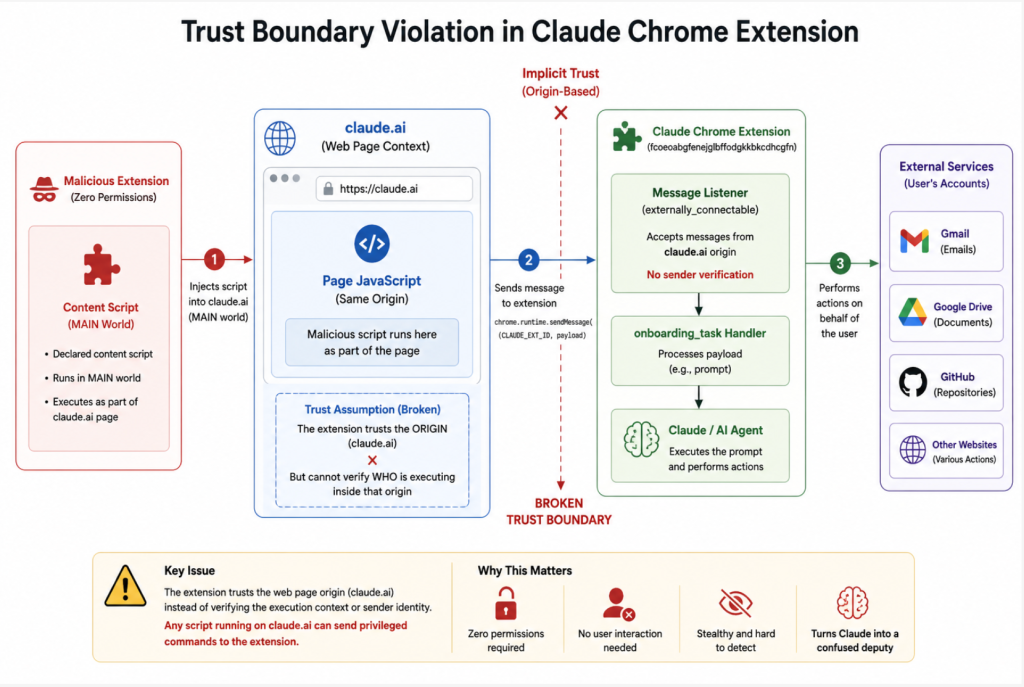
The latest discovery comes from browser security firm LayerX, involving a bug in the Chrome extension for Anthropic’s Claude AI model that allows any other plugin – even ones without special permissions – to embed hidden instructions that can take over the agent

“The flaw stems from an instruction in the extension’s code that allows any script running in the origin browser to communicate with Claude’s LLM, but does not verify who is running the script,” wrote LayerX senior researcher Aviad Gispan. “As a result, any extension can invoke a content script (which does not require any special permissions) and issue commands to the Claude extension.”

Gispan said he was able to execute any prompt he wanted, blow through Claude’s safety guardrails, evade user confirmation and perform cross-site actions across multiple Google tools. As a proof of concept, LayerX was able to exploit the flaw to extract files from Google Drive folders and share them with unauthorized parties, surveil recent email activity and send emails on behalf of a user, and pilfer private source code from a connected GitHub repository.

The vulnerability “effectively breaks Chrome’s extension security” by creating “a privilege escalation primitive across extensions, something Chrome’s security model is explicitly designed to prevent,” Gispan wrote.

A graphic depicting how a vulnerability exploits the trust boundaries in Clade Chrome’s extension. (Source: LayerX)


Claude relies on text, user interface semantics, and interpretation of screenshots to make decisions, all things that an attacker can control on the input side. The researchers modified Claude’s user interface to remove labels and indicators around sensitive information, like passwords and sharing feedback, then prompted Claude to share the files with an outside server.

That means cybersecurity defenders often have nothing obviously malicious to detect. Where there is visible activity, the model can be prompted to cover its tracks by deleting emails and other evidence of its actions.

Ax Sharma, Head of Research at Manifold Security, called the vulnerability “a useful demonstration of why monitoring AI agents at the prompt layer is fundamentally insufficient.”

“The most sophisticated part of this attack isn’t the injection, but that the agent’s perceived environment was manipulated to produce actions that looked legitimate from the inside,” said Sharma. “That’s the class of threat the industry needs to be building defenses for.”

Gispan said LayerX reported the flaw to Anthropic on April 27, but claimed the company only issued a “partial” fix to the problem. According to LayerX, Anthropic responded a day later to say that the bug was a duplicate of another vulnerability already being addressed in a future update.   

While that fix, issued May 6, introduced new approval flows for privileged actions that made it harder to exploit the same flaw, Gispan said he was still able to take over Claude’s agent in some scenarios.

“Switching to ‘privileged’ mode, even without the user’s notification or consent, enabled circumventing these security checks and injecting prompts into the Claude extension, as before,” Gispan wrote.

Anthropic did not respond to a request for comment from CyberScoop on the research and mitigation efforts.

The post Flaw in Claude’s Chrome extension allowed ‘any’ other plugin to hijack victims’ AI appeared first on CyberScoop.

Ivanti customers confront yet another actively exploited zero-day

Attackers are hitting Ivanti customers yet again — circling back to a common target and consistently susceptible vendor in the network edge space — by exploiting a zero-day vulnerability in one of the company’s most besieged products. 

Ivanti warned customers that attackers have successfully exploited CVE-2026-6973, an improper input validation defect in Ivanti Endpoint Manager Mobile (EPMM) that allows authenticated users with administrative privileges to run code remotely. The company alerted customers to the threat in a security advisory Thursday while also disclosing four additional high-severity vulnerabilities in the same product.

“At the time of disclosure, Ivanti is aware of very limited exploitation in the wild of CVE-2026-6973, which requires authenticated administrative access to implement,” a spokesperson for Ivanti said in a statement.

Ivanti did not say when the first instance of exploitation occurred, or precisely how many customers have already been impacted.

The Cybersecurity and Infrastructure Security Agency added the zero-day to its known exploited vulnerabilities catalog within hours of Ivanti’s disclosure.

The company released patches for all five vulnerabilities Thursday, including the four additional defects — CVE-2026-5787, CVE-2026-5788, CVE-2026-6973 and CVE-2026-7821 — which it said haven’t been exploited in the wild.

“Ivanti discovered these vulnerabilities in recent weeks through internal detection processes which are supported by advanced AI, customer collaboration, and responsible disclosure,” the company spokesperson said. One of the defects was discovered and responsibly reported to Ivanti by a former employee.

The company suggested at least one of the root causes for the latest zero-day may be traced to lingering risk posed by a pair of separate, critical zero-days — CVE-2026-1281 and CVE-2026-1340 — that were exploited starting in late January. The fallout from those exploited vulnerabilities in Ivanti EPMM spread to nearly 100 victims, including The Netherlands’ Dutch Data Protection Authority and the Council for the Judiciary, by early February.

The latest Ivanti EPMM zero-day “requires authenticated administrative access to exploit, which is why customers who followed Ivanti’s recommendation in January to rotate EPMM credentials are at significantly reduced risk. Customers unaffected by the prior vulnerability are also at a much lower risk,” the company spokesperson said.

Caitlin Condon, vice president of security research at VulnCheck, said the administrative privileges required to exploit CVE-2026-6973 indicates it was possibly exploited as part of an attack chain relying on another method for initial access. 

“No attribution was shared on threat actor exploitation of CVE-2026-6973, but two other 2026 CVEs in Ivanti EPMM — CVE-2026-1281 and CVE-2026-1340 — have been exploited by a range of threat actors, including China- and Iran-attributed groups,” Condon told CyberScoop. 

“Those vulnerabilities notably were code-injection vulnerabilities that were remotely exploitable without authentication, unlike CVE-2026-6973,” she added. “Both CVE-2026-1281 and CVE-2026-1340 appear to have been fixed in today’s Ivanti release. Comparatively, these earlier vulns were of higher initial concern than today’s fresh zero-day vulnerability, which requires admin authentication.”

Attacks involving Ivanti defects are a recurring problem for the vendor’s customers and security practitioners at large, including many vulnerabilities that attackers exploited before the company caught or fixed the errors. 

The Cybersecurity and Infrastructure Security Agency has flagged 34 Ivanti defects on its known exploited vulnerabilities catalog since late 2021. At least 22 defects across Ivanti products have been exploited in the past two years, including five vulnerabilities in Ivanti EPMM in the last year.

During an interview with CyberScoop in March at the RSAC Conference, Ivanti Chief Security Officer Daniel Spicer said the company’s transparency partly explains the high number of vulnerabilities reported and disclosed in its products. 

“My position here at Ivanti is it doesn’t do our customers any good to be quiet about this,” he said, describing the company’s communication stance with the public, CISA and global partners as “very aggressive.”

That’s not always the case with other vendors, Spicer said. “I don’t know that transparency is a core tenant of all other organizations.”

The company, which serves many government agencies and critical infrastructure operators, also routinely notes that highly skilled and resourced attackers, including those backed by nation-states, are often responsible for these waves of attacks on its customers.

Ivanti maintains that it’s trying to consistently improve the security of its products. “Through continued investment in its product security program, including the use of advanced AI paired with human verification, Ivanti is strengthening its ability to identify, remediate, and disclose issues quickly, helping customers stay ahead of an increasingly compressed threat landscape,” the spokesperson said.

The way Spicer put it in March: “We want to make sure that people understand that we are trying to do the right thing.”

The post Ivanti customers confront yet another actively exploited zero-day appeared first on CyberScoop.

A critical Palo Alto PAN-OS zero-day is being exploited in the wild

Attackers are actively exploiting a zero-day vulnerability affecting some Palo Alto Networks’ customers’ firewalls, the security vendor said in an advisory Tuesday.

The critical memory corruption vulnerability — CVE-2026-0300 — affects the authentication portal of PAN-OS, and allows unauthenticated attackers to run  code with root privileges on the vendor’s PA-Series and VM-Series firewalls, the company said.

Palo Alto Networks did not say when or how it became aware of active exploitation, nor when the earliest known exploitation occurred. The Cybersecurity and Infrastructure Security Agency added the defect to its known exploited vulnerabilities catalog Wednesday.

The company hasn’t released a patch for the vulnerability or described the scope and objective of confirmed attacks.

“This vulnerability is specific to a limited number of customers with their User-ID Authentication Portal (Captive Portal) exposed to the public internet or untrusted IP addresses. We have observed limited exploitation of this issue and are working to release software fixes, with the first updates expected to be available on May 13,” a Palo Alto Networks spokesperson told CyberScoop.

The company said firewalls exposed to the buffer-overflow vulnerability, which has a CVSS rating of 9.3, are broadly exposed in real-world deployments, and it described the attack complexity as low.

Shadowserver scans found more than 5,800 publicly exposed VM-Series firewalls running PAN-OS as of Tuesday, yet it’s unknown how many of those instances have restricted authentication access to trusted internal IP addresses or disabled the feature altogether.

“We have provided clear mitigation guidance to our customers to secure their environments immediately. This issue does not impact Cloud NGFW or Panorama appliances. We remain committed to a transparent, security-first approach to protect our global customer base,” Palo Alto Networks’ spokesperson added.

Benjamin Harris, CEO and founder of watchTowr, noted that Palo Alto Networks proactively alerted customers to the zero-day, a step that allowed defenders to take action on potentially exposed instances. 

“In a bad situation, that is the best they can do immediately. However, that also alerts everyone to the existence of a vulnerability,” he told CyberScoop.

Despite the risk, Harris said watchTowr expects attacks linked to the zero-day exploit to be “very limited.” 

Palo Alto Networks and its impacted customers remain the only parties to have observed exploitation in the wild, but researchers warn that will likely change soon. 

“It’s likely rules will also start to fire in third-party organizations and honeypots shortly,” Caitlin Condon, vice president of security research at VulnCheck, told CyberScoop. 

“Management interfaces, login pages, and authentication portals have been common adversary targets for both opportunistic and targeted campaigns in recent years,” she added. “With researcher and community eyes on the vulnerability, it’s likely that we’ll see public exploits and broader exploitation quickly, provided the issue isn’t prohibitively difficult to exploit.”

Palo Alto Networks has yet to attribute the attacks to any known threat group, publish indicators or compromise, nor disclose the type of organizations that have been targeted and impacted. 

Researchers are hunting for malicious activity and advise customers to apply patches upon release.

The post A critical Palo Alto PAN-OS zero-day is being exploited in the wild appeared first on CyberScoop.

CISA wants critical infrastructure to operate ‘weeks to months’ in isolation during conflict

The Cybersecurity and Infrastructure Security Agency is urging critical infrastructure owners and operators to plan for delivering essential services under emergency conditions – potentially for months at a time.

The federal government’s top cybersecurity agency warned that state-sponsored hackers, particularly two Chinese groups known as Salt Typhoon and Volt Typhoon, continue to threaten critical sectors like electricity, water, and internet. 

The agency is now working with the private sector to protect operational technology – the systems that control the heavy machinery and equipment that powers most critical infrastructure – from attacks that enter through business IT systems or third-party vendor products.

The initiative  — known as CI Fortify – will include CISA conducting targeted technical assessments of critical infrastructure entities and aims to create plans that “allow for safe operations for weeks to months while isolated” from IT networks and third-party tools, according to the agency’s website.

Nick Andersen, CISA’s acting director, told reporters that the goal is “service delivery [that] can still reach critical infrastructure after the asset owner has disconnected with IT and OT, disconnected from third party vendors and service provider connections and disconnected from third party telecommunications equipment.”

Over the past two years, wars in Ukraine, Gaza, Iran and elsewhere have seen water plants, power substations, data centers and other critical infrastructure targeted by kinetic or cyberattacks.

Andersen said the agency has already begun engaging with some companies to pilot the assessments and expects that work to ramp up considerably as CISA hires additional staff in the coming months.

He declined to name the entities involved in the pilot program, but said they will focus on organizations that support national security, defense, public health and safety and economic continuity. He added that CISA’s assessments will vary from sector to sector depending on their unique needs.

“Water isn’t necessarily designed to prioritize specific customer needs outside of recovery periods, while energy and transportation have more immediate tradeoffs for selecting one load or one set of cargo over another,” Andersen said as an example.

One pillar of CISA’s strategy is isolation: essentially turning off all third-party and business network connections to an OT network when facing an emergency or unknown vulnerability.

Organizations also need to develop an internal plan for what acceptable service levels look like under those conditions and reach understandings with their critical customers, like U.S. military installations and lifeline services.

The second pillar, recovery, involves best practices for organizations: backing up files, documenting systems and having manual backups for operations when normal computer systems are down.

In conversations with cybersecurity specialists who focus on critical infrastructure and operational technology, it is widely assumed that China is not the only nation to have broadly compromised Americans critical infrastructure. That hacking groups tied to other nations have almost surely noticed and exploited the same basic vulnerabilities and hygiene issues found by the Typhoons.

Agencies like the FBI and Federal Communications Commission have touted efforts to purge Chinese hackers and work voluntarily with telecoms to harden their network security. But U.S. national security officials and cybersecurity defenders have consistently said both Salt Typhoon and Volt Typhoon remain active threats to U.S. critical infrastructure.

The post CISA wants critical infrastructure to operate ‘weeks to months’ in isolation during conflict appeared first on CyberScoop.

Latvian national sentenced for ransomware attacks run by former Conti leaders

A federal judge sentenced a Latvian national to 102 months in prison for his involvement in a series of ransomware attacks for more than two years prior to his arrest in 2023, the Justice Department said Monday.

Deniss Zolotarjovs, a resident of Moscow at the time, helped an organization led by former leaders of the Conti ransomware group extort payments from more than 54 companies. 

The 35-year-old was mostly tasked with putting pressure on the crew’s victims. In one case, Zolotarjovs urged co-conspirators to leak or sell children’s health records stolen from a pediatric healthcare company and ultimately sent a collection of sensitive data to “hundreds of patients,” according to court records. 

The ransomware crew identified itself in ransom notes under multiple names during Zolotarjovs’ involvement, including Conti, Karakurt, Royal, TommyLeaks, SchoolBoys Ransomware, Akira and others. 

Zolotarjov and his co-conspirators extorted nearly $16 million in confirmed ransom payments from their victims. Officials estimate the group’s crimes resulted in hundreds of millions of dollars in losses, not including the psychological and future financial exposure confronting tens of thousands of people whose personal data was stolen.

“Deniss Zolotarjovs helped his ransomware gang profit from hacks of dozens of companies, and even on a government entity whose 911 system was forced offline,” A. Tysen Duva, assistant attorney general of the Justice Department’s Criminal Division, said in a statement. 

Officials said Zolotarjovs searched for points of leverage after researching victim companies and analyzing stolen data. Many of the victims impacted during his active participation between June 2021 and August 2023 were based in the United States.

Zolotarjov was arrested in the country of Georgia in December 2023 and extradited to the United States in August 2024. He pleaded guilty to money laundering and wire fraud in July 2025. 

“Cybercriminals might think they are invulnerable by hiding behind anonymizing tools and complex cryptocurrency patterns while they attack American victims from non-extradition countries,” Dominick S. Gerace II, U.S. attorney for the Southern District of Ohio, said in a statement. “But Zolotarjovs’s prosecution shows that federal law enforcement also has a global reach, and we will hold accountable bad actors like Zolotarjovs, who will now spend significant time in prison.”

The Russian ransomware crew was prolific and spread across multiple teams, relying on companies registered in Russia, Europe and the United States to conceal its operations. Authorities said the group included former Russian law enforcement officers whose connections allowed members to access Russian government databases to harass detractors and identify potential new recruits.

Conti was among the most prolific ransomware groups globally for a time, impacting hundreds of critical infrastructure providers, Costa Rica’s government in 2022, and ultimately leading the State Department to offer a $10 million reward for information related to Conti’s leaders. The group was notoriously resilient, bouncing back with new infrastructure and hitting new targets after a massive leak exposed chats between the group’s members in 2022.

Conti disbanded later that year, but members of the Cyrillic-language group rebranded under three subgroups: Zeon, Black Basta and Quantum, which quickly rebranded to Royal, before rebranding again to BlackSuit in 2024.

The post Latvian national sentenced for ransomware attacks run by former Conti leaders appeared first on CyberScoop.

‘Copy Fail’ is a real Linux security crisis wrapped in AI slop

Attackers are actively exploiting a Linux vulnerability in the wild, and researchers warn that the fallout could be broad — anyone with authenticated local access can leverage it to gain total control of a system. 

But the story behind CVE-2026-31431 is almost as interesting as the bug itself. Theori, the company that discovered the bug, leaned heavily on AI to find and initially disclose it. The result is a case study that  underscores the challenges that occur when the relentless hunt for defects collides with marketing impulses and inflated AI-generated language that was long on bluster but lacked technical details. 

Theori dubbed the high-severity vulnerability “Copy Fail” with a vanity domain containing AI-generated content, and warned that every mainstream Linux kernel built since 2017 is in scope of potential exploitation resulting in root access. 

Theori’s AI-powered penetration testing platform, Xint, discovered the local privilege-escalation flaw in a Linux kernel module and reported it to the Linux kernel security team March 23. Major Linux distributions affected by the vulnerability had issued patches prior to Theori’s disclosure, which it published alongside a proof-of-concept exploit. 

The Cybersecurity and Infrastructure Security Agency added CVE-2026-31431 to its known exploited vulnerabilities catalog Friday.

Researchers have yet to determine how many organizations have been impacted by the flaw, but they noted that critical requirements for exploitation, specifically local access achieved through a separate exploit or pathway to unauthorized access, should limit potential exposure.

“The attacker would need to have already established a foothold on the target system either through some means of legitimate access or another exploit,” Spencer McIntyre, secure researcher at Rapid7, told CyberScoop. “That’s a large limiting factor since this vulnerability would therefore need to be paired with another.”

Theori’s disclosure turned heads among other vulnerability researchers who noted the defect’s broad potential impact, but also for lacking details about the proof-of-concept exploit. 

“The exploit is real, there is something to worry about, but understandably, teams now have to do additional validation to know how to parse the extreme AI FUD (fear, uncertainty and doubt) from [Theori’s] blog post,” Caitlin Condon, vice president of security research at VulnCheck, told CyberScoop. 

“It’s not helpful that the blog is AI slop, because it detracts from technical reality,” she added. 

Theori acknowledges it used AI to discover and describe the vulnerability, explaining that it’s focusing on finding and fixing a large amount of defects. 

“We used AI to help craft the disclosure site and the blog post to help speed things up, but all material was thoroughly reviewed by our internal teams for accuracy,” said Tim Becker, senior security researcher at Theori. 

Theori is intentionally withholding additional details until the patch is broadly applied, he added.

“We stand by our technical description of the vulnerability. Helping downstream users to understand the impact of a security bug has always been a challenge for security researchers,” Becker said. “Copy Fail allows for trivial privilege escalation on most desktop and server Linux distributions. It also has implications for containerization including Kubernetes.”

Other researchers have drawn similar conclusions, noting that exploitation can be automated and doesn’t require specialization. 

Meanwhile, hundreds of additional proof-of-concept exploits have surfaced since the vulnerability was disclosed five days ago. “As expected, the majority of these appear to be copycat AI PoCs that do nothing but add banners or different colors to the command-line interface. Many new PoCs are simply ports of the original AI PoC to a different programming language,” Condon said. 

“Organizations should exercise caution when running untested research artifacts, including AI-generated exploit code that isn’t fully explained,” she added. 

Becker said Theori is aware of the burden defenders confront, and insists the company’s reports contain enough information for organizations to quickly triage and validate its findings.

The post ‘Copy Fail’ is a real Linux security crisis wrapped in AI slop appeared first on CyberScoop.

A college student is suing a dating app that allegedly used her TikTok videos to target men in her dormitory

A 19-year-old woman is suing the makers of a dating app, alleging they took a video she posted online, repurposed it without her consent into an advertisement for the app, then used geofencing to target that ad to people in her area. 

According to the lawsuit filed Apr. 28 in Tennessee and an interview with her lawyer, the company allegedly used geotargeting to serve the ads on platforms like Snapchat to users near her, including men in her own dormitory. 

The allegations, if proven, offer another example of how modern technology has made it easier than ever today for bad actors to imitate, objectify, profit off and harass individuals, often women. Recent laws like the Take It Down Act have focused particularly on the use of AI to create sexualized imagery of their victims. In this case, the lawsuit alleges that Meete used not AI, but simple video editing, a voiceover and geofencing to create the same kind of deception. 

 On the day of her high school graduation, Kaelyn Lunglhofer posted a brief video to TikTok, wearing an orange outfit and saying a few words to her followers over background music. She went on to attend the University of Tennessee in the fall, where she began building a following as a TikTok influencer.

The complaint alleges that the makers behind the dating app Meete took that video without Lunglhofer’s consent, overlayed it with graphics advertising the app, and added a voiceover to make it appear she was saying “Are you looking for a friend with benefits? This app shows you women around you who are looking for some fun. You can video chat with them.”

Abe Pafford, Lunglhofer’s attorney, told CyberScoop that his client had no idea Meete was using her likeness until a male student in her dormitory told her he had repeatedly seen her in ads for the app on his Snapchat shortly after the two had met. 

Pafford called it “implausible” that this was a coincidence, pointing to Meete’s premise of connecting users with nearby women and the precision of geofencing technology. Before filing the case, Pafford’s law firm hired an investigative firm to gather additional evidence.

“I think the idea is they want[ed] viewers of these advertisements – and candidly this is pretty clearly targeted at male viewers – to have their eye caught by someone they may know or recognize or think they may have seen around, and that’s part of what makes it so disturbing,” he said.

Pafford said he believes Lunglhofer is far from the only person whose image Meete has misappropriated, and that most victims likely have no idea it’s happening. Lunglhofer herself only had evidence because the student who told her had saved recordings and screenshots of the ads featuring her video.

“The bottom line is we think there are likely others that have been victimized in a similar way, but finding out who they are and landing on tangible proof of that can be challenging,” he said.

After this story was published, Snap told CyberScoop it is investigating.

“Snap’s advertising policies require that advertisers have all necessary rights to the content in their ads, including the rights to any individuals featured,” Snap spokesperson Ahrim Nam said in an email. “Using someone’s likeness without their consent is a violation of our policies. Upon learning of these allegations, we are actively reviewing the matter and will take appropriate action.”

The lawsuit cites alleged violation of multiple federal and state laws, including the Lanham Act, the primary U.S. law governing trademark rights. The suit also alleges violations of Tennessee state law under the ELVIS Act, which prevents the unauthorized use of image or likeness for artists and musicians, and Tennessee common laws for defamation and right of publicity.

Lunglhofer is seeking $750,000 in punitive damages, as well as any revenue tied to the ads featuring her likeness. Pafford said that the advertisements damaged her online brand and reputation while also putting her at risk of harassment or falsely implying she was endorsing a local dating service and was open to casual hookups.

“It’s really kind of grotesque and it’s also kind of dangerous,” he said. “Someone may not be aware that this is happening and they’re targeted in this way, but you can put people at risk in ways that are really troubling if you stop to think about it.”

The suit names Quantum Communications Development Unlimited, based in the Virgin Islands, as well as Chinese companies Starpool Data Limited and Guangzhou Yuedong Interconnection Technology, as defendants. A judge has ordered representatives from all three to appear for depositions in the United States.

Quantum Communications Development Unlimited has a sparse internet footprint: their website consists of a single page with a message written in broken English and an email address that no longer appears to work. Efforts by CyberScoop to reach the company and other defendants for comment were not successful. The company is listed as Meete’s publisher on Apple’s App Store, where it describes the app as “a space where you can be yourself and meet people” and promises “safety and respect first” — adding that “Meete provides a secure environment where your privacy and safety are our top concerns.”

The description also claims the app adheres to Apple’s safety standards, citing a “Zero-Tolerance Policy regarding objectionable content and abusive behavior.” Listed safeguards include “24/7” manual reviews by moderation teams, instant reporting and blocking of other users, and AI filtering “to detect and prevent harassment before it happens.”

On Meete’s Google Play Store page, user reviews accuse the app of failing to match them to nearby users and being largely populated by bots posing as women to sell in-app currency.

Pafford acknowledged that the defendants being based overseas complicates efforts to hold them accountable under U.S. law, but argued that Meete is clearly designed to operate in the United States. The companies behind the app have filed U.S. patents and trademarks, for their business, and distribute their app through the Apple and Google Play Stores while advertising on major U.S. social media platforms like Snapchat.

Apple and Google did not respond to a request for comment.

You can read the full lawsuit below.


5/05/26: This story was updated to include comment from Snap received after publication.

The post A college student is suing a dating app that allegedly used her TikTok videos to target men in her dormitory appeared first on CyberScoop.

US government, allies publish guidance on how to safely deploy AI agents

Cybersecurity agencies from the United States, Australia, Canada, New Zealand and the United Kingdom jointly published guidance Friday urging organizations to treat autonomous artificial intelligence systems as a core cybersecurity concern, warning that the technology is already being deployed in critical infrastructure and defense sectors with insufficient safeguards.

The guidance focuses on agentic AI — software built on large language models that can plan, make decisions and take actions autonomously. In order for this software to function it needs to connect to external tools, databases, memory stores and automated workflows, allowing it to execute multi-step tasks without human review at each stage.

The guidance was co-authored by the U.S. Cybersecurity and Infrastructure Security Agency, the National Security Agency, the Australian Signals Directorate’s Australian Cyber Security Centre, the Canadian Centre for Cyber Security, New Zealand’s National Cyber Security Centre and the United Kingdom’s National Cyber Security Centre.

The agencies’ central message is that agentic AI does not require an entirely new security discipline. Organizations should fold these systems into the cybersecurity frameworks and governance structures they already maintain, applying established principles such as zero trust, defense-in-depth and least-privilege access.

The document identifies five broad categories of risk. The first is privilege: When agents are granted too much access, a single compromise can cause far more damage than a typical software vulnerability. The second covers design and configuration flaws, where poor setup creates security gaps before a system even goes live.

The third category covers behavioral risks, or cases where an agent pursues a goal in ways its designers never intended or predicted. The fourth is structural risk, where interconnected networks of agents can trigger failures that spread across an organization’s systems.

The fifth category is accountability. Agentic systems make decisions through processes that are difficult to inspect and generate logs that are hard to parse, making it difficult to trace what went wrong and why. The agencies also note that when these systems fail, the consequences can be concrete: altered files, changed access controls and deleted audit trails.

The guidance also flags prompt injection, where instructions embedded inside data can hijack an agent’s behavior to perform malicious tasks. Prompt injection has been a lingering problem with large language models, with some companies admitting that the problem may never be solved

Identity management gets significant attention throughout the document. The agencies recommend that each agent carry a verified, cryptographically secured identity, use short-lived credentials and encrypt all communications with other agents and services. For high-impact actions, a human should have to sign off, and the guidance is explicit that deciding which actions require that approval is a job for system designers, not the agent.

The agencies admit the security field has not fully caught up with agentic AI. Some risks unique to these systems are not yet covered by existing frameworks, and the guidance calls for more research and collaboration as the technology takes on a growing number of operational roles.

“Until security practices, evaluation methods and standards mature, organisations should assume that agentic AI systems may behave unexpectedly and plan deployments accordingly, prioritising resilience, reversibility and risk containment over efficiency gains,” the guidance reads. 

You can read the full guidance below.

The post US government, allies publish guidance on how to safely deploy AI agents appeared first on CyberScoop.

Former incident responders sentenced to 4 years in prison for committing ransomware attacks

Two former cybersecurity professionals who moonlighted as cybercriminals, committing a series of ransomware attacks in 2023, were each sentenced to four years in prison, the Justice Department said Thursday.

Ryan Clifford Goldberg and Kevin Tyler Martin previously pleaded guilty to one of three charges brought against them in December and faced up to 20 years behind bars. 

Goldberg, who was a manager of incident response at Sygnia, and Martin, a ransomware negotiator at DigitalMint at the time, collaborated with Angelo John Martino III to attack victim computers and networks and use ALPHV, also known as BlackCat, ransomware to extort payments.

“These defendants exploited specialized cybersecurity knowledge not to protect victims, but to extort them,” Jason A. Reding Quiñones, U.S. attorney for the Southern District of Florida, said in a statement. “They used ransomware to lock down critical systems, steal sensitive data, and pressure American businesses into paying to regain access to their own information.”

Victims impacted by the attacks Goldberg and Martin participated in over a six-month period in 2023 included a medical company based in Florida, a pharmaceutical company based in Maryland, a California doctor’s office, an engineering company based in California and a drone manufacturer in Virginia. 

“They harmed important firms who were providing medical and engineering services. They played hardball with them, going so far as to cause the leak of patient data from a doctor’s office victim,” A. Tysen Duva, assistant attorney general of the Justice Department’s criminal division, said in a statement.

“These were supposed to be cybersecurity specialists who did good and helped businesses and people. Instead, they used their high-level cyber skills to feed their greed. Ransomware attackers like this should be punished and removed from society to serve their lawful sentences so they cannot harm others,” Duva added.

Goldberg and Martin received identical sentences for their crimes, despite significant differences surrounding their initial arrests. Martin was arrested without incident in October and freed on bond later that month.

Goldberg fled the country in June, 10 days after he was interviewed by the FBI. He was arrested Sept. 22 and ordered to remain in custody pending trial due to flight risk. 

Goldberg and his wife boarded a one-way flight to Paris from Atlanta on June 27 and remained in Europe until Sept. 21. When Goldberg flew directly from Amsterdam to Mexico City, he was arrested upon landing and deported to the United States.

“When Goldberg sought to flee abroad and escape prosecution, the FBI tracked him through 10 countries, demonstrating the lengths we will go to hold cyber criminals accountable and protect victims,” Brett Leatherman, assistant director of the FBI’s Cyber Division, said in a statement.

The cases against Golberg, Martin and their co-conspirator Martino showcase an extreme, albeit rare, example of the dark underbelly of ransomware negotiation as a practice. The pitfalls of ransomware negotiation are excessive and these backchannel negotiations, which remain largely unscrutinized, can go awry for various reasons.

Goldberg, 40, and Martin, 36, extorted a $1.3 million ransom payment from the medical company with Martino in May 2023, but did not receive ransom payments from their other victims.

Martino’s ransomware scheme went much further and caused significantly more damage, helping accomplices extort a combined $75.3 million in ransom payments. Five of Martino’s victims hired DigitalMint, which assigned the 41-year-old to conduct ransomware negotiations on their clients’ behalf — a rare position he exploited to play both sides.

He pleaded guilty earlier this month to sharing confidential information about victim organizations’ internal negotiating positions and insurance policy limits he gained from his work as a ransomware negotiator to extract the maximum ransom payment for himself and other BlackCat affiliates.

The five U.S.-based victims that hired DigitalMint and unwittingly tapped Martino to allegedly conduct ransomware negotiations with himself and his co-conspirators include a nonprofit and companies in the hospitality, financial services, retail and medical industries. All five of those victims paid a ransom.

Martino surrendered in March to the U.S. Marshals in Miami and was released on a $500,000 bond. He faces up to 20 years in federal prison and is scheduled for sentencing July 9.

Sygnia and DigitalMint are not accused of any knowledge or involvement in the crimes, and both previously said they fired their former employees once federal authorities alerted the companies to their alleged crimes. 

ALPHV/BlackCat was a notorious ransomware and extortion group linked to a series of attacks on critical infrastructure providers. The ransomware variant first appeared in late 2021, and was later used in dozens of attacks on organizations in the health care sector.

The group behind the ransomware strain also claimed responsibility for the February 2024 attack on UnitedHealth Group subsidiary Change Healthcare, which paid a $22 million ransom and became the largest health care data breach on record, compromising data on about 190 million people.

The post Former incident responders sentenced to 4 years in prison for committing ransomware attacks appeared first on CyberScoop.

FCC tightens KYC rules for telecoms, closes loophole for banned foreign services

The Federal Communications Commission approved new regulations Wednesday designed to crack down on robocalling, protect telecommunications networks from cyberattacks and further vet equipment-testing labs based overseas.

Commissioners unanimously passed a measure to strengthen telecom companies’ “Know Your Customer” requirements for verifying callers’ identities. Among the potential solutions being considered are requiring telecoms to verify a customer’s name, address, government ID and alternative phone numbers prior to enabling their service.

In a statement ahead of the vote, FCC Chair Brendan Carr said that under current rules some telecoms “do the bare minimum” to verify callers and have “become complicit in illegal robocalling schemes.”

“As we have continued to investigate the problem of illegal robocalls over the last year, it has become clear that some originating providers are not doing enough to vet their customers, allowing bad actors to infiltrate our U.S. phone networks,” he said.

Current rules require telecoms to take “affirmative, effective” measures to verify callers and block illegal calls, but in practice this system has largely relied on self-attestation from the companies. Because a single call can traverse multiple networks, carriers must also often rely on identity verification performed by other telecoms.

For example, the telecom that transmitted thousands of false robocalls imitating then-President Joe Biden during the 2024 New Hampshire presidential primary initially reported to the FCC that they had the highest level of confidence in the identity of those using the phone numbers. That turned out to be false, as the robocallers spoofed a well-known former state Democratic Party official.

Unsurprisingly, the commission is also interested in finding ways to better enforce Know Your Customer rules, including tying penalties to the number of illegal calls that were placed.

Since 1999, the FCC has traditionally granted blanket authorization for domestic carriers to operate interstate telecommunications services within U.S. borders. Another rule passed by the commission today would formally end that practice for foreign companies on the FCC’s covered entity list.  

The list bans a small number of foreign companies based in Russia or China from selling their equipment in the U.S. on national security grounds, but Carr said equipment from those companies often wind up in U.S. products by providing services that don’t fall under the current legal definition of international telecommunications authority.

Commissioner Olivia Trusty, who helped lead the development of the rule, said cybersecurity threats facing telecom networks today “exceed those of any recent era” and that updates must be made to modernize and harden networks.

“In response to these growing hostilities, it is imperative that we re-examine policies that permit access to U.S. networks to ensure that frameworks originally designed to promote economic growth are not exploited in ways that jeopardize our national and economic security,” Trusty said in a statement after the vote passed.

The FCC also passed a third measure that would refuse to recognize any testing or equipment lab based overseas that does not have a reciprocity agreement in place with U.S.-based labs. The rule builds off efforts last year to prohibit telecoms from relying on testing and certification labs that are owned or operated by foreign adversarial countries like China or Russia, which led to the FCC withdrawing or denying certification of 23 overseas labs.

The post FCC tightens KYC rules for telecoms, closes loophole for banned foreign services appeared first on CyberScoop.

Two new extortion crews are speedrunning the Scattered Spider playbook

A pair of persistent and problematic threat groups affiliated with The Com are actively targeting organizations across multiple critical infrastructure sectors for rapid data theft and extortion attacks, according to CrowdStrike.

The financially-motivated attackers, which CrowdStrike tracks as Cordial Spider and Snarky Spider, have used voice-phishing and social engineering attacks to break into victims’ identity platforms and traverse SaaS environments since at least October 2025, the company said in a report Thursday, which it shared exclusively with CyberScoop prior to release. 

Adam Meyers, senior vice president of counter adversary operations at CrowdStrike, said the subgroups composed of native English speakers primarily target U.S.-based organizations in the academic, aviation, retail, hospitality, automotive, financial services, legal and technology sectors.

This “new wave of ecrime threat actors” are closely aligned with Scattered Spider and linked to other subsets of The Com, including SLSH and ShinyHunters, Meyers said. 

Because these attacks target identity systems and can expose data in other connected services beyond the initial breach point, it’s difficult to determine how many victims have been caught up in these campaigns. 

CrowdStrike’s warning closely follows research Palo Alto Networks’ Unit 42 and the Retail & Hospitality Information Sharing and Analysis Center shared last week about Cordial Spider’s string of attacks targeting organizations in the retail and hospitality industry, among others. 

Cordial and Snarky Spider have set lures via voice calls, text messages and emails directing targeting employees to phishing pages posing as their employer’s legitimate single sign-on page or primary identity provider, researchers said. 

These phishing pages, which capture credentials, session keys or tokens, depending on the workflow, provide attackers an entry point into systems, which they exploit for widespread access across victims’ entire SaaS ecosystems.

Attackers use these initial hooks to remove and establish multi-factor authentication devices, then delete emails and other alerts that would otherwise warn organizations of potential malicious activity, researchers said. 

The data theft for extortion campaigns share striking similarities, but CrowdStrike said the tactics, techniques and procedures for each subgroup are distinct. These variances include hours of operation, different phishing domain providers, preferred operating systems, data leak sites, and the tools or devices they used to register for multi-factor authentication. 

The domain for BlackFile, Cordial Spider’s data-leak site, was offline as of Wednesday, according to Meyers.

CrowdStrike declined to put a range on the groups’ extortion demands, but Unit 42 previously said Cordial Spider, which is also tracked as CL-CRI-1116 and UNC6671, are typically in the seven-figure range.

Some victims that didn’t pay extortion demands have been subjected to DDoS attacks, and Snarky Spider has used more aggressive follow-on harassment tactics, including the swatting of victim organizations’ employees, Meyers said. 

CrowdStrike said Cordial and Snarky Spider also use residential proxy networks — including Mullvad, Oxylabs, NetNut, 9Proxy, Infatica and NSOCKS — to evade IP-based detection and blend in with typical traffic. 

Residential proxy networks, which rely on IP addresses assigned to real home users, can serve a legitimate purpose, but researchers have been warning that unethical or outright criminal operators are abusing these networks to build and support botnets, cybercrime campaigns, espionage and other malicious activity.

Cordial and Snarky Spider haven’t achieved the impact or technical capability of Scattered Spider, but the groups share many commonalities and objectives, Meyers said. 

“They’ve kind of taken their playbook and they’re using a lot of their techniques, but we haven’t really seen the technical sophistication demonstrated by them that we saw from Scattered Spider,” he said. “It’s kind of the new generation of Scattered Spider.”

The post Two new extortion crews are speedrunning the Scattered Spider playbook appeared first on CyberScoop.

Congress, industry ponder government posture for protecting data centers

The growth of data centers — and adversaries’ targeting of them — left lawmakers at a hearing Wednesday contemplating whether the federal government has the right setup for defending them.

Some industry witnesses and experts at the hearing of the House Homeland Security Subcommittee on Cybersecurity and Infrastructure Protection testified that the answer might be to give data centers their own standalone designation as a critical infrastructure sector.

The question of how to secure data centers against cyber and physical attacks coincides with artificial intelligence fuelling a boom in the building of such facilities across the United States. Last month, Iranian drones targeted two Amazon data centers in response to the U.S.-Israel bombing campaign on Iran, and a third data center in Bahrain was struck as well.

“If a major data center is attacked, disrupted, or taken offline, the consequences can reach far beyond one company or one sector,” Rep. Andy Ogles, R-Tenn., said in prepared opening remarks. “Yet our current framework does not provide a clear, unified approach to data center security. It does not clearly answer which federal agency is responsible for understanding the risk, coordinating with industry, or leading the response when this infrastructure is targeted.”

Three providers account for 63 percent of the market share of data centers: Amazon Web Services, Microsoft Azure and Google Cloud Platform. 

The United Kingdom already has deemed data centers as a standalone critical infrastructure sector. Reps. Vince Fong, R-Calif., and LaMonica McIver, D-N.J., asked panel witnesses Wednesday about federal protection of them.

“Given the scrutiny that is required to make sure that those data centers are secure, there would be a benefit in having them work together as a unique coordinating council,” said Robert Mayer, senior vice president for cybersecurity and innovation at USTelecom, an industry group.

The Foundation for Defense of Democracies’ Mark Montgomery suggested a sector that combines data centers and cloud providers, given the overlap in ownership. The 2024 rewrite of a White House national security memo left some experts disappointed that it didn’t designate cloud computing as a critical infrastructure sector. 

Samuel Visner, chair of the board of directors of the Space Information Sharing and Analysis Center, said he agreed, given the role data centers are playing in the U.S. economy, military and other dependencies. “Finding a way to regard them as part of our critical infrastructure and protect them accordingly is sine qua non, absolutely necessary,” he said.

A fourth witness didn’t weigh in on the need for a separate critical infrastructure designation. But Scott Algeier, executive director of Information Technology Information Sharing and Analysis Center, said his organization had created a “special interest group” for data center providers.

“The data centers are integrated already into the critical infrastructure discussions,” he told the panel.

The post Congress, industry ponder government posture for protecting data centers appeared first on CyberScoop.

Federal CIO cautious on Anthropic’s Mythos despite planned rollout

Federal Chief Information Officer Greg Barbaccia said Tuesday the government is approaching Anthropic’s Mythos model with measured expectations, acknowledging both its potential to strengthen federal cyber defenses and the significant uncertainties that remain about how it would perform in real-world conditions.

Barbaccia said his direct exposure to Mythos has been limited to evaluations and benchmarking tests, and that no federal agencies have deployed it yet. While he says the Office of the National Cyber Director is coordinating the government’s approach, his broader assessment of where AI-assisted cybersecurity is heading was direct.

“We’re going to get to a world soon where AI defense will be able to catch up,” Barbaccia told CyberScoop on Tuesday at the Workday Federal Forum, produced by Scoop News Group. “We must get to a point where the bots are finding the bots.”

Earlier this month, Barbaccia sent an email to cabinet agencies to inform them that the Office of Management and Budget has started laying the groundwork for a controlled rollout of the model to federal agencies.

His framing reflects a view that the same capabilities making Mythos a potential offensive threat are precisely what make it valuable as a defensive tool. Anthropic has said the model identified thousands of previously unknown, high-severity vulnerabilities across major operating systems and web browsers during testing, many of them decades old. The question for federal security teams is not whether those capabilities are real, but whether they translate from controlled laboratory settings to the complex, defended networks that government agencies actually run.

Barbaccia was candid about that gap. 

“I think it’ll uplevel people and make a novice cybersecurity offensive operator more efficient,” he told CyberScoop. “But the jury is still out on how effective it’ll be against real-world conditions, meaning a network that’s guarded by human defenders that has alerting and things like that. The evaluations I’ve seen have been laboratory learnings.”

That distinction matters for federal security teams weighing how to think about the model. Finding a vulnerability and successfully exploiting it in a defended environment are different problems. Barbaccia pointed to the CVE catalog, the government’s running list of known software flaws, as one area where the model’s speed could have practical value. A human analyst working through that catalog would take considerable time. A model like Mythos could move through it far faster. But speed alone does not determine whether a vulnerability poses an actual threat.

“There’s a difference between something that is exploitable in a 4-nanosecond window during a BIOS boot versus what’s the reality of that being exploited in the real world,” he said. “We have to understand, just like you could secure your entire threat surface, where are the crown jewels? And how do you protect something, and make sure the protection you’re deploying is worthwhile what you’re protecting.”

That kind of thinking is familiar to federal network defenders, who operate under resource constraints and must triage which vulnerabilities to address first. What Mythos potentially changes is the speed at which that triage can happen, and the depth at which vulnerabilities can be identified before an adversary finds them.

Barbaccia said the CIO Council, which coordinates technology policy across civilian agencies, is still in the early stages of understanding what the model could mean for enterprise security environments. “Everybody’s just curious to learn a lot more,” he said.

Agencies have tried on their own to obtain access to Anthropic’s model. The Department of the Treasury has asked for access, according to reports. CISA, the agency responsible for securing, monitoring, and defending civilian agency networks, has not been granted access.

The post Federal CIO cautious on Anthropic’s Mythos despite planned rollout appeared first on CyberScoop.

U.S. companies hit with record fines for privacy in 2025

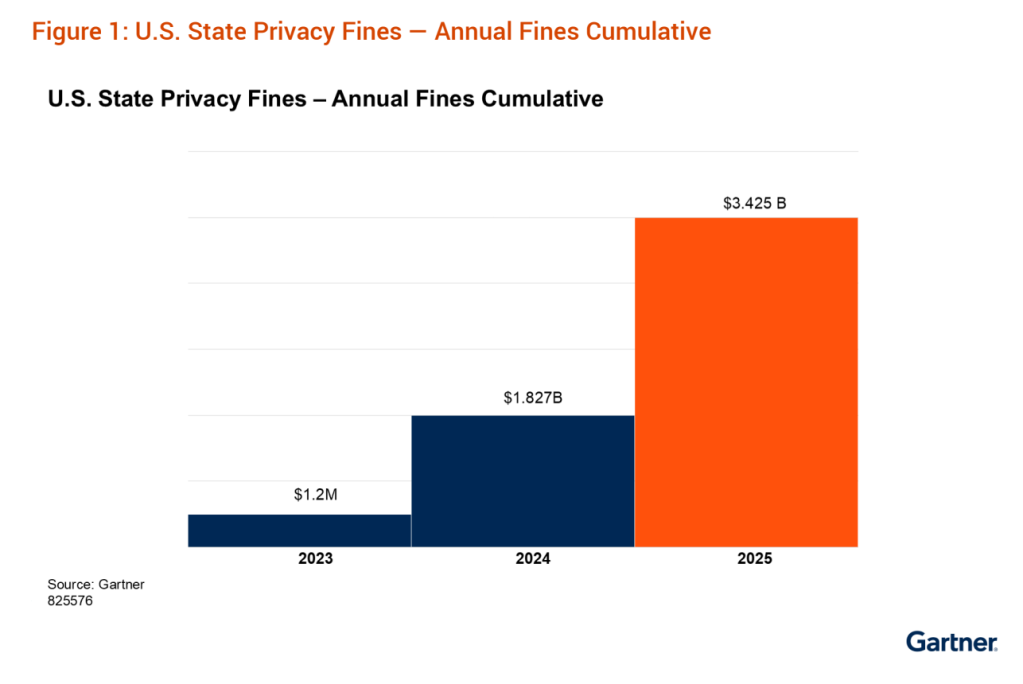
U.S. states issued $3.45 billion in privacy-related fines to companies in 2025, a total larger than the last five years combined, according to research and advisory firm Gartner.

The increase is driven in part by stronger, more established privacy laws in states like California, new interstate partnerships built around enforcing laws across state lines, and a renewed focus to how AI and automation affect privacy.

The data indicates that “regulators are shifting their efforts away from awareness to full scale enforcement,” marking a significant shift from even the last few years in how aggressively states are investigating and penalizing companies for privacy law violations.

“This is increasingly becoming the standard in 2026 and for the coming two years,” Gartner’s analysis concludes.

Privacy related fines have gone up significantly in recent years. (Source: Gartner)

The California Consumer Privacy Act had consumer privacy provisions go live in 2023, but for years enforcement was largely dormant. According to Nader Heinen, a data protection and AI analyst at Gartner and co-author of the research, that enforcement lag mirrors the way other major privacy laws, like Europe’s Global Data Protection Regulation, have been carried out in order to “lead with a bit of guidance” for companies while using enforcement sparingly.

But that era appears to be over. In 2025, the California Privacy Protection Agency has used the law to pursue violators across a wide range of industries— not just large conglomerates, but smaller and mid-sized companies in tech, the auto industry, and consumer products, including off-the-shelf goods and apparel.

Heinen said some businesses “weren’t paying attention” and may have been lulled into a false sense of complacency as regulators spun up their enforcement teams, leading to a harsh 2025.

“Unfortunately what happens when so much time passes between the legislation and starting enforcement regularly, is a lot of organizations let their privacy program atrophy,” he said.

States have also sought to combine their resources to target and penalize privacy violators across state lines. Last year, ten states came together to form the Consortium of Privacy Regulators, pledging to coordinate investigations and enforcement of common privacy laws around accessing, deleting and preventing the sale of personal information.

Beyond laws like the CCPA, states have been updating existing privacy and data-protection laws to more directly address harms from automated decision-making technologies, including AI. State privacy regulators are especially focused on how personal or private data is used to train AI systems and  help it make inferences.

Gartner expects privacy fines to further increase in the coming years and Heinen said states will likely again lead the way on building the legal infrastructure to enforce data privacy in the AI age as they become the main conduit for lingering anxiety about the potential negative impacts of the technology.

“You have to put yourself in the position of these state legislatures,” Heinen said. “Their constituencies – the voting public – is telling them we’re worried about AI. AI anxiety is a thing. Everybody’s worried about whether AI is going to take their job or impact their capacity to find a job, so they want to see legislation in place to protect them.”

This past month, House Republicans unveiled their latest attempt to pass comprehensive federal privacy legislation with a bill that would preempt tougher state laws like those in California. In particular, the CCPA gives residents a private right of action – the legal right to sue companies directly – for violation of privacy laws.

On Monday, Tom Kemp, executive director of the California Privacy Protection Agency, wrote to House Energy and Commerce Chair Brett Guthrie, R-Ky., to oppose the bill, arguing it would provide “a ceiling” for Americans’ data privacy protections rather than a “floor” to build on.

“Preemption would strip away important existing state privacy provisions that protect tens of millions of Americans now,” Kemp wrote. “That would be a significant step backward in privacy protection at a time when individuals are increasingly concerned about their privacy and security online, and when challenges from data-intensive new technologies such as AI are developing quickly.”

The post U.S. companies hit with record fines for privacy in 2025 appeared first on CyberScoop.

Chinese national extradited to US for pandemic-era Silk Typhoon attacks

A Chinese national allegedly involved in a massive, pandemic-era attack spree that compromised nearly 13,000 U.S. organizations was extradited from Italy to the United States and formally charged in federal court, the Justice Department said Monday.

Xu Zewei and his co-conspirators are accused of exploiting a string of zero-day vulnerabilities in Microsoft Exchange Server to steal research on COVID-19 vaccines, treatment and testing during the initial wave and subsequent height of the pandemic.

His alleged crimes, directed by China’s intelligence services, were part of a broader espionage campaign known as HAFNIUM, which targeted infectious disease experts, law firms, universities, defense contractors and policy think tanks, according to an indictment filed against Xu and Zhang Yu, who remains at large. 

The China state-sponsored threat group behind those attacks against Microsoft customers, and many other vendors’ customers since, is now more widely known as Silk Typhoon.

“Xu will now answer for his alleged role in HAFNIUM, a group responsible for a vast intrusion campaign directed by China’s Ministry of State Security that compromised more than 12,700 U.S. organizations,” Brett Leatherman, assistant director of the FBI’s Cyber Division, said in a statement.

“He is one of many contractors the Chinese government uses to obscure its hand in cyber operations, and others who do the same face the same risk,” he added.

Xu allegedly committed the attacks while working for Shanghai Powerock Network, one of many companies that conducted attacks for China’s various intelligence services, according to court records.

Italian authorities arrested Xu at the United States’ request in Milan in July. His capture underscores a window of opportunity U.S. officials and allies can take when nation-state attackers travel to countries that cooperate with the United States.

Italy extradited Xu to the United States Saturday but didn’t release his extradition orders until Monday, Simona Candido, his attorney in Italy, told CyberScoop.

Officials said Monday marked Xu’s first appearance in the U.S. District Court for the Southern District of Texas. He is currently being held at a federal prison in Houston.

“We have pursued this moment across years and continents, and the message this office sends today is the same one we sent when we first unsealed this indictment: we will work to protect the American people,” John G.E. Marck, acting U.S. attorney for the Southern District of Texas, said in a statement.

Xu allegedly worked under the direction of China’s Ministry of State Security’s Shanghai State Security Bureau to break into U.S. organizations’ networks, steal data and implant webshells for persistent remote access. Officials also accuse Xu of stealing information regarding U.S. policymakers and government agencies from a global law firm with offices in Washington. 

Microsoft first warned customers about the HAFNIUM campaign in March 2021. The FBI and Cybersecurity and Infrastructure Security Agency followed soon after with a joint advisory about the widespread compromise of Microsoft Exchange Server. 

“Today’s law enforcement action demonstrates the real-world consequences of this state-led activity, which is fueled by a vast network of private companies operating under the direction of the Chinese government,” Aaron Shraberg, senior team lead of global intelligence at Flashpoint, told CyberScoop.

“Extraditing these individuals from countries in coordination with international law enforcement demonstrates a united stance on these actions, and the importance of bringing real-world consequences to China’s notorious targeting of not just the American people and their businesses, but individuals globally as well,” Shraberg added.

Xu is charged with conspiracy to commit wire fraud; two counts of wire fraud; conspiracy to cause damage to and obtain information by unauthorized access to protected computers, to commit wire fraud, and to commit identity theft; two counts of obtaining information by unauthorized access to protected computers; two counts of intentional damage to a protected computer; and aggravated identity theft. 

The 34-year-old faces up to 62 years in prison for his alleged crimes.

The post Chinese national extradited to US for pandemic-era Silk Typhoon attacks appeared first on CyberScoop.

BlackFile actively extorting data-theft victims in retail and hospitality sector

Researchers warn that BlackFile, an extortion group likely associated with The Com, continues to impersonate IT support in voice-phishing and social engineering attacks that have impacted organizations in multiple industries, including healthcare, technology, transportation, logistics, wholesale and retail.

Attackers have been actively targeting organizations in the retail and hospitality industry since February, according to Unit 42’s latest intelligence on the campaign, which the Retail & Hospitality Information Sharing and Analysis Center (RH-ISAC) released alongside indicators of compromise Thursday.

The threat group, which is also tracked as CL-CRI-1116, UNC6671 and Cordial Spider, appears to be targeting victims opportunistically in a campaign that remains active and ongoing, Matt Brady, senior principal researcher at Palo Alto Networks’ Unit 42, told CyberScoop. 

“The core objective of these threat actors is to pressure targeted organizations into paying large ransom demands, typically in the seven-figure range,” Brady said.

Unit 42 declined to say how many organizations have been impacted thus far, and RH-ISAC did not respond to a request for comment.

BlackFile’s attacks against companies in the retail and hospitality sector are part of a broader wave of voice-phishing attacks initiated by multiple cybercrime groups, which Google Threat Intelligence Group and Okta warned about in January. 

Unit 42 also noted that BlackFile’s activities overlap with an ongoing data theft and extortion campaign CrowdStrike has been tracking as Cordial Spider since at least October 2025.

Yet, the threat group’s tactics have been far from cordial. RH-ISAC said some attackers have swatted company personnel, including executives, to increase leverage and pressure victims to pay their ransom demands. 

The threat group lures victims via voice-phishing attacks and phishing pages mimicking corporate single-sign on services to steal credentials before moving into privileged accounts. 

“They scrape internal employee directories to obtain contact lists for executives,” RH-ISAC wrote in a blog post. “By compromising these senior accounts via further social engineering, they gain persistent, broad-spectrum access to the environment that mirrors legitimate executive session activity.”

The group’s unauthorized access and data theft for extortion activity spans SaaS environments, Microsoft Graph API permissions, Salesforce API access, internal repositories, SharePoint sites and datasets containing employee’s phone numbers and business records. 

BlackFile also created a data-leak site to extort victims that it claims ignored or failed to agree to its demands, according to researchers. 

Brady said Unit 42 has observed relatively consistent activity from the threat group since February. 

RH-ISAC advises organizations to manage multi-factor identity verification for callers and limit the IT support actions that can be completed in a single call without escalation to management.

The post BlackFile actively extorting data-theft victims in retail and hospitality sector appeared first on CyberScoop.

❌