Reading view

There are new articles available, click to refresh the page.

Intel agencies: Frontier AI models will reshape cybersecurity faster than expected

Intelligence agencies for the United States, Canada, UK, Australia and New Zealand are warning that advanced AI models capable of wreaking havoc in the cyber domain are “months away” from being publicly available.

In a joint statement, the Five Eyes alliance say they expect the kind of advanced hacking capabilities provided by frontier models like Anthropic’s Fable 5 and OpenAI’s Daybreak to become broadly available the public within the year, despite efforts by AI companies to withhold them or restrict their access.

“Frontier Al models are anticipated to exceed current industry expectations, fundamentally transforming both offensive and defensive cyber capabilities,” the agencies said. “The timeline is not years, it is months.”

The statement, which included signatures from NSA’s Director of the Cybersecurity Directorate David Imbordino and acting CISA Director Nick Andersen, does not specifically cite secret or classified sources or methods to reach this conclusion.

But much of the underlying justification provided by the intelligence agencies also aligns with what public cybersecurity and AI experts have been warning about for months.

AI models capable of exploiting cybersecurity weaknesses are already available today through multiple channels: older commercial models, open-source versions, or foreign and black-market sources. And while newer models like Mythos are reportedly significantly more powerful for cybersecurity-related tasks, the breakneck pace of frontier model development often means that yesterday’s restricted frontier AI is tomorrow’s free, open-source AI.

Representative Andrew Garbarino, R-N.Y., Chair of the House Homeland Security Committee, said the warning from intelligence agencies “underscores what the Committee has repeatedly heard through roundtables, briefings, and hearings with industry leaders: China is just months, if not now weeks, away from achieving frontier AI capabilities comparable to those of the United States.”

“This threat reinforces the urgency of ensuring that federal agencies and critical infrastructure operators can responsibly leverage advanced U.S. models, and receive the guidance and support necessary to do so, to find vulnerabilities before adversaries can exploit them,” said Garbarino in a statement.”

The agencies flag legacy systems, sluggish patching loops, unnecessary internet connectivity, weak identity and access controls, and a lack of pre-incident planning by organizations as key weaknesses that AI will excel at exploiting.

“The rapid pace of frontier AI development means cyber risk assumptions can become outdated in months, not years,” the agencies wrote. “We must act before and be prepared to adapt and withstand evolving threats.”

Since large language models burst onto the scene, open-source models have run about 6-8 months behind the largest frontier AI companies.

To give an idea of how quickly the field develops: the capabilities described in the Amazon threat intelligence report that convinced the Trump administration to place export controls on Fable 5 could already be accomplished through older models like Claude Opus and Claude Sonnet, as well as open-source Chinese models.

Anthropic shut down access to their Fable 5 and Mythos 5 models as a result, and despite releasing a statement that they believe the White House decision was a “misunderstanding” the dispute remains resolved.

Programs like Anthropic’s Project Glasswing and OpenAI’s Trusted Access for Cyber Program provide AI systems to organizations for cyberdefense.  The goal is to give defenders a head start in finding and fixing vulnerabilities before AI systems can exploit them routinely in the coming years.

However, for all the fear surrounding the new technology, the recommended guidance is largely the same as it has been for decades. Governments, businesses and leaders must stop treating the digital security of their work as an afterthought or compliance issue.

“Success will come from getting the basics right, acting quickly, and integrating cyber security into core business strategy,” the agencies wrote. “Those that do not will face growing operational and strategic disadvantage.”

06/23/2026: This story was updated to include comment from Rep. Andrew Garbarino, R-N.Y.

The post Intel agencies: Frontier AI models will reshape cybersecurity faster than expected appeared first on CyberScoop.

Trump administration releases scaled-back AI executive order

The Trump administration issued a revised executive order Tuesday focused on artificial intelligence, offering a significantly pared-back vision for the federal government’s role vetting AI systems compared with a draft version that was spiked weeks ago.

The order keeps in place the administration’s largely voluntary framework for companies to engage with the federal government around testing new models before release, but appears to considerably weaken or loosen provisions that had been opposed by industry.

Under the order, AI companies would voluntarily provide the federal government access to frontier models before release, but now it will be for “up to” 30 days instead of the 90-day timeline included in previous drafts.

It also explicitly states that nothing in the program will be construed as mandatory or part of a federal licensing or permitting regime, and gives AI companies significant influence to help define what models would and would not be covered under for testing.

It also states that all federal testing and access to the models would be subject to “confidentiality, cybersecurity, insider-risk, and intellectual-property protection, use, and nondisclosure requirements.”

Section one of the order highlights the central friction that has plagued the Trump administration’s AI policy since assuming power: While the White House increasingly sees national security implications in the rapid release of frontier models from the private sector, it has also been one of the loudest critics of regulating the technology for fear it could harm American businesses.

“The United States continues to lead the world in Artificial Intelligence (AI) because of the enormous talent and innovation of our AI industry, and because we refuse to stifle this innovation with overly burdensome regulation,” the order reads.

That argument was bolstered in recent days as industry members and top advisers to Trump, like tech investor and AI czar David Sacks, lobbied against previous draft language, arguing it would put too much of a regulatory burden on U.S. businesses.

On X, Sacks called the revised EO, including changes reducing the government’s access from 90 days to up to 30 days “a game changer” because it would allow frontier labs to comply without delaying new model releases. He also said the discussions he’s had with the White House indicate that not all new model releases would be subject to even that level of scrutiny.

The White House characterization that the order is not a program for conducting oversight of all new AI models “is completely consistent with the discussions that I have participated in, where it was agreed that the EO is intended to apply only to models that represent a meaningful step-change in cyber capabilities (eg Mythos), not to incremental version numbers of existing models,” Sacks wrote.

The order also puts the Department of Treasury at the head of a new interagency cybersecurity clearinghouse on AI, where the private sector, critical infrastructure operators and federal agencies voluntarily collaborate to coordinate and deconflict scanning for software vulnerabilities, discovery and validation and remediation activities, like patching.

Treasury, the Cybersecurity and Infrastructure Security Agency, the NSA, the Office of the National Cyber Director and other agencies would also be responsible for developing classified benchmarks that would be used to identify or flag the kind of advanced cyber and hacking capabilities that agencies are interested in testing.  

Questions linger over implementation, politicization

Consisting of less than 1200 words, the directive is vague in many areas about exactly how implementation will work.

“On frontier capability access, vulnerability discovery for critical infrastructure, and sharing with trusted partners, many questions remain,” wrote American Enterprise Institute fellow Ryan Fedasiuk.

Senator Mark Warner, D-Va., said the order would help the White House “begin to grapple” with the threats that new frontier models and their hacking capabilities pose to critical infrastructure and praised certain provisions, like putting the NSA in charge of classified testing of new models. But he was also sharply critical of the administration’s about face on the need for federal scrutiny of emerging AI technologies.

“Once again, the Trump administration has belatedly discovered the need to redo something it hastily dismantled in its first year,” Warner said in a statement. “While this course correction – a rehash of proposals contained in the last administration’s 2023 executive order, bipartisan congressional legislation, and each of the last three years of intel authorization bills the Senate Intel Committee has passed – can begin to grapple with widespread impacts that new frontier models will have on our critical infrastructure, it can’t undo the years wasted on dismantling some of the most vital pillars of our nation’s cybersecurity response, including key information sharing initiatives and the federal agency established to protect the security of U.S. critical infrastructure.”

Warner also said he will be “watchful” for indications the administration may politicize any testing regime, for instance, such as using the partnerships “to pressure U.S. firms into making changes to their products or Terms of Service to suit partisan or legally questionable objectives of the president and his allies.”

The administration’s lighter touch approach around voluntary testing yielded approval from some experts who have traditionally been more in favor of regulation, but who also expressed similar worries about the downsides of putting the federal government in charge of vetting AI models.

Samir Jain of the Center for Democracy and Technology, said that while AI models pose real cybersecurity threats to critical services, the order “attempts to avoid the deeply concerning implications of a mandatory licensing regime for release of new models.”

“Testing and benchmarking programs are important to promote cybersecurity and address other risks,” Jain said in a statement. “However, the EO should not become a mechanism for the Administration to punish companies for political or other arbitrary reasons, and so we will be closely monitoring the details of its implementation as they emerge.”

You can read the full order on the White House’s website.

The post Trump administration releases scaled-back AI executive order appeared first on CyberScoop.

Lawmakers Demand Answers as CISA Tries to Contain Data Leak

Lawmakers in both houses of Congress are demanding answers from the U.S. Cybersecurity & Infrastructure Security Agency (CISA) after KrebsOnSecurity reported this week that a CISA contractor intentionally published AWS GovCloud keys and a vast trove of other agency secrets on a public GitHub account. The inquiry comes as CISA is still struggling to contain the breach and invalidate the leaked credentials.

On May 18, KrebsOnSecurity reported that a CISA contractor with administrative access to the agency’s code development platform had created a public GitHub profile called “Private-CISA” that included plaintext credentials to dozens of internal CISA systems. Experts who reviewed the exposed secrets said the commit logs for the code repository showed the CISA contractor disabled GitHub’s built-in protection against publishing sensitive credentials in public repos.

CISA acknowledged the leak but has not responded to questions about the duration of the data exposure. However, experts who reviewed the now-defunct Private-CISA archive said it was originally created in November 2025, and that it exhibits a pattern consistent with an individual operator using the repository as a working scratchpad or synchronization mechanism rather than a curated project repository.

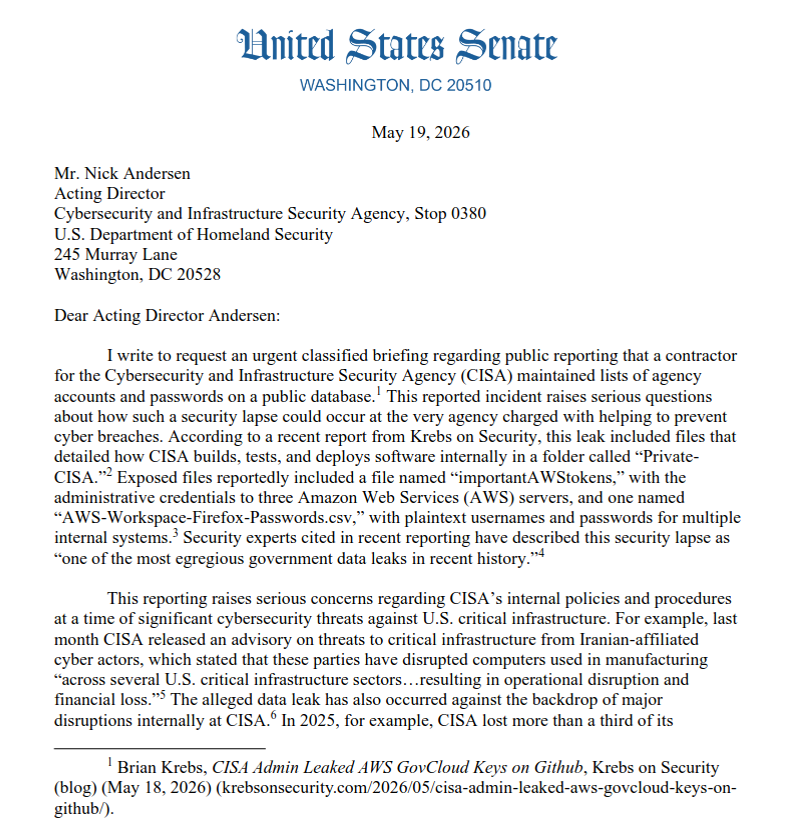
In a written statement, CISA said “there is no indication that any sensitive data was compromised as a result of the incident.” But in a May 19 a letter (PDF) to CISA’s Acting Director Nick Andersen, Sen. Maggie Hassan (D-NH) said the credential leak raises serious questions about how such a security lapse could occur at the very agency charged with helping to prevent cyber breaches.

“This reporting raises serious concerns regarding CISA’s internal policies and procedures at a time of significant cybersecurity threats against U.S. critical infrastructure,” Sen. Hassan wrote.

A May 19 letter from Sen. Margaret Hassan (D-NH) to the acting director of CISA demanded answers to a dozen questions about the breach.

Sen. Hassan noted that the incident occurred against the backdrop of major disruptions internally at CISA, which lost more than a third of it workforce and almost all of its senior leaders after the Trump administration forced a series of early retirements, buyouts, and resignations across the agency’s various divisions.

Rep. Bennie Thompson (D-MS), the ranking member on the House Homeland Security Committee, echoed the senator’s concerns.

“We are concerned that this incident reflects a diminished security culture and/or an inability for CISA to adequately manage its contract support,” Thompson wrote in a May 19 letter to the acting CISA chief that was co-signed by Rep. Delia Ramirez (D-Ill), the ranking member of the panel’s Subcommittee on Cybersecurity and Infrastructure Protection. “It’s no secret that our adversaries — like China, Russia, and Iran — seek to gain access to and persistence on federal networks. The files contained in the ‘Private-CISA’ repository provided the information, access, and roadmap to do just that.”

KrebsOnSecurity has learned that more a week after CISA was first notified of the data leak by the security firm GitGuardian, the agency is still working to invalidate and replace many of the exposed keys and secrets.

On May 20, KrebsOnSecurity heard from Dylan Ayrey, the creator of TruffleHog, an open-source tool for discovering private keys and other secrets buried in code hosted at GitHub and other public platforms. Ayrey said CISA still hadn’t invalidated an RSA private key exposed in the Private-CISA repo that granted access to a GitHub app which is owned by the CISA enterprise account and installed on the CISA-IT GitHub organization with full access to all code repositories.

“An attacker with this key can read source code from every repository in the CISA-IT organization, including private repos, register rogue self-hosted runners to hijack CI/CD pipelines and access repository secrets, and modify repository admin settings including branch protection rules, webhooks, and deploy keys,” Ayrey told KrebsOnSecurity. CI/CD stands for Continuous Integration and Continuous Delivery, and it refers to a set of practices used to automate the building, testing and deployment of software.

KrebsOnSecurity notified CISA about Ayrey’s findings on May 20. Ayrey said CISA appears to have invalidated the exposed RSA private key sometime after that notification. But he noted that CISA still hasn’t rotated leaked credentials tied to other critical security technologies that are deployed across the agency’s technology portfolio (KrebsOnSecurity is not naming those technologies publicly for the time being).

CISA responded with a brief written statement in response to questions about Ayrey’s findings, saying “CISA is actively responding and coordinating with the appropriate parties and vendors to ensure any identified leaked credentials are rotated and rendered invalid and will continue to take appropriate steps to protect the security of our systems.”

Ayrey said his company Truffle Security monitors GitHub and a number of other code platforms for exposed keys, and attempts to alert affected accounts to the sensitive data exposure(s). They can do this easily on GitHub because the platform publishes a live feed which includes a record of all commits and changes to public code repositories. But he said cybercriminal actors also monitor these public feeds, and are often quick to pounce on API or SSH keys that get inadvertently published in code commits.

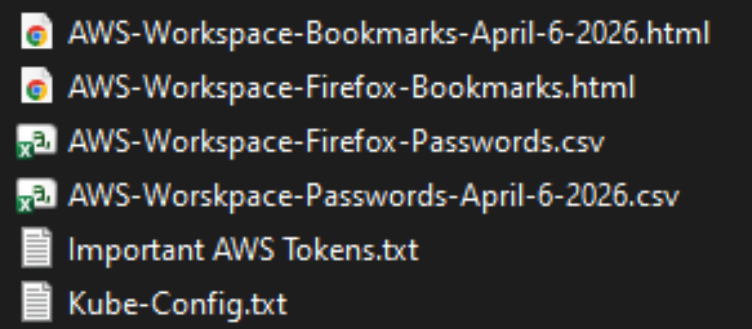
The Private CISA GitHub repo exposed dozens of plaintext credentials to important CISA GovCloud resources. The filenames include AWS-Workspace-Bookmarks-April-6-2026.html, AWS-Workspace-Firefox-Passwords.csv, Important AWS Tokens.txt, kube-config.txt, etc.

The Private-CISA GitHub repo exposed dozens of plaintext credentials to important CISA GovCloud resources.

In practical terms, it is likely that cybercrime groups or foreign adversaries also noticed the publication of these CISA secrets, the most egregious of which appears to have happened in late April 2026, Ayrey said.

“We monitor that firehose of data for keys, and we have tools to try to figure out whose they are,” he said. “We have evidence attackers monitor that firehose as well. Anyone monitoring GitHub events could be sitting on this information.”

James Wilson, the enterprise technology editor for the Risky Business security podcast, said organizations using GitHub to manage code projects can set top-down policies that prevent employees from disabling GitHub’s protections against publishing secret keys and credentials. But Wilson’s co-host Adam Boileau said it’s not clear that any technology could stop employees from opening their own personal GitHub account and using it to store sensitive and proprietary information.

“Ultimately, this is a thing you can’t solve with a technical control,” Boileau said on this week’s podcast. “This is a human problem where you’ve hired a contractor to do this work and they have decided of their own volition to use GitHub to synchronize content from a work machine to a home machine. I don’t know what technical controls you could put in place given that this is being done presumably outside of anything CISA managed or even had visibility on.”

Update, 3:05 p.m. ET: Added statement from CISA. Corrected a date in the story (Truffle Security said it found the repo gained some of its most sensitive secrets in late April 2026, not 2025).

Attackers hit vulnerabilities hard last year, making exploits the top entry point for breaches

Attackers couldn’t get enough of the vulnerabilities at their disposal last year, making exploits the top initial access vector across more than 22,000 breaches Verizon analyzed in its latest Data Breach Investigations Report released Tuesday.

The massive annual study uncovered a surge of exploited vulnerabilities during a one-year period ending in October 2025. Exploited defects accounted for 31% of all known initial access vectors, jumping from 20% the previous year. 

The uptick in exploited vulnerabilities is a reflection of the “sisyphean cause” of vulnerability management, researchers wrote in the report. “Put quite simply, there are often too many vulnerabilities and not enough time for patching all of them.”

Organizations are struggling to keep up with the torrent of vulnerabilities affecting technology across their systems. This slide is especially worrisome, and declining, among defects in the Cybersecurity and Infrastructure Security Agency’s known exploited vulnerabilities catalog.

Only 26% of the critical vulnerabilities in CISA’s catalog were fully remediated by more than 13,000 organizations Verizon studied in 2025, marking a drop from 38% the year prior. 

“There is also a worse result for the median time elapsed for a vulnerability to be fully patched by detection,” researchers wrote in the report. “Our new median time is 43 days, almost two weeks longer than last year’s 32 days.”

Verizon also noted that the median number of KEV vulnerabilities that organizations had to patch jumped from 11 in 2024 to 16 in 2025.

CISA’s KEV catalog contained more than 1,500 CVEs as of February, and 65% of those were exploited during the previous year, according to the report.

Verizon identified the five most common weaknesses of CISA KEV CVEs in its report as out-of-bounds read, heap-based buffer overflow, use after free, external control of file name or path and access of resource using incompatible type.

Attacker motivations remained relatively consistent last year, with financially-motivated cybercriminals accounting for 88% of all breaches. Espionage-driven attacks from state-affiliated groups made up the remainder.

“Ransomware continues to be among the most disruptive and impactful types of breaches we see. Not unlike the price of everything from fast food to adult beverages in ballparks, it continues to trend upward,” researchers wrote in the report.

Ransomware accounted for 48% of all breaches last year, up from 44% in 2024. Yet, Verizon observed some positive trends in ransomware as well.

Ransom payments continued to decline, with 69% of victims reporting they didn’t pay, and the median payment slid from $150,000 in 2024 to almost $140,000 last year.

Tracking ransomware remains a challenge for researchers and authorities. 

“There is a growing disconnect between what is being reported and the reality of what has occurred, in no small part due to threat actors reusing old breaches, reposting breaches from other criminal partners and making up breaches out of whole cloth to help increase their notoriety in the criminal world,” Verizon wrote in the report. “We’re beginning to think that these cybercriminals might not be entirely trustworthy.”

Yet, despite the lack of indisputable data on ransomware activity, researchers concluded: “Ransomware is still the yoga pants of cybersecurity — ubiquitous, stubbornly popular and appearing in unexpected places near you.”

The post Attackers hit vulnerabilities hard last year, making exploits the top entry point for breaches appeared first on CyberScoop.

Cisco zero-day under ongoing attack by persistent threat group

Attackers returned once again to a common target with a massive user base by exploiting a max-severity zero-day vulnerability affecting Cisco Catalyst SD-WAN Controller and Manager.

The threat group behind the “limited” number of attacks Cisco is aware of thus far are also linked to a series of previously disclosed vulnerabilities in the vendor’s firewalls and SD-WAN systems, the company said in a threat advisory Thursday.

The authentication bypass vulnerability — CVE-2026-20182 — has a CVSS rating of 10 and “behaves like a master key,” Douglas McKee, director of vulnerability intelligence at Rapid7, wrote in a blog post. 

“An attacker can present themselves to the controller as a trusted network router and, if the system accepts that claim without properly validating it, they can obtain the highest level of administrative access,” he added. “That is the cybersecurity version of a Jedi mind trick.”

Rapid7 discovered and reported the vulnerability to Cisco on March 9, and Cisco said it became aware of limited exploitation of the vulnerability earlier this month. The vendor disclosed and released a patch for the vulnerability Thursday, and the Cybersecurity and Infrastructure Security Agency quickly added the defect to its known exploited vulnerabilities catalog.

Cisco did not explain what occurred during that two-month window. Yet, the disclosure and warning from researchers marks another challenge for Cisco customers that have confronted a flood of actively exploited vulnerabilities affecting the vendor’s network edge software since late February. 

Cisco isn’t the only security vendor facing an onslaught of attacks on its customers, but it is among the most heavily targeted. CISA has added seven vulnerabilities affecting Cisco SD-WANs and firewalls to its known exploited vulnerabilities catalog in less than three months.

Cisco Talos researchers attributed the latest round of zero-day attacks to UAT-8616, the same attackers that exploited a pair of separate zero-days in Cisco’s network edge software for at least three years before the activity was discovered and reported in February. 

The company, which described the exploitation of the new zero-day as ongoing, once again declined to answer questions about the origins or motivations of UAT-8616. 

“We strongly recommend customers apply the available fixed software releases and follow the guidance provided in the advisories and Cisco Talos blog,” a spokesperson for the company said in a statement.

Cisco Talos researchers also warned that UAT-8616 and at least 10 other threat groups have chained together and achieved “widespread in-the-wild active exploitation of three vulnerabilities in unpatched Cisco Catalyst SD-WAN Infrastructure.” The company previously disclosed and released patches for the vulnerabilities — including CVE-2026-20122, CVE-2026-20128 and CVE-2026-20133 — in February. 

Rapid7 said it discovered the latest critical authentication bypass vulnerability when it was researching CVE-2026-20127, a previous zero-day the Five Eyes identified and confirmed as actively exploited by UAT-8616 in late 2025. Authorities and Cisco waited at least two months to disclose and patch the vulnerability, and share emergency mitigation guidance.

That campaign, which got underway at least three years prior, marked the second series of actively exploited zero-days in Cisco edge technology in less than a year. Both campaigns prompted CISA to issue emergency directives months after the attacks were first detected, and both attack sprees were underway for at least a year before they were discovered. 

The latest zero-day, which bypasses authentication in the same control-plane service as CVE-2026-20127,  requires no credentials or prior knowledge of the target environment for exploitation, Jonah Burgess, senior security researcher at Rapid7, told CyberScoop.

“Cisco confirmed it affects all deployment types, including on-premises, cloud, and FedRAMP environments. The SD-WAN Controller manages routing and policy for the entire overlay network, so a single compromised controller can potentially give an attacker influence over every branch, data center, and cloud edge connected to that fabric,” Burgess added.

His colleague at Rapid7, McKee, said attackers have become very good at turning weaknesses in central network infrastructure into high-impact operations. 

“Compromising one branch router is useful. Compromising the controller that manages the entire estate is a very different conversation. Now you are talking about the ability to reroute traffic, intercept communications, push malicious configuration, or simply break connectivity across the whole organization,” he wrote.

“That is the real paradox here,” McKee added. “The same architecture that gives defenders scale and simplicity can also give attackers a single point of catastrophic leverage.”

The post Cisco zero-day under ongoing attack by persistent threat group appeared first on CyberScoop.

Instructure claims hackers returned stolen Canvas data after an extortion standoff

Instructure, the company behind Canvas, said it reached an agreement with the cybercriminals who threatened to leak a trove of sensitive data they claim was stolen during a prolonged cyberattack on the widely used education tech platform.

Pressure was mounting on the company as widespread outages left schools, students and teachers temporarily unable to access critical data late last week when the company took Canvas offline after the attackers defaced the platform’s login page. By Friday, the company said Canvas — a central hub for K-12 and university coursework, exams, grades and communication — was back online and fully operational. 

ShinyHunters, a decentralized crew of prolific cybercriminals that researchers affiliate with The Com, claimed responsibility for the attack on its data leak site and was attempting to extort the company for an unknown ransom amount. 

Instructure didn’t outright say it paid a ransom, but insisted the agreement provided all necessary assurances. “The data was returned to us. We received digital confirmation of data destruction (shred logs),” the company said in an update Monday.

“We have been informed that no Instructure customers will be extorted as a result of this incident, publicly or otherwise,” the company added. “This agreement covers all impacted Instructure customers, and there is no need for individual customers to attempt to engage with the unauthorized actor.”

The threat group initially set a deadline of May 6 — four days after Instructure previously said the incident was contained — claiming it stole 3.65 terabytes of data spanning 275 million records across 8,809 school systems. 

When that deadline passed without payment, ShinyHunters escalated its pressure on the company by “injecting an extortion message directly into the Canvas login pages of roughly 330 institutions, and pivoted to school-by-school extortion with a current deadline of May 12,” Cynthia Kaiser, senior vice president of Halcyon’s Ransomware Research Center, told CyberScoop.

The additional public pressure prompted Infrastructure to take Canvas offline, disrupting schoolwork and access to critical systems nationwide. 

Instructure CEO Steve Daly apologized over the weekend for the company’s inconsistent communication and deficient public response to the cyberattack. 

“Over the past few days, many of you dealt with real disruption. Stress on your teams. Missed moments in the classroom. Questions you couldn’t get answered. You deserved more consistent communication from us, and we didn’t deliver it. I’m sorry for that,” he said in a statement.

Daly acknowledged that the attack, which remains under investigation aided by CrowdStrike, exposed usernames, email addresses, course names, enrollment information and messages. He insisted that course content, submissions and credentials were not compromised.

The temporary but widespread disruption has spurred broad concern across the education sector as ransomware experts and threat hunters continue to track developments. The cyberattack also caught the attention of lawmakers on Capitol Hill. 

The House Homeland Security Committee on Monday published a letter to Daly seeking a briefing with him or a senior leader at Instructure by May 21. 

“The recurrence of an intrusion within days of an initial breach disclosure, and Instructure’s apparent failure to fully remediate the underlying vulnerabilities during that window, raise serious questions about the company’s incident response capabilities and its obligations to the institutions and individuals whose data it holds,” House Homeland Security Chairman Andrew Garbarino, R-N.Y., wrote in the letter to Daly.

The committee wants to learn more about the “circumstances of both intrusions, the the nature and volume of data accessed, the steps Instructure has taken and is taking to contain the threat and notify affected institutions, and the adequacy of the company’s coordination with federal law enforcement and the Cybersecurity and Infrastructure Security Agency,” he added. 

CISA did not describe the extent of its involvement in Instructure’s response. “CISA is aware of a potential cyber incident affecting Canvas. As the nation’s cyber defense agency, we provide voluntary support and cybersecurity services to organizations in responding to and recovering from incidents,” Chris Butera, the agency’s acting executive assistant director for cybersecurity, said in a statement.

Instructure’s timeline of the attack has changed and remains incomplete. The company said it first detected unauthorized activity in Canvas on April 29 and immediately revoked the attacker’s access and initiated an incident response. Researchers not directly involved with the formal investigation said ShinyHunters gained access to Canvas at least a few days earlier.

The follow-on malicious activity on May 7 — the defacement of public login pages — was tied to the same incident, the company said. 

“We have since confirmed that the unauthorized actor carried out this activity by exploiting an issue related to our Free-For-Teacher accounts. This is the same issue that led to the unauthorized access the prior week. As a result, we have made the difficult decision to temporarily shut down Free-For-Teacher accounts,” the company said in an updated post about the incident.

Instructure did not answer questions about the vulnerability or explain how attackers intruded its systems. The company said it also revoked privileged credentials and access tokens for affected systems, rotated internal keys, restricted token creation pathways, and deployed additional security controls and monitoring.

Canvas is fully operational and safe to use, the company said, adding that CrowdStrike has reviewed known indicators of compromise and “found no evidence that the threat actor currently has access to the platform.”

Access still remains spotty and unavailable for some Canvas users as school districts restore the platform in phases after conducting their own internal checks.

Halcyon published an alert about the attack Friday, including a screenshot of the message that some school staff, guardians and students encountered before Instructure took the learning management system offline.

ShinyHunters is a notorious data theft extortion group that previously hit major cloud platforms, including Salesforce and Snowflake, via voice phishing, credential theft and supply-chain attacks. 

Education is a recurring and consistent target for cybercriminals, accounting for more than 250 ransomware attacks globally last year, according to Halcyon. 

Yet, the scope of the attack on Canvas “makes this one of the largest single education-sector exposures we’ve tracked,” Kaiser said.

“By compromising a shared platform used across thousands of schools, ShinyHunters hit the entire education sector in one move, which is the same playbook Clop ran against Oracle EBS customers last fall,” she added. “Among 2026 incidents against critical infrastructure, this is at or near the top for education-sector impact, and it highlights a trend of third-party software vendors now being part of an attack surface, and causing cascading effects across an entire sector.”

Cybersecurity professionals focused on ransomware and data theft extortion consistently encourage victims to not pay ransoms, but they also often acknowledge that companies have to make tough decisions based on their own interests and the security of their customers or users caught up in the aftermath.

Allison Nixon, chief research officer at Unit 221B, said the threat group claiming responsibility for the attack should not be trusted. 

“They are claiming they will delete the data after they are paid, and if they are not paid that they will leak the data,” she told CyberScoop. “This is in line with the past data extortion scams run by the same and related Com actors, who have made false statements to victims and to the public in the past.”

Instructure acknowledged that its agreement with the attackers isn’t ironclad. “While there is never complete certainty when dealing with cybercriminals, we believe it was important to take every step within our control to give customers additional peace of mind, to the extent possible,” the company said.

Daly — a longtime security executive who was previously CEO at Ivanti — ended his mea culpa with a pledge to improve communications and provide a summary of a forensics report soon.

“Last week, we made a call to get the facts right before speaking publicly. That instinct isn’t wrong, but we got the balance wrong. We focused on fact-finding and went quiet when you needed consistent updates. You’ve been clear about that, and it’s fair feedback. We will change that moving forward,” he said. 

“Rebuilding trust takes time,” Daly added. “We’re going to earn it back through consistent action and honest communication.”

Update: May 12, 11:00 am: This story has been updated to reflect that Instructure announced they have reached a deal with ShinyHunters.

The post Instructure claims hackers returned stolen Canvas data after an extortion standoff appeared first on CyberScoop.

A critical Palo Alto PAN-OS zero-day is being exploited in the wild

Attackers are actively exploiting a zero-day vulnerability affecting some Palo Alto Networks’ customers’ firewalls, the security vendor said in an advisory Tuesday.

The critical memory corruption vulnerability — CVE-2026-0300 — affects the authentication portal of PAN-OS, and allows unauthenticated attackers to run  code with root privileges on the vendor’s PA-Series and VM-Series firewalls, the company said.

Palo Alto Networks did not say when or how it became aware of active exploitation, nor when the earliest known exploitation occurred. The Cybersecurity and Infrastructure Security Agency added the defect to its known exploited vulnerabilities catalog Wednesday.

The company hasn’t released a patch for the vulnerability or described the scope and objective of confirmed attacks.

“This vulnerability is specific to a limited number of customers with their User-ID Authentication Portal (Captive Portal) exposed to the public internet or untrusted IP addresses. We have observed limited exploitation of this issue and are working to release software fixes, with the first updates expected to be available on May 13,” a Palo Alto Networks spokesperson told CyberScoop.

The company said firewalls exposed to the buffer-overflow vulnerability, which has a CVSS rating of 9.3, are broadly exposed in real-world deployments, and it described the attack complexity as low.

Shadowserver scans found more than 5,800 publicly exposed VM-Series firewalls running PAN-OS as of Tuesday, yet it’s unknown how many of those instances have restricted authentication access to trusted internal IP addresses or disabled the feature altogether.

“We have provided clear mitigation guidance to our customers to secure their environments immediately. This issue does not impact Cloud NGFW or Panorama appliances. We remain committed to a transparent, security-first approach to protect our global customer base,” Palo Alto Networks’ spokesperson added.

Benjamin Harris, CEO and founder of watchTowr, noted that Palo Alto Networks proactively alerted customers to the zero-day, a step that allowed defenders to take action on potentially exposed instances. 

“In a bad situation, that is the best they can do immediately. However, that also alerts everyone to the existence of a vulnerability,” he told CyberScoop.

Despite the risk, Harris said watchTowr expects attacks linked to the zero-day exploit to be “very limited.” 

Palo Alto Networks and its impacted customers remain the only parties to have observed exploitation in the wild, but researchers warn that will likely change soon. 

“It’s likely rules will also start to fire in third-party organizations and honeypots shortly,” Caitlin Condon, vice president of security research at VulnCheck, told CyberScoop. 

“Management interfaces, login pages, and authentication portals have been common adversary targets for both opportunistic and targeted campaigns in recent years,” she added. “With researcher and community eyes on the vulnerability, it’s likely that we’ll see public exploits and broader exploitation quickly, provided the issue isn’t prohibitively difficult to exploit.”

Palo Alto Networks has yet to attribute the attacks to any known threat group, publish indicators or compromise, nor disclose the type of organizations that have been targeted and impacted. 

Researchers are hunting for malicious activity and advise customers to apply patches upon release.

The post A critical Palo Alto PAN-OS zero-day is being exploited in the wild appeared first on CyberScoop.

CISA wants critical infrastructure to operate ‘weeks to months’ in isolation during conflict

The Cybersecurity and Infrastructure Security Agency is urging critical infrastructure owners and operators to plan for delivering essential services under emergency conditions – potentially for months at a time.

The federal government’s top cybersecurity agency warned that state-sponsored hackers, particularly two Chinese groups known as Salt Typhoon and Volt Typhoon, continue to threaten critical sectors like electricity, water, and internet. 

The agency is now working with the private sector to protect operational technology – the systems that control the heavy machinery and equipment that powers most critical infrastructure – from attacks that enter through business IT systems or third-party vendor products.

The initiative  — known as CI Fortify – will include CISA conducting targeted technical assessments of critical infrastructure entities and aims to create plans that “allow for safe operations for weeks to months while isolated” from IT networks and third-party tools, according to the agency’s website.

Nick Andersen, CISA’s acting director, told reporters that the goal is “service delivery [that] can still reach critical infrastructure after the asset owner has disconnected with IT and OT, disconnected from third party vendors and service provider connections and disconnected from third party telecommunications equipment.”

Over the past two years, wars in Ukraine, Gaza, Iran and elsewhere have seen water plants, power substations, data centers and other critical infrastructure targeted by kinetic or cyberattacks.

Andersen said the agency has already begun engaging with some companies to pilot the assessments and expects that work to ramp up considerably as CISA hires additional staff in the coming months.

He declined to name the entities involved in the pilot program, but said they will focus on organizations that support national security, defense, public health and safety and economic continuity. He added that CISA’s assessments will vary from sector to sector depending on their unique needs.

“Water isn’t necessarily designed to prioritize specific customer needs outside of recovery periods, while energy and transportation have more immediate tradeoffs for selecting one load or one set of cargo over another,” Andersen said as an example.

One pillar of CISA’s strategy is isolation: essentially turning off all third-party and business network connections to an OT network when facing an emergency or unknown vulnerability.

Organizations also need to develop an internal plan for what acceptable service levels look like under those conditions and reach understandings with their critical customers, like U.S. military installations and lifeline services.

The second pillar, recovery, involves best practices for organizations: backing up files, documenting systems and having manual backups for operations when normal computer systems are down.

In conversations with cybersecurity specialists who focus on critical infrastructure and operational technology, it is widely assumed that China is not the only nation to have broadly compromised Americans critical infrastructure. That hacking groups tied to other nations have almost surely noticed and exploited the same basic vulnerabilities and hygiene issues found by the Typhoons.

Agencies like the FBI and Federal Communications Commission have touted efforts to purge Chinese hackers and work voluntarily with telecoms to harden their network security. But U.S. national security officials and cybersecurity defenders have consistently said both Salt Typhoon and Volt Typhoon remain active threats to U.S. critical infrastructure.

The post CISA wants critical infrastructure to operate ‘weeks to months’ in isolation during conflict appeared first on CyberScoop.

Chinese national extradited to US for pandemic-era Silk Typhoon attacks

A Chinese national allegedly involved in a massive, pandemic-era attack spree that compromised nearly 13,000 U.S. organizations was extradited from Italy to the United States and formally charged in federal court, the Justice Department said Monday.

Xu Zewei and his co-conspirators are accused of exploiting a string of zero-day vulnerabilities in Microsoft Exchange Server to steal research on COVID-19 vaccines, treatment and testing during the initial wave and subsequent height of the pandemic.

His alleged crimes, directed by China’s intelligence services, were part of a broader espionage campaign known as HAFNIUM, which targeted infectious disease experts, law firms, universities, defense contractors and policy think tanks, according to an indictment filed against Xu and Zhang Yu, who remains at large. 

The China state-sponsored threat group behind those attacks against Microsoft customers, and many other vendors’ customers since, is now more widely known as Silk Typhoon.

“Xu will now answer for his alleged role in HAFNIUM, a group responsible for a vast intrusion campaign directed by China’s Ministry of State Security that compromised more than 12,700 U.S. organizations,” Brett Leatherman, assistant director of the FBI’s Cyber Division, said in a statement.

“He is one of many contractors the Chinese government uses to obscure its hand in cyber operations, and others who do the same face the same risk,” he added.

Xu allegedly committed the attacks while working for Shanghai Powerock Network, one of many companies that conducted attacks for China’s various intelligence services, according to court records.

Italian authorities arrested Xu at the United States’ request in Milan in July. His capture underscores a window of opportunity U.S. officials and allies can take when nation-state attackers travel to countries that cooperate with the United States.

Italy extradited Xu to the United States Saturday but didn’t release his extradition orders until Monday, Simona Candido, his attorney in Italy, told CyberScoop.

Officials said Monday marked Xu’s first appearance in the U.S. District Court for the Southern District of Texas. He is currently being held at a federal prison in Houston.

“We have pursued this moment across years and continents, and the message this office sends today is the same one we sent when we first unsealed this indictment: we will work to protect the American people,” John G.E. Marck, acting U.S. attorney for the Southern District of Texas, said in a statement.

Xu allegedly worked under the direction of China’s Ministry of State Security’s Shanghai State Security Bureau to break into U.S. organizations’ networks, steal data and implant webshells for persistent remote access. Officials also accuse Xu of stealing information regarding U.S. policymakers and government agencies from a global law firm with offices in Washington. 

Microsoft first warned customers about the HAFNIUM campaign in March 2021. The FBI and Cybersecurity and Infrastructure Security Agency followed soon after with a joint advisory about the widespread compromise of Microsoft Exchange Server. 

“Today’s law enforcement action demonstrates the real-world consequences of this state-led activity, which is fueled by a vast network of private companies operating under the direction of the Chinese government,” Aaron Shraberg, senior team lead of global intelligence at Flashpoint, told CyberScoop.

“Extraditing these individuals from countries in coordination with international law enforcement demonstrates a united stance on these actions, and the importance of bringing real-world consequences to China’s notorious targeting of not just the American people and their businesses, but individuals globally as well,” Shraberg added.

Xu is charged with conspiracy to commit wire fraud; two counts of wire fraud; conspiracy to cause damage to and obtain information by unauthorized access to protected computers, to commit wire fraud, and to commit identity theft; two counts of obtaining information by unauthorized access to protected computers; two counts of intentional damage to a protected computer; and aggravated identity theft. 

The 34-year-old faces up to 62 years in prison for his alleged crimes.

The post Chinese national extradited to US for pandemic-era Silk Typhoon attacks appeared first on CyberScoop.

Secretary Mullin must help finish the job: Urge the Senate to confirm Plankey

On March 23, the Senate confirmed Senator Markwayne Mullin as the next homeland security secretary, marking an important step in strengthening leadership during a critical moment for our nation’s security.

But only half of the job is done.

The Cybersecurity and Infrastructure Security Agency (CISA), the federal government’s main civilian cyber defense agency, still lacks a Senate-confirmed director. As global cyber threats escalate,  this prolonged leadership gap poses a growing national security risk.

As Executive Director of the National Technology Security Coalition (NTSC), I represent Chief Information Security Officers who are responsible for protecting the systems that sustain America’s economy and critical infrastructure. In every sector, energy, healthcare, financial services, manufacturing, and transportation, there is a common concern: the threat landscape is growing more aggressive, and our defenses must stay ahead.

Our enemies are not waiting.

Since the start of the conflict with Iran, cybersecurity experts have reported increased malicious cyber activity targeting U.S. and allied systems. Iran-linked actors have shown their ability to disrupt operations and exploit vulnerabilities. Meanwhile, China continues its long-term effort to infiltrate American networks and position itself for possible disruption of critical infrastructure. Russia and its affiliated groups remain persistent, probing Western systems for weaknesses and exerting constant pressure.

This is the reality of modern conflict. Cyber operations have emerged as a primary domain of competition. In some cases, they can rival the effects of traditional military action, disrupting economies, communications, and public safety through code alone. 

Leadership is important in this environment.

CISA plays a key role in coordinating federal cyber defense, sharing threat intelligence with the private sector, and supporting state and local governments. It serves as the link between government and industry in protecting the nation’s digital infrastructure. Without a Senate-confirmed director, the agency’s ability to set priorities, coordinate efforts, and respond quickly is limited.

That challenge is growing more urgent. The President’s fiscal year 2027 budget plan proposes significant cuts to CISA’s funding. At a time when the agency faces increasing operational pressure, fewer resources make strong, steady leadership even more crucial.

This is the moment when Secretary Mullin’s leadership is critical.

As a former member of the Senate, Secretary Mullin understands the institution, its dynamics, and how to build consensus. He is uniquely positioned to connect with past colleagues and help advance Sean Plankey’s nomination as Director of CISA.

Plankey is highly qualified and widely respected in the cybersecurity community. His experience in the U.S. Coast Guard, at the Department of Energy securing the nation’s energy infrastructure, and in the private sector provides him with a clear understanding of both the threat landscape and the importance of public-private collaboration. At a time when coordination between government and industry is vital, these qualities are essential.

The Senate has already signaled that it takes cyberthreats seriously. It recently confirmed Lt. Gen. Joshua Rudd to lead U.S. Cyber Command and serve as director of the National Security Agency, ensuring strong leadership of America’s military cyber defense team.

Now it needs to do the same on the civilian side.

Confirming Plankey matters because the country’s main civilian cyber defense agency needs established leadership to combat adversaries who are already inside our networks, probing our systems, and preparing for the next phase of conflict.

The leadership gap at CISA has gone on long enough.

Secretary Mullin must engage. The Senate needs to act. And Sean Plankey should be confirmed without further delay.

America’s cyber defenses depend on it.

Chris Sullivan is the executive director of the National Technology Security Coalition, a nonprofit, non-partisan organization that serves as an advocacy voice for chief information security officers across the nation.

The post Secretary Mullin must help finish the job: Urge the Senate to confirm Plankey appeared first on CyberScoop.

❌