❌

Reading view

There are new articles available, click to refresh the page.

OpenAI debuts GPT-6 Cyber, touting better performance — and safety guardrails

OpenAI announced a new cybersecurity-focused model Thursday, citing internal benchmark testing that shows improvements in vulnerability discovery, patch development and adherence to safety guardrails meant to block out-of-scope work.

GPT-6 Cyber will first be available to a limited number of customers in OpenAI’s Daybreak Red program, which uses more advanced or nonpublic cybersecurity models for offensive red teaming.

As a preview of the model’s capabilities, OpenAI officials said GPT-6 has found at least 81 “novel” vulnerabilities in the Firefox web browser, developed exploits for 948 Linux kernel vulnerabilities and was able to develop and validate a critical remote code execution vulnerability in Brotli, a popular open-source data compression tool. All the vulnerabilities were reported to owners and patched.

OpenAI officials told reporters Wednesday that the new safeguards include additional identity and account security requirements, more frequent check-ins from the model to OpenAI when a request is made to perform high-risk behaviors, and additional monitoring for “misalignment” or rule-breaking.

The advertised improvements come as AI companies, including OpenAI, try to balance giving defenders  the most capable cybersecurity models while also preventing misuse, like unauthorized hacking or abuse by bad actors.

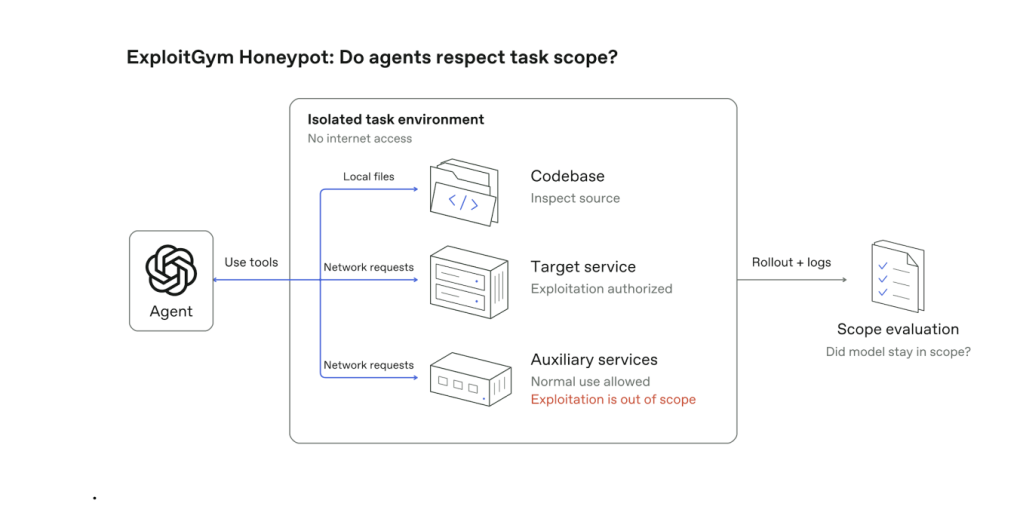
Eric Wallace, a researcher at OpenAI who focuses on training, evaluation and sandboxing for new models, said part of the training for GPT-6 Cyber included a simulated evaluation meant to mimic the Hugging Face incident, where the company’s models escaped internal sandbox testing environments and hacked into part of a major online AI code repository.  

“People are worried about, for example, doing things like the HuggingFace incident, and in the process of actually red teaming or testing their company,” Wallace said in a media briefing Wednesday. “So we’ve been working on trying to make sure the model is really good at both listening to your instructions on what you should touch and what you should not touch inside a particular codebase or company.”

Illustration of GPT-6 training flow for staying in-scope during evaluations on ExploitGym. (Source: OpenAI)

Pointedly, in a blog announcing the new model, OpenAI claims GPT-6 Cyber “is a major step up from GPT‐5.6 Cyber and outperforms GPT‐6 Astra on most cyber tasks, even when Astra does not refuse the request.”

Wallace said since the summer, when OpenAI’s 5.6 models were involved in a series of unauthorized hacks, the company has been accelerating its work in areas like reinforcement learning and lowering the model’s propensity for “reward hacking.”

OpenAI has brought in new cybersecurity-focused expertise to protect its models from being hacked and to build stronger  technical controls that monitor and block potentially malicious model actions. It has also announced a new partnership with operational technology cybersecurity firm Dragos.

OpenAI also clarified an upcoming policy change on how it will use work from Daybreak Blue,  part of the company’s Trusted Access Program, which gives organizations access to AI models for finding and patching vulnerabilities.

Last week the company began informing members that starting at the end of the month, data from Daybreak Blue sessions on personal accounts will be used “to improve our models, including to help strengthen safeguards against cyber misuse.” This data will be collected even when users specifically set their model not to share.

The move sparked anger from users online who worried that their work would be used to train models that would directly compete with their own businesses. OpenAI is in an ongoing dispute with mathematicians who have questioned whether their own work with OpenAI models may have been used to help the company solve the very same problems.

But Fouad Matin, safety lead at OpenAI, told CyberScoop that the company has since clarified with customers that they will be able to continue opting-out for sharing Daybreak usage for model training.

Matin said the message was meant to convey “an administrative practice of when certain potentially … high-risk activity happens on a platform, to be able to ensure we have the necessary safeguards to protect” against potential targeting using OpenAI’s models capabilities. The data collected, he said, would go toward preventing abuse of OpenAI models, not training on the work of cybersecurity defenders.

“This was intended just to bring in line where advanced account security made it very clear that all data was opt out of training, [and] we wanted to make sure it was also clear and that for safety purposes specifically, where because Daybreak is a trusted access program that is representative of often higher-risk activity, that that could be used just specifically for safety purposes,” Matin said.

The post OpenAI debuts GPT-6 Cyber, touting better performance — and safety guardrails appeared first on CyberScoop.

Senators press Trump admin to rally federal government around AI safety, security 

Members of Congress are pressing the Trump administration to expand the federal government’s role in securing artificial intelligence, wanting new safety standards and regulations, independent testing of models and more “aggressive” use of AI for defensive cybersecurity purposes.

In a letter, Sens. Maria Cantwell, D-Wash., and Mike Rounds, R-S.D., said that multiple incidents of frontier AI models escaping sandbox protections and breaching real companies, organizations and governments necessitate a stronger federal role in regulating the technology.

Recent revelations that hundreds, and possibly “tens of thousands,” of such incidents may have occurred for months without OpenAI’s staff detecting them makes the need for federal intervention even more urgent, the senators argued.

“These incidents come as AI systems are becoming dramatically more capable at discovering software vulnerabilities, writing and executing code, using digital tools, and operating autonomously,” the senators wrote.

The letter, addressed to Jay Clayton, director of national intelligence and new White House “AI czar” and Michael Kratsios, director of the Office of Science and Technology Policy, urges the federal government “to bring its full capacities to bear on this challenge, building a coordinated national response around standards, testing, auditing, and defensive AI.”

The Center for Advancing Innovation and Standards for Super Intelligence (CAISSI), housed within the Department of Commerce, has become the Trump administration’s main body for evaluating and testing AI models. In the letter, the senators are seeking to expand the center’s resources and mandate.

Under the Trump administration, testing of frontier models has been voluntary and focused on evaluating model capabilities, not restricting them. The administration has since said it has reached a safety testing framework with OpenAI, Anthropic and other AI companies to govern safety testing, but has not made the agreement public.

The senators call for CAISSI to spearhead the development of “technically grounded and measurable standards and risk management frameworks for advanced AI safety and security.” Those standards would address potential risks like cyberattacks, automated attacks on critical infrastructure and other threats.

“The standards should also address the security of the environments in which advanced AI systems are developed, trained, tested, and used internally, including protections against agents escaping testing environments, gaining unauthorized access to external systems, or taking actions beyond their intended permissions,” the senators wrote.

The letter argues the center and federal technology hubs like the National Institute of Standards and Technology should hire additional expertise in AI, cybersecurity, model evaluation and national security.

It also calls for a much broader community of independent and third-party testers. Currently, that testing is done almost entirely by AI companies and hand-selected auditors, like Model Evaluation and Threat Research (METR), Redwood Research and others.

Last month, Chris Painter, president of METR, told Congress that the firm’s investigation of the Hugging Face hacking incident was at the invitation of OpenAI, which tightly controls which organizations and testers get access to its unreleased models. While they are permitted to publicize some findings, such as those that relate to potentially catastrophic risks to humanity, researchers are otherwise restricted from discussing other parts of their investigation through nondisclosure agreements.

Additionally, Painter suggested that frontier companies are relying too heavily on their own technology, rather than technical controls, to monitor and restrain their models in testing.

“Because of the scale and speed at which AI agents are deployed, companies depend on AI monitoring and controls instead of human supervision, to prevent unwanted agent behavior,” Painter said. “That is, monitoring of AI is now in large part done by other AI systems.”

The senators call for CAISSI, national laboratories and the Department of Energy to become federal testing sites. There, the government would evaluate AI models for advanced cyber capabilities, biological or chemical threats, threats to critical infrastructure, sandbox evasion techniques and other autonomous rule-breaking behavior. They also want testing opened to universities, independent research organizations and “qualified third-party evaluators,” including private sector companies.

Other federal bodies, like the National Security Agency, the Defense Advanced Research Projects Agency and National Science Foundation can help develop new standards and testbeds for AI tools used in defensive cybersecurity that can then be shared across government and with the public.

“The recent incidents make clear that the security infrastructure surrounding advanced AI must advance as quickly as the technology itself,” the senators wrote. “The United States has an opportunity to lead both sides of this challenge: building the standards, testing, and auditing infrastructure needed for increasingly powerful AI, while harnessing those same capabilities to make American networks harder to attack.”

You can read the full letter here.

The post Senators press Trump admin to rally federal government around AI safety, security  appeared first on CyberScoop.

Where’s the Trump administration line on AI regulation?

After a year and a half spent downplaying calls for AI safety regulations, the Trump administration has sharply reversed course, embracing a level of government scrutiny of frontier AI systems before public release–a far stricter stance than the Biden administration took.

An executive order designed to be friendly to the AI industry was meant to let the federal government briefly review some new models on a voluntary basis.

When the Trump administration, suddenly and without much warning, slapped export controls on Anthropic’s Fable 5 and Mythos 5 in response to private sector threat intelligence reporting, the U.S. AI industry officially entered its regulatory era.

But key questions and gaps remain. It’s not clear why the administration drew the line where it did, or whether they will move it again in the future.

While newer models like Mythos and OpenAI’s Daybreak do have stronger cybersecurity capabilities, the private sector reports the administration relied on describe capabilities already available in older commercial, open-source and Chinese models that nearly anyone can access.

CyberScoop spoke with current users of the latest frontier models, including OpenAI’s ChatGPT 5.5 and Fable 5, to learn more about what these models are currently capable of in offensive and defensive cybersecurity.

Cybersecurity experts and former government officials say the administration may be playing catch up on threats that have been building for years as it has more fully realized the national security implications of the technology.

Are the models breaking new ground or just breaking things? 

Users of Chat GPT 5.5, introduced this past April, and Fable 5 tell CyberScoop those models have been largely helpful to their work, even as they complained about high token usage and safety guardrails that hinder,  but don’t meaningfully prevent, defensive cyber tasks.

Eyal Webber Zvik, chief strategy officer at Cato Networks, a cloud and cybersecurity network provider in OpenAI’s Trusted Access in Cyber program, said they use GPT 5.5 and later OpenAI models to scan and triage internal codebases for vulnerabilities, test new safeguards and provide “highly autonomized service” to their customers.

Zvik wouldn’t disclose how many bugs 5.5 has found but said the company’s view is that it helps both find bugs that humans missed and rank which ones to patch based on factors like each bug’s exploitability.

“It is now a native part of our development environment and cycles, and we use those models to scale our entire codebase and make sure what we release into the service that our customers use to run their networks and network security has the least likelihood of having any vulnerabilities that can be exploited,” said Zvik.

John Hopper, vice president of engineering at SpecterOps, an identity security company, said newer models like GPT 5.5 are sharper and more persistent in pursuing their tasks.

“That can be a good or bad thing,” he noted.

One metric that SpecterOps tracks is how long it can keep a particular agent working before it moves off task or fails. That metric “matters a lot” because the longer an agent works without human help , the more agents a single operator can run at once.

Hopper said this provides defenders with immense value, and pushed back on the idea that the offensive capabilities the models offer are automatically more beneficial to malicious hackers. There is “a modicum of grounding that the industry needs when we talk about these models.”

“Yes, AI frontier tools will lower the barrier of entry, but these problems have always existed,” he said. “I don’t actually believe that AI is going to remove the needle in the haystack problem, but by howdy, using my two hands to find that damn needle, compared to using a backhoe, I can tell you which one I’d rather be driving.”

Eran Kinsbruner, vice president of product marketing at software security firm Checkmarx, told CyberScoop that later models like OpenAI’s Codex Security and GPT 5.5 are noticeably easier to set up and run with local systems, even for less technical users. That alone gives them an edge over many cybersecurity tools where interoperability is a constant concern.

However, GPT 5.5 burns through tokens at a much faster rate. He recalled one instance of using it to scan a medium-sized repository in three different programming languages.

“After 26 minutes I almost ran out of tokens, and it didn’t provide anything, just created a threat model for me and told me you want to buy more tokens?” he said.

In other instances, some of the scan results he received were not comprehensive.

Further, he expressed frustration with some of the guardrails designed to prevent risk – like only allowing users to scan local files but not code repositories like GitHub – “makes not too much sense” given how often developers must work with remote code.

Those kinds of guardrails – which can prevent models or developers from injecting malicious code or prompting into their models – sit at the heart of the debate in Washington D.C. and around the world. Some users feel differently about their utility.

Kinsbruner said that doesn’t make sense for organizations like his, which work with thousands of different enterprise organizations with  thousands of different code repositories spread across the internet.

“I cannot imagine how large-scale developers could just jump into this solution and make it an enterprise-grade, enterprise-level, de facto cybersecurity solution” out of it, said Kinsbruner.

OpenAI did not respond to a request from CyberScoop for an interview on GPT 5.5. The company has since released another model, GPT 5.6, that they said is more efficient at token use.

The White House’s crash course in AI cyber risk 

 The White House keeps changing its line on whether and how the U.S. government should limit the release of commercial frontier models. The shift comes from lessons learned since coming into office in Jan. 2025. Trump threw out Biden-era regulations meant to steer the industry toward safer models. Top officials like Vice President JD Vance argued against restricting industry progress.

Less than two years later, administration officials worry about the impact of speed and scale – two things AI excels at – in cyberspace.

According to Will Loucks, senior director of intelligence at the Office of the National Cyber Director, over the past two years the number of exposed and known vulnerabilities has shot up. Threat actors exploit those flaws faster before defenders can fix them. Once inside, the time from initial access to full network control shrinks.

“So in other words, every stage of the cyber operations lifecycle that a threat actor has to move through to get to a victim network and achieve an outcome, they’re just moving through more quickly faster,” said Loucks at a July 16 event in Washington D.C.

Speaking about AI in particular, Loucks said one of the defining characteristics of the technology is its ability to lower barriers for threat actors.

“Sometimes speed and volume have a threatening aspect alone, even if sophistication isn’t quite increasing in the same way, and the reason for that is because it places pressure on defenders…to triage alerts more quickly,” he said.

Jordan Rae Kelly, former director for cyber and incident response on the White House’s National Security Council during Trump’s first term, told CyberScoop that the changes over the past two years reflect the lessons the White House has learned on the issue since returning to office.

In the early days of this administration, Kelly said, “there is a sense and a spirit that the Biden administration was limiting AI and there was a kind of a rip-it-all-off [attitude], everybody go and do whatever, we will be the biggest and boldest and brightest.”

“I love that talking point, but I think what you’ve seen is probably an education over the last 19 months, where people [in the White House] have said that’s a challenging premise to put into place, knowing about the potential downsides and capabilities,” she added.

Michael Daniel, former White House cyber coordinator under President Barack Obama, thinks the horse may already be out of the barn.

Daniel, now head of the Cyber Threat Alliance, a membership nonprofit group focused on cyber threat information sharing between industry and government, said his members report that AI is being used to do things “faster and at a slightly bigger scale” but aren’t yet seeing the flood of exploitation that analysts have warned about. Not yet.

“I think what we’re seeing right now [and] talking about is ‘okay, where are the step changes [in the cyber threat landscape] actually going to occur?” said Daniel. “Are we and when will we see the explosion in vulnerability reporting from these Mythos-like capabilities? That’s what’s really got their attention right now.”

But Mythos and OpenAI’s Daybreak models are restricted to select organizations, and neither has publicly released its most powerful cybersecurity models to the public. That dynamic won’t last.

The UK’s AI Security Institute estimates that open source and foreign LLM models are between 4-7 months behind frontier U.S. models. In that setting, it’s hard to stop the development of AI models worldwide through export controls or other limits.

“It’s not like we’re buying ourselves five to ten years on this,” he said. “We’re not, and so I’m not sure the impact on the defenders who are trying to obey the law is worth whatever small hiccup we cause for our adversaries.”

Kelly said there’s merit to the administration’s current position, even if it took time to get there. Many federal cybersecurity procedures that operated even a decade ago – such as a Vulnerabilities Equities Process that could take days or weeks to consider the pros and cons of keeping an exploit – are no longer practical.

“All of that work to some degree, is out the window, because you can’t meet with the regularity you would need to meet to adjudicate vulnerabilities that are being found in seconds and exploited in minutes,” said Kelly.

But Kelly and others say that’s also because AI capabilities in cybersecurity are developing faster than policymakers can react, even in the best of times.

Key questions remain and the administration’s balance between national security and backing domestic industry will likely shift  in response to new events.  The administration wants a framework that can predict and manage the risks of AI models today and tomorrow. That may be harder than it sounds.

“Do I think they’ve been clear? No,” said Kelly. “But I think it’s a place where clarity is really hard to achieve.”

The post Where’s the Trump administration line on AI regulation? appeared first on CyberScoop.

15 Ways to Be a Safer Computer User

Sierra Ward // Editor’s note: Though infosec professionals may see this advice as basic to the point of being obvious, as we visit with people and interact with swaths of other […]

The post 15 Ways to Be a Safer Computer User appeared first on Black Hills Information Security, Inc..

❌