Cybercriminals are infecting devices on a large scale with spyware, increasingly compromising systems belonging to average people, according to a new report.
The two expected incoming leaders of the Senate and House homeland security panels expressed reservations Tuesday about the Trump administration’s pick to lead the Cybersecurity and Infrastructure Security Agency because he currently works for the oft-controversial tech company Palantir.
The Trump administration on Monday announced its intent to nominate Michael LoSapio, chief information security officer for Palantir, to fill the long-vacant Senate-confirmed position of CISA director.
The Senate Homeland Security and Governmental Affairs Committee has authority over approving CISA director nominees. A spokesperson for its current chairman, Rand Paul, R-Ky., didn’t respond to a request for comment, but he won’t hold the gavel much longer with Sen. Maggie Hassan, D-N.H., in line to take over as chair in 2027.
Hassan and her counterpart on the House side, prospective Homeland Security Committee Chairman Bennie Thompson, D-Miss., both voiced concerns about Palantir’s work at the Department of Homeland Security and with its subagency, Immigration and Customs Enforcement.
“CISA plays a critical role in protecting our nation’s cybersecurity infrastructure, and the Trump-Vance administration has undermined CISA by cutting its funding, reducing agency staff, and making us vulnerable to cyberattacks from our adversaries,” Hassan said in a statement to CyberScoop. “I will carefully review Mr. LoSapio’s nomination to lead CISA, as I do with any nominee. But given his senior role at Palantir, which has provided tools that helped enable ICE’s lawless behavior under this administration, I have serious questions about whether he has the independence and judgement needed for this position.”
Thompson expressed apprehensions for similar reasons.
“CISA is at a critical juncture, rebuilding after a year of reckless efforts to hack up the agency. I don’t know much about Mr. LoSapio, but certainly his relationship with Palantir raises very serious concerns given its role in DHS surveillance programs,” he said in a statement to CyberScoop. “I’m concerned that baggage will be an unnecessary distraction from the urgent rebuilding efforts at CISA. I urge my Senate colleagues to thoroughly vet Mr. LoSapio before proceeding with his nomination.”
The current top Democrat on the Senate panel, the retiring Gary Peters of Michigan, also cited the threats CISA is facing amid cutbacks: “Mr. LoSapio must demonstrate that he possesses the independent judgment and qualifications to decisively place national security and the national interest above political pressure.”
The current chairman of the House panel, Andrew Garbarino, R-N.Y., said he appreciated Trump putting forward a nominee given the need for a Senate-confirmed director, something CISA has lacked for his second term, even as he praised the leadership of acting director Nick Andersen.
“I look forward to reviewing the qualifications of Michael LoSapio and urge the Senate to do so with urgency,” he said in a statement.
Unlike another of the top cybersecurity officials in the Trump administration prior to his nomination, National Cyber Director Sean Cairncross, LoSapio comes with technical credentials.
A former Trump administration official said that LoSapio’s name was first floated months ago, and said his cybersecurity certifications and experience managing cyber risk for a major public company would make him a good fit for the role.
A cybersecurity executive who knows and has worked with LoSapio said he was an “exceptional choice” for the job.
“Mike LoSapio is an extremely competent and talented cybersecurity leader. He knows his stuff,” the executive said. “He defends one of the most targeted organizations on the planet” because of Palantir’s sensitive government work.
CISA is primarily a technical agency, so “that work is best done by someone who knows how to do it,” the executive said. LoSapio is also a “high-integrity” person who isn’t “dogmatic or political” or “the kind of person that would be cowed by political pressure.”
But his role at Palantir is drawing criticism, something the executive said he understood given concerns about surveillance in the United States, even as the executive noted LoSapio has proven capable of navigating those “thorny issues.”
Patrick Eddington, a senior fellow at the libertarian Cato Institute think tank, acknowledged LoSapio’s technical background but said his lack of a government background and no public record of weighing in on the subject matter CISA works on adds up to a “thin resume.” More worrisome, he said, is that CISA is a Palantir customer.
“The nominee would come from the vendor whose software is already being bought, without competition, by the office he’d run,” Eddington said. “And the agency responsible for judging the security of federal civilian systems would be led by the former security chief of a vendor whose platforms now run across DHS. That’s where ethics rules would normally help, yet this administration has weakened them.”
Before confirming LoSapio, senators should find out what kind of Palantir stock or other holdings LoSapio has and whether he’ll divest it, whether he’ll recuse himself from Palantir matters for longer than the Trump administration would require, whether he has made bargains to return to Palantir after CISA service and other answers about potential conflicts of interest.
“Bottom line: Palantir’s business is fusing government data at scale, and DHS has made it the default analytics vendor across the department,” Eddington said. “Putting the company’s security chief in charge of the agency that sets the security bar for those systems, with a one-year recusal as the main safeguard, risks making CISA one vendor’s customer, regulator and alumni network all at once. Even if LoSapio is entirely well-intentioned, that’s the wrong setup.”
A Palantir spokesperson didn’t respond to requests for comment.
Even in optimal circumstances for a nominee, it can take some time to work through the Senate confirmation process and then begin shaping an agency as its leader, said Joshua Corman, a former CISA adviser and now executive in residence for public safety and resilience at the Institute for Security and Technology.
Andersen and his team, even amid budget cutbacks, “never gave up” on the agency, Corman said, and set important priorities for “the most life-safety of our critical functions.”
With two years left in Trump’s term, “it may be hard to have much of a dent, no matter who gets the nod, and as such, I really hope they lean on the current steward” in Andersen, Corman said.
Madison Alder contributed reporting to this story.
There’s mounting evidence of spyware attacks growing more indiscriminate, leading to more everyday citizens being hit as opposed to traditionally “high-value” targets.
The AdFection spyware attacks, which could infect anyone visiting a website that had advertising on it, represented the most recent revelation. And iVerify published a report Tuesday analyzing customer infections and threat notifications from Apple that contributes to the trend.
“Conventional guidance on spyware risk focused on people with a public profile, a sensitive job or a role that put them on a government’s radar,” the company said. “Some Apple Threat Notification cases iVerify saw this year don’t fit that pattern.”
“In Ottawa, Apple Threat Notifications reached the children of a city bus driver and a stay-at-home mom,” it continued. “In Australia, one went to a limousine driver. None of them had a public profile, a sensitive job or an obvious connection to anyone worth spying on. These cases matter because they show the threat reaching people who had no reason to expect it. For an enterprise, the employees most likely to be hit look much more like the limousine driver than like the CEO.”
Part of that is that when spyware attacks are less targeted, they might be more likely to hit those who aren’t as diligently focused on routine cyber hygiene, as opposed to CEOs who are probably regularly upgrading their defenses, iVerify told CyberScoop.
Rocky Cole, co-founder of the company, said the change reflects a shift in who’s using spyware.
“The vast majority of our detections were mass attacks by criminal groups looking to do purely criminal things,” Cole said. “For the purposes of stealing credentials and selling them on the black market, an executive credential is not necessarily more valuable than a system administrator or even an average employee.”
iVerify’s report looked at other trends as well. Among the findings:
iVerify didn’t see any devices that were infected by the DarkSword or Coruna iOS exploit kits where users received Apple threat notifications, suggesting that the tech giant might be overly focused on nation-state threats and well-known commercial mercenary spyware like NSO Group’s Pegasus.
The rate of spyware infections held relatively steady in 2026, at 1.07 infections per 1,000 iOS consumer scans.
“Three in four of this year’s detections were criminal adversaries stealing credentials and cryptocurrency, not state-sponsored actors,” the report said.
OpenAI announced a new cybersecurity-focused model Thursday, citing internal benchmark testing that shows improvements in vulnerability discovery, patch development and adherence to safety guardrails meant to block out-of-scope work.
GPT-6 Cyber will first be available to a limited number of customers in OpenAI’s Daybreak Red program, which uses more advanced or nonpublic cybersecurity models for offensive red teaming.
As a preview of the model’s capabilities, OpenAI officials said GPT-6 has found at least 81 “novel” vulnerabilities in the Firefox web browser, developed exploits for 948 Linux kernel vulnerabilities and was able to develop and validate a critical remote code execution vulnerability in Brotli, a popular open-source data compression tool. All the vulnerabilities were reported to owners and patched.
OpenAI officials told reporters Wednesday that the new safeguards include additional identity and account security requirements, more frequent check-ins from the model to OpenAI when a request is made to perform high-risk behaviors, and additional monitoring for “misalignment” or rule-breaking.
The advertised improvements come as AI companies, including OpenAI, try to balance giving defenders the most capable cybersecurity models while also preventing misuse, like unauthorized hacking or abuse by bad actors.
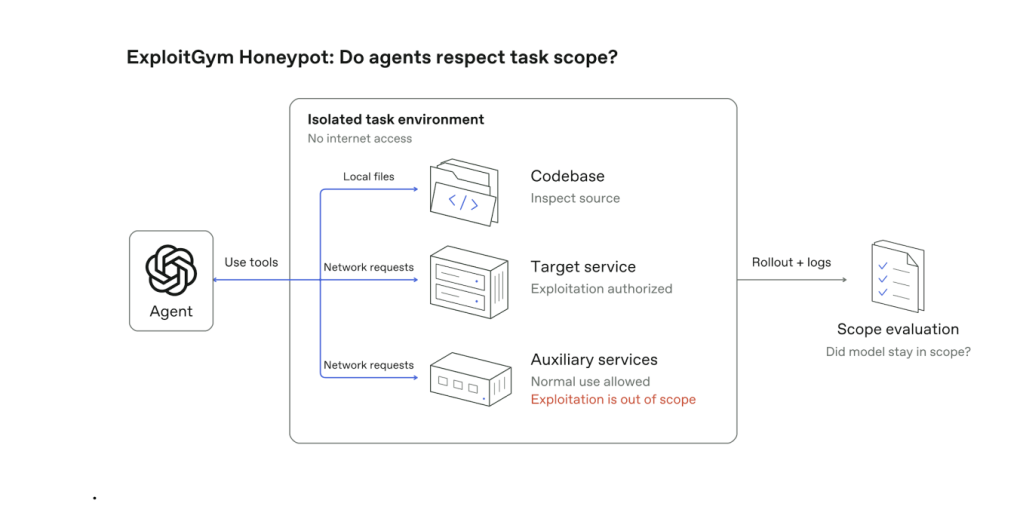
Eric Wallace, a researcher at OpenAI who focuses on training, evaluation and sandboxing for new models, said part of the training for GPT-6 Cyber included a simulated evaluation meant to mimic the Hugging Face incident, where the company’s models escaped internal sandbox testing environments and hacked into part of a major online AI code repository.
“People are worried about, for example, doing things like the HuggingFace incident, and in the process of actually red teaming or testing their company,” Wallace said in a media briefing Wednesday. “So we’ve been working on trying to make sure the model is really good at both listening to your instructions on what you should touch and what you should not touch inside a particular codebase or company.”
Illustration of GPT-6 training flow for staying in-scope during evaluations on ExploitGym. (Source: OpenAI)
Pointedly, in a blog announcing the new model, OpenAI claims GPT-6 Cyber “is a major step up from GPT‐5.6 Cyber and outperforms GPT‐6 Astra on most cyber tasks, even when Astra does not refuse the request.”
Wallace said since the summer, when OpenAI’s 5.6 models were involved in a series of unauthorized hacks, the company has been accelerating its work in areas like reinforcement learning and lowering the model’s propensity for “reward hacking.”
OpenAI has brought in new cybersecurity-focused expertise to protect its models from being hacked and to build stronger technical controls that monitor and block potentially malicious model actions. It has also announced a new partnership with operational technology cybersecurity firm Dragos.
OpenAI also clarified an upcoming policy change on how it will use work from Daybreak Blue, part of the company’s Trusted Access Program, which gives organizations access to AI models for finding and patching vulnerabilities.
Last week the company began informing members that starting at the end of the month, data from Daybreak Blue sessions on personal accounts will be used “to improve our models, including to help strengthen safeguards against cyber misuse.” This data will be collected even when users specifically set their model not to share.
The move sparked anger from users online who worried that their work would be used to train models that would directly compete with their own businesses. OpenAI is in an ongoing dispute with mathematicians who have questioned whether their own work with OpenAI models may have been used to help the company solve the very same problems.
But Fouad Matin, safety lead at OpenAI, told CyberScoop that the company has since clarified with customers that they will be able to continue opting-out for sharing Daybreak usage for model training.
Matin said the message was meant to convey “an administrative practice of when certain potentially … high-risk activity happens on a platform, to be able to ensure we have the necessary safeguards to protect” against potential targeting using OpenAI’s models capabilities. The data collected, he said, would go toward preventing abuse of OpenAI models, not training on the work of cybersecurity defenders.
“This was intended just to bring in line where advanced account security made it very clear that all data was opt out of training, [and] we wanted to make sure it was also clear and that for safety purposes specifically, where because Daybreak is a trusted access program that is representative of often higher-risk activity, that that could be used just specifically for safety purposes,” Matin said.
Joe_Dragon shares a report from TechCrunch: Applebee's has fixed a security flaw that allowed anyone to access the personal information of its registered customers, after a researcher found a password for an internal database inside Applebee's mobile app, TechCrunch has learned. The popular restaurant chain confirmed [last Thursday] that it had taken action to address the security issue to prevent any unauthorized access to its customer database. [...] The exposed database contained customer names, email addresses (including whether or not the customer verified their email), dates of birth, phone numbers, and ZIP codes. The data also included veteran status, the number of times customers had logged in, when their accounts were created, and the IP addresses of their most recent log-ins, which can be used to reveal the person's approximate location.
[...] When asked by TechCrunch, the spokesperson would not say if the company has server logs that it can review to determine whether anyone accessed the database, or if it has any logs at all. "Our investigation is ongoing, and we will take appropriate steps based on our findings," the company added. It's unclear how many customers were affected by the data exposure. [...] Applebee's had at least 8.5 million customers enrolled in its rewards program as of last year, though the company would not provide a number of how many customers had their personal information exposed by this security flaw.
"Police continue to blindly trust Flock cameras above and beyond the evidence in front of their own eyes," reports Jalopnik.com.
"After incorrectly connecting Rosalyn Crump's car to a shooting that had occurred the previous day, police had her car towed and impounded as evidence, reports Moneywise..."
According to WWBT 12 On Your Side, Richmond, Virginia, police didn't have a license plate number for the suspect's car, making it impossible to search Flock's records for that plate. Flock cameras collect more than just license plate information, so police searched for a make, model, color, and approximate model year. Based on this extremely vague description, police zeroed in on Crump's 2012 Hyundai Elantra. Around 2 a.m. they started looking through the windows with flashlights to see what was in plain sight, which isn't technically a "search" — at least, not one that would require a warrant... [Crump was asleep, but left her home to speak to the police officers to tell them they had the wrong car. But they didn't believe her.]
Other body cam footage shows an officer expressing doubt that Crump's car is the right one, since child seats and other items inside seem inconsistent with a shooting. Another officer replies, "Don't be surprised if they would have set that up like that." Instead of believing the evidence, or Crump, or interviewing witnesses who could have corroborated her story, police called Seibert's Towing to impound the car...
[Later] Police identified a similar-looking car that seemed to be actually connected to the shooting, and released Crump's Elantra. Nobody actually told Crump this until four days later. Seibert's told Moneywise that police didn't actually release the car until then. Either way, they didn't tell her that Seibert's had ripped the front bumper off during the towing process — leaving the car undrivable — until she arrived to pick it up. Seibert's took responsibility for causing the cosmetic damage, and was willing to cover the $2,212.30 bill to paint and replace the bumper cover, fog lights, and wheel liners. Then Crump asked for a full mechanical inspection, which revealed damaged tie rods and ball joints, jacking the bill beyond $6,000. Seibert's says it didn't cause this damage. Regardless of how it occurred, Seibert's insurer and Crump agree that her Hyundai is now a total loss due to the cost of the repairs it needs. It had been drivable, if mechanically worn, before police ordered it towed, damaging it for nothing more than a case of mistaken identity.
The president of Seibert's towing told Moneywise that while they'd originally offered $2,200 to repair the bumper damage, Crump must now negotiate with their insurance company. Crump has now resorted to a GoFundMe campaign to attempt to raise $17,100 for rental car expenses, a new car, and the expenses of moving to a different neighborhood. 130 donors have already contributed $7,431.
Reached for comment, the Richmond Police Department told local newscasters they "understand that Ms. Crump did not ask to become part of this investigation," and that they recognize the "frustration of having a vehicle towed and subsequently damaged." But they also said they were following a "credible" lead, which is their responsibility. The department "appreciates Ms. Crump's cooperation" (and "sincerely hopes the remaining concerns about her vehicle can be resolved.")
The city of Richmond has "already started backing away from Flock before Crump's story aired," reports Moneywise. "Mayor Danny Avula has decided not to renew Richmond's license plate reader deal with Flock, which ends June 30, 2027. As of September, the city had 99 Flock readers on its streets."
They note that the Institute for Justice, a public interest law firm in Arlington, Virginia, "has tallied at least 27 cases since 2018" of similar police errors. "In each case, a license plate reader mistake led police to stop, jail or point guns at drivers who'd done nothing wrong. More than half came in 2023 or later."
Inside Higher Ed reports:
In September, Emory University removed a dozen license plate-reading cameras from its campus in Atlanta and declined to renew its contract with Flock Safety, the company that sells and operates the automatic license plate readers and other mass-surveillance technology. For the coalition of Emory students and employees who had spent months pushing the university to "de-Flock," this was a victory... "We made it very clear that these cameras were unneeded surveillance considering we already have regular security cameras," [said Tony Torres, a sophomore biology major]...
Through campus protests, petitions, meetings and teach-ins during the spring and summer, DeFlock Emory broadcast their concerns about the devices: Opaque data-sharing agreements could leave undocumented students vulnerable, the cameras could be hacked, institutions could use them to retaliate against student protesters and they could make students who fear being surveilled less likely go to class, see their friends or seek medical attention when they need it.
Such concerns aren't unique to DeFlock Emory. College students across the country — including at Indiana University Bloomington, the University of Florida and the University of North Georgia — are mobilizing to de-Flock their campuses. And like Emory, other institutions are nixing their contracts. Cornell University announced last week it had not renewed its contract with Flock Safety and would be removing the cameras. Pennsylvania State University officials also announced earlier this month plans to end their contract with Flock.
An Emory spokesperson told Inside Higher Edthat eliminating Flock's cameras "retains institutional control over our safety infrastructure."
But the article also includes a quote from media/technology studies professor Torin Monahan at the University of North Carolina at Chapel Hill. He's spoken with campus police officers about how they're using Flock's cameras, and learned police departments have upgraded surveillance efforts in recent years. "They have an elaborate arsenal in place of high-tech surveillance equipment that really seems overpowered for what their day-to-day needs are, and also incredibly expensive."
Earlier The Drive reported a police chief "had to direct his staff to disconnect the power cords from Flock cameras in Plymouth, Minnesota after Flock Safety ignored and failed to respond to the department's notice the city was canceling its service.
"But in other instances Flock's gone and reinstalled cameras without permission," The Drive reported this week:
On September 29th the city of Dayton, Minnesota posted a community update on its Facebook page alerting residents that Flock had installed and put into service two cameras against the City's direction without authorization... "The City notified Flock on September 18, 2026, that the program was on hold, and no work orders were to be completed. Unfortunately, the City's direction was not followed, and the camera was placed back into service without authorization." The statement continued and noted, "Following the report, City staff reviewed locations throughout the community to determine whether any additional cameras had been reinstalled, and one additional location was identified. The Police Department has been notified, and both cameras will be removed promptly...."
The Minnesota cities of both St. Paul and Crystal told Kare 11 that they removed the Flock cameras themselves following their respective city council votes in August and September respectively. The cameras are stored and are still waiting to be picked up by Flock. Crystal Chief of Police Pete Underthun told Kare 11, "Once we made this decision, I personally went to the locations and removed the cameras and poles myself." Chief Underthun noted, "We are still working with the company to close out our contract and for them to pick the cameras up from our garage."
Meta's smart glasses face new questions from two U.S. Senators, reports Gizmodo.
Oregon Sen. Ron Wyden and Massachusetts Sen. Edward Markey "are requesting that Meta provide more information before Thanksgiving on whether it conducted detailed human rights due diligence and safety testing on the product before releasing it," reports Gizmodo. The Senators also requested information from Meta about " how it evaluated the privacy risks posed by the glasses, and what kinds of safeguards are currently in place."
"Although Meta identified risks to bystander privacy and vulnerable populations before launching its glasses in 2021, it nevertheless launched a product tailor-made for invading the privacy of its users and bystanders," [the senators wrote in a letter Thursday...] The glasses have also been spotted on ICE agents during raids, and have raised potential surveillance concerns. The surveillance fears were even reportedly raised by the New York Police Department's counterterrorism unit in a memo issued earlier this year....
"Meta's own disclosures confirm that imagery processed through its glasses' visual AI features may be retained and used to train AI systems, including with the assistance of human reviewers," the senators' letter states, calling the practice an invasion of privacy. "Retaining that material for AI development, thereby extending the period during which it can be accessed, disclosed, or misused, exploits people's highly sensitive information for Meta's commercial benefit."
Apple has sent new notifications of mercenary spyware infections to almost 100 countries, with recipients including journalists and documentary filmmakers.
“Today’s notification is being sent to targeted users in 99 countries, and to date we have notified users in over 150 countries in total,” the company said. “The extreme cost, sophistication, and worldwide nature of mercenary spyware attacks make them some of the most advanced digital threats in existence today. As a result, Apple does not attribute the attacks or the notice you’re receiving to any specific attackers or geographical regions.”
Apple didn’t immediately respond to a request for comment Friday about the countries targeted. Researchers and groups that work on spyware said the notifications were significant, however.
“This again promises to be an important set of notifications with a bunch of cases, based purely on what we see publicly,” said John Scott-Railton, senior researcher at The Citizen Lab at the University of Toronto. He also posted on social media about how potential victims could defend themselves, warning people to be cautious about companies that offer paid solutions to spyware infections.
He cautioned that the lack of notification doesn’t rule out an infection. The steps Apple recommends, which Scott-Railton seconded, were to enable Lockdown Mode and to get in touch with the digital rights group Access Now.
“The number of Apple threat notifications we are seeing from countries around the world indicates that the fight against the scourge of spyware abuse is far from over,” said Natalia Krapiva, senior tech-legal counsel with Access Now. “While we have increased our capacity to investigate spyware abuse, and companies like Apple have done a lot to notify and protect people from it, repressive states continue to use these powerful surveillance technologies, including against civil society actors and opposition figures.”
Apple sent its last major batch of notifications in August. The notifications frequently lead to victims approaching Access Now, The Citizen Lab and other groups seeking further assistance and prompting deeper investigations.
The notifications come shortly before the final rounds of negotiations over industry standards for commercial hacking tools being developed under the voluntary Pall Mall Process. The industry guidelines follow an earlier set of guidelines catered to governments.
“The states that will ultimately adopt these guidelines must come to terms that the current system is not working, and that the spyware industry must face some real consequences for the uncontrolled sale of these tools and refusal to curb the abuses,” Krapiva said.
The DOJ’s Executive Office for U.S. Trustees said a consumer privacy ombudsman is needed to advise the court on how to regulate what data from Character.AI can be sold and under what terms.
The state’s Department of Education (FLDOE) said on Thursday it became aware of a data breach involving the Florida Student Financial Aid website on October 19.
A company working on behalf of the Department of Homeland Security sought to cut off online access to information on more than 41,000 employees that hacktivists said they obtained from a database breached at DHS.
A search tool for the database, named Icepick, went offline for a spell before coming online again Thursday under a different registrar.
Icelandic hosting company FlokiNET said Thursday that it received a request from DHS contractor ZeroFox to remove the data, which it refused.
“By mid-morning, icepi.cx no longer resolved. Its registrar, CentralNic, had placed the domain on serverHold,” FlokiNET said in a blog post. “Our refusal kept nothing online. The request that decided the outcome to take the site down was not the one sent to us. A registrar reached the opposite conclusion the same morning, published nothing, and a global audience lost access to the site. In the meantime the site is online again under a domain from a different registrar.”
CentralNic and ZeroFox did not immediately respond to requests for comment Thursday.
DHS said late Wednesday that it was working to protect its employees against any breach.
“DHS is aware of a potential breach and is actively working to address the situation swiftly and effectively,” a spokesperson said. “We take all security threats against our employees and officers seriously and will work to ensure all are properly protected. We will update the public when more information is available.”
The social media site Bluesky was also blocking links to the archive because it shared people’s contact information without their permission, although a company official said changes were coming because the wording had identified it as a malicious link.
FlokiNET said it refused the ZeroFox request that mislabeled the archive as part of a doxxing campaign.
“Doxxing publishes private details about private people so that others can find them at home. Icepick publishes work identities of government employees,” it wrote. “Who they work for. What their role is. How they can be reached in that role. The information describes people in the exercise of public authority, not in their private lives. Federal officers carrying out an enforcement programme are not private individuals while they are carrying it out.”
“The public has a legitimate interest in knowing who is doing that work, under whose authority, and in which office,” it continued. “Journalists cannot report on an agency whose personnel are structurally unknowable.”
ZeroFox said that regardless of that, the data made it possible to locate people whose information was in the database.
“The request does not depend on who the listed individuals are or what their duties are,” ZeroFox wrote to FlokiNET. “It rests on two facts: the data was stolen, and it is personal data that identifies and locates real people.”
General Motors agreed to pay $220 million to settle a lawsuit filed by a coalition of 36 state attorneys general who alleged the company unlawfully sold information about driver behavior to outside parties.
The Federal Trade Commission ordered nine food delivery, airline and ride-sharing companies to turn over detailed information on how they harness personal data to set individual consumer prices and employee compensation.
The Federal Public Service Finance (FPS Finance), which oversees taxation and other financial administration, said Wednesday that it was investigating the extent of the attack and had temporarily suspended access to MyMinfin, the country's main online platform for managing tax and financial affairs.
A leak website was published Wednesday, showcasing internal data on more than 41,000 Department of Homeland Security employees and contractors after it was obtained by hackers who claimed to have breached an identity service used by the agency.
The transparency nonprofit Distributed Denial of Secrets and the hacker maia arson crimew got the data from a hacktivist outfit known as the Department of Peace.
”The leak is extraordinary but deceptive in [its] simplicity as it identifies the officials responsible for overseeing covert and undercover operations, the government’s hunt for leakers and the failed BlueLeaks investigation — along with key personnel in DHS’s ever-escalating rendition and deportation programs,” said Emma Best, founder of DDoSecrets.
CyberScoop was able to verify numerous current Cybersecurity and Infrastructure Agency employees are listed in the data, along with some former leadership members who left the agency years ago.
The data goes back years, with various group names listed in the database making reference to COVID-19 planning and internal summits in 2023.
As of Thursday morning, the website hosting a searchable form of the data has been taken offline.
The hacktivists said the breach was a response to the promise of stepped-up operations from Immigrations and Customs Enforcement by DHS Secretary Markwayne Mullin.
”On July 17th, Markwayne Mullin said he was ’turning up the heat.’ This is what happens to ICE when you do that,” said a spokesperson for the Department of Peace.
The spokesperson said they obtained the database from an Okta single sign-on service used at DHS. Okta said it was aware of the report.
“Okta is secure, and we have no evidence our data or systems were compromised,” an Okta spokesperson said.
DHS did not immediately respond to a request for comment.
”This dataset is massive in terms of both size and impact,” said crimew, a Swiss hacker and journalist who has been indicted in the United States over past leaks and who created a search tool for the DHS data. “It provides an unprecedented look into the Department of Homeland Security’s organizational structure, highlighting which people do what work across multiple DHS agencies, including ICE.”
One researcher said the leak could prove valuable for Freedom of Information Act requests.
“Email addresses and phone numbers are indispensable tools for FOIA researchers, often making the difference between a vague records request that gets stonewalled and one that gets results,” Ryan Shapiro, executive director of Property of the People, said. “Given the Trump administration’s contempt for even basic transparency, the need for such tools is urgent.”
DHS has suffered notable breaches before, dating back to a 2014 breach that may have exposed the data of 390,000 then-current and former Homeland Security Department employees, job applicants and contractors. In 2018, DHS notified nearly 250,000 people of a breach at the department.
Earlier this year, Security firm GitGuardian said it discovered a public GitHub repository that exposed credentials for privileged AWS GovCloud accounts and internal CISA systems dating back to November 2025.
Greg Otto contributed to this story.
UPDATE: 10/29/2026, 9:30 a.m.: This story has been updated with details about the web-based database being taken offline.
Longtime Slashdot reader schwit1 shares a report from TechCrunch: In an email blast to customers titled "Protecting your finances in the Al World," Bank of America urged customers to never share their username and password with another person or an outside service, "including an Al-enabled tool or agent that offers to act on your behalf." [...] A spokesperson for Bank of America confirmed the authenticity of the bank's email that was posted to social media. But heed the bank's warning, for if things go wrong, it's on you. Account agreements at most banks hold customers responsible for anyone they give their log-in to. "If you do share your credentials," its email reads, "keep in mind that you're responsible for activity resulting from that access."
A massive leak has exposed records tied to more than 41,000 DHS employees and contractors, including roughly 10,000 ICE personnel. The data, reportedly taken from DHS's Okta login system, reveals phone numbers, email and office addresses, reporting relationships, and permission groups associated with undercover operations, wiretapping and surveillance tools. Wired reports: In all, the leak provides a map of how DHS is organized and how it operates. The records, which span DHS itself as well as seven component agencies, including Immigration and Customs Enforcement and US Customs and Border Protection, were last updated on August 19, 2026.
The transparency nonprofit Distributed Denial of Secrets and cybersecurity researcher and journalist maia arson crimew previewed the data to WIRED, which they say they obtained from a group calling itself the Department of Peace. DDoSecrets published the archive, which it calls "Icepick," on Wednesday. In a press release, DDoSecrets says the data is from DHS's Okta login system. In a note with the files, the hackers wrote, "They have our information, so it's only fair that we have theirs." An Okta spokesperson tells WIRED that it is unaware of any breach of its systems. "We are aware of this report. Okta is secure, and we have no evidence our data or systems were compromised," the spokesperson says.
 Login