Reading view

There are new articles available, click to refresh the page.

How software development’s speed obsession enabled TeamPCP’s chaos crusade

TeamPCP is on a rampage through open-source software.

In less than four months, the threat actor has compromised and injected malicious code into more than 1,000 software packages. The extraordinary spree has transformed how software developers and maintainers distribute and manage their code, as their dependencies and repositories have become one of the most effective and prevalent attack vectors this year.

While there has been a host of technical exploits, TeamPCP’s greatest attack has been the uprooting of trust — repeatedly proving that most organizations fail to verify the code they ingest into their systems is legitimate, abusing a nearly blind faith that much of the software development industry relies on to power today’s modern economy.

Starting with Trivy in February, TeamPCP’s attacks have shaken that trust many times over.

The scale of TeamPCP’s attacks lies partly in the automated systems companies use to deploy code, like CI/CD pipelines. It is also capitalizing on new security gaps created by developers’ increasing reliance on AI. Yet, with relatively low effort and unoriginal tactics, TeamPCP is wrecking open-source frameworks and underlying systems at levels the technology community has rarely reckoned with.

“Developers didn’t do a great job of analyzing the security of their open-source dependencies before but, now with AI, there’s in some cases virtually no human in the loop or any kind of sanity check on what these tools are doing,” Feross Aboukhadijeh, founder and CEO at Socket, told CyberScoop.

“You have agents installing packages that haven’t been vetted,” he said. “When an attacker gets in, the impact is even broader because there’s less checks and balances to stop it from affecting everybody.”

TeamPCP hasn’t identified a new problem or proved anything novel. The crux of these attacks hinge on a central theme — defensive vulnerabilities the entire software industry has known about for years. Researchers and developers know the open source trust model is broken and susceptible to sabotage. Yet, the software industry has not fixed this problem. 

“The speed and scale of these attacks is what makes it most notable, not necessarily the methodology behind it, because at the core it is really about exploiting third-party trusts that we have,” said Kimberly Goody, senior manager at Google Threat Intelligence Group.

Software packages are typically subjected to intensive security monitoring to test for vulnerabilities and poisoned updates before they are released to live environments. 

Yet, the real vulnerability highlighted by TeamPCP lies further up the chain of command with the organizations or individuals that publish these packages to the wider market, according to Nathaniel Quist, manager of cloud threat intelligence at Palo Alto Networks.

“It is their responsibility to secure their credentials and not provide a jump off point to trigger a supply-chain event,” he said. “Everything that interacts with or crosses through that zone must be highly monitored and controlled to ensure a compromise can be contained quickly and easily.”

TeamPCP’s motivation

TeamPCP, like any prolific cybercriminal, has captured significant attention from threat hunters since it emerged in late 2025. Google attributes the activity to one core operator.

The company said it traced TeamPCP’s residential and mobile IP address connections to South Africa, indicating the primary operator was located there during at least some of its attacks.

“We don’t believe that there’s an established core group, at least not yet, and that a lot of this has been conducted by an individual,” Goody said. Google declined to name the core operator or confirm it knows the person’s true identity. 

Palo Alto Networks said the core manager of TeamPCP uses the “ResoluteXBF” handle on multiple platforms. The cybersecurity firm is also tracking two additional core members: “diencracked” and “Shinigami.”

If TeamPCP is primarily run by one person, law enforcement has a rare opportunity to make a lasting impact with a single arrest.

TeamPCP has collaborated with other cybercriminals, but most of those partnerships were short-lived and ended in a public feud or otherwise failed to get off the ground in any meaningful way, Goody said.

Researchers have linked TeamPCP to extortion crews, dark web forums and affiliates including Lapsus$, ShinyHunters, Vect, DragonForce, BreachForums and “HasanBroker.” TeamPCP listed about 4,000 private code repositories on a dark web forum with an asking price of $95,000.

The actions to date, including unpredictable behavior, indicate motivations beyond financial gain and a “clear desire for notoriety,” Goody said. “They seem to like to make chaos.”

Quist draws the same conclusion from his months-long investigation, noting that it encourages other cybercriminals to get in on the action, at one point offering financial rewards for the largest software supply-chain attack. 

TeamPCP isn’t in the game for extortion payments, he said. “These actors are more interested in the underground street cred they are gaining” and “causing as much damage and mayhem as possible.”

Victims abound, but exposure limited

TeamPCP has been remarkably noisy, opportunistically injecting malware into open-source software for the purpose of stealing credentials for Kubernetes environments, Amazon Web Services, Microsoft Azure, Google Cloud and many other connected services.

The group’s claimed victim list is staggering: Checkmarx, Bitwarden, LiteLLM, Telnyx, Mercor AI, PyTorch Lightning, AntV, SAP, GitHub, TanStack, UiPath, MistralAI, Microsoft DurableTask, Red Hat and Nx Console.

The full collection of packages compromised or poisoned by TeamPCP to date accounts for roughly 500 million weekly downloads combined, according to Quist.

While the breadth of potential downstream compromise flowing from those downloads is substantial, many endpoints infected with those malware-riddled packages aren’t exposed to the internet and less susceptible to attack, he added.

“I don’t think there’s going to be a very extremely large number of victims,” Quist said. “There’s going to be a lot of people who potentially could be compromised and have potentially vulnerable packages in their environment, but that doesn’t necessarily mean they’re in an exploitable position.”

While these incidents have grabbed headlines, TeamPCP hasn’t accumulated payouts nearly as large as other cybercriminals. The broader reputational impact it has wrought, however, is massive.

TeamPCP has publicly claimed more than 10,000 victims and about $90,000 in extortions, according to Quist.

“They might not be making a lot of money, but they are causing a lot of impact,” Goody said. “Their campaigns have been very disruptive.”

How TeamPCP’s operating model targets development

TeamPCP’s victim list has grown as its hijacked open-source repositories on npm, PyPI, GitHub and other outsourced developer tools that are incorporated into upstream code running in production environments.

Developer laptops and other endpoints that are assigned to install, build and publish software widely contain keys and access to source code that create incredibly valuable supply-chain targets for attackers, Amitai Cohen, head of the attack vector intel team at Wiz, explained during a June presentation on TeamPCP at SleuthCon in Arlington, Va. 

The group targets CI runners, which are automated systems that build, test, and publish code. TeamPCP injects malware into the code repositories these runners maintain. When other developers pull that code into their own systems, they unknowingly download the malware alongside it. 

Some of these artifacts, including Python libraries, npm registries and GitHub Actions, are downloaded almost immediately by thousands or millions of developers who’ve set their runners up to consistently pull the latest version, according to Cohen. “We as a security industry have taught them that that is the right thing to do. You want to use the latest version because you want to be protected against vulnerabilities, and obviously you want to benefit from all the latest features.”

That instinct is exactly what TeamPCP exploits. By compromising one company’s CI/CD workflow, the group gains access to every downstream user who automatically pulls that infected code. “This is what allows [TeamPCP] to leverage initial access to some patient zero, some company that had a vulnerability in their CI/CD workflow, in order to gain access to their downstream users,” Cohen said. “That’s just how the software supply chain works. Everything has dependencies upon dependencies upon dependencies.”

Some of the packages compromised by TeamPCP were live for almost 13 hours, but security practitioners have responded by identifying code-injection attacks much quicker now, pulling some compromised repositories within 15 minutes, said Ben Read, director of strategic intelligence at Wiz.

The threat group’s operations remain high-tempo. TeamPCP infects new software packages almost daily, validates compromises and captures sensitive data within 24 hours, according to Wiz researchers.

The threat group has consistently evolved its tactics, developing payloads in JavaScript and Python while spreading from local files to Kubernetes application programming interfaces and bundled software development kits. Most recently, it’s been stealing credentials via custom protocols. 

The group’s ambitions have expanded beyond its own attacks. TeamPCP is also responsible for a self-replicating piece of malware known as Mini Shai-Hulud, which infected hundreds of software packages across open-source registries in back-to-back attack sprees last month. A TeamPCP affiliate published the full source code for the malware on GitHub last month and encouraged other cybercriminals to use it for their own campaigns.

“TeamPCP is going for volume. They are not being discriminating, they’re not necessarily trying to be stealthy or trying to maximize ROI. They’re going for an all-of-the-above strategy,” Read said during the Sleuthcon presentation.

Defensive gaps create openings for attack

TeamPCP’s attack spree has also underscored how difficult it is for organizations to revoke compromised secrets. Multiple victims have experienced recurring infections, sometimes falling prey to TeamPCP three times within a month, because they didn’t rotate secrets properly, Cohen said. 

At its core, these attacks highlight a direct trade-off organizations accept when they update software quickly to fix vulnerabilities, but learn that doing so too quickly could expose them to illegitimate registries containing malware.

TeamPCP has targeted what Aboukhadijeh describes as a “public good,” open-source registries that were never perfect but widely trusted and rarely turned into a point of entry for supply-chain attacks. 

Rapid open source software installation is one of the most dangerous things an organization can do right now, he said, adding that there’s a roughly 1 in 10 chance that any package installed by an organization could trigger an active attack. 

TeamPCP has compromised security scanners, password managers, automation tools, data visualization software, and CI/CD infrastructure across various environments.

And it’s lifted a trove of credentials and other sensitive data from victims.

Researchers like Cohen at Wiz, who have been tracking this attack spree since the beginning, are nearing a breaking point. 

“This is also too hard on us. We’re very tired. I’m sure a lot of people working on this problem space are very tired, and it’s just kind of become untenable,” Cohen said.

“You can’t keep existing in a world where you wake up every morning and some super prevalent package is compromised and everybody’s just going to be using it like nothing,” he added. “We need to start taking this a bit more seriously.”

The post How software development’s speed obsession enabled TeamPCP’s chaos crusade appeared first on CyberScoop.

A case for how to shape ‘ingredient lists’ for AI models

A policy paper published Tuesday advocates for software bills of materials (SBOMs) for artificial intelligence as a mechanism for reducing cyber risk and improving transparency, and seeks to give lawmakers, federal agencies and others a roadmap on how to proceed.

The SBOM, commonly described as an inventory of software ingredients, emerged in the 2010s and has expanded beyond software to include hardware and AI.

But the paper from the Institute for Security and Technology, which CyberScoop is the first to report on, argues that AIBOMS require foundational work before they can be widely implemented.  This comes as some companies are already offering AIBOM services and other organizations are actively shaping AIBOM policy.

“What we’re worried about is we would end up in a ‘fire, ready, aim’ situation where everyone was doing it, but we were all doing slightly different things,” said a co-author of the paper, Allan Friedman, who has worked on SBOMs in multiple U.S. government roles. “If we don’t have a shared vision, it becomes a lot harder to have a coherent policy. It becomes a lot harder to have common tools and interoperable data and it becomes a lot harder to use the data that we’re tracking to actually deliver on the promise of supply chain transparency.”

The idea for the paper sprung from discussions with Hill aides and Pentagon staffers, Friedman said, and people like them are the target audience as well.

A key premise is that AIBOM policy needs to explore the topic from two sides.

“How do you solve the chicken-and-egg issue, where no one’s providing the data, so no one’s asking for it, and no one’s asking for it, so no one’s providing it?” Friedman told CyberScoop. “The answer is, you have to go from both supply and demand.”

On the supply side, “An AIBOM should capture relevant details about the models and datasets used for training, fine-tuning, evaluation, validation, testing, retrieval, grounding, augmentation, or other model development or operational purposes,” the paper suggests.

“The demand side begins with some form of forcing function or requirement that organizations understand what is in the products they manufacture and sell,” it states, with one such requirement potentially being an industry mandate to require the tracking of system components — for example, like the “lightweight” standards used in the payment card industry on data security that isn’t overly exact about how components should be tracked.

But it could also include government regulations or contracting conditions, Friedman argues with his Institute for Security and Technology colleague Nick Leiserson. (The scope of government directives on AI is a topic of considerable debate on Capitol Hill and within the Trump administration right now.)

Friedman said the paper isn’t meant to be the be-all, end-all, and acknowledged the prior work of organizations like the Open Worldwide Application Security Project (OWASP) and Linux Foundation.

“We’re not saying this is a brand new topic, nor are we saying that AIBOM will solve all AI security issues,” he said. “I’ve been fighting this fight for SBOM for a decade. You know, SBOM will not pick up your dry cleaning.”

And as AI continues to evolve rapidly, that means papers like the one published Tuesday are just at the beginning of the discussion, Friedman said.

The post A case for how to shape ‘ingredient lists’ for AI models appeared first on CyberScoop.

House panel poised to hold hearing centered on AI impact on cyber

A House subcommittee will hold an open hearing next week on how frontier artificial intelligence models are shaping the cybersecurity landscape, for good and for ill.

The June 4 hearing will be the second the Homeland Security Subcommittee on Cybersecurity and Infrastructure Protection has held that was focused at least in part on the subject, following a similar hearing held in December. But unlike at that joint subcommittee hearing, where members also examined other emerging technologies, AI takes center stage next week.

It caps a series of closed-door meetings of the Homeland panel where members and staff have been evaluating the intersection of AI and cyber. CyberScoop is first to report details on the hearing.

The witnesses will be Sandra Joyce, vice president of Google Threat Intelligence; Chris Meserole, executive director of the Frontier Model Forum; Jack Cable, a former top official at the Cybersecurity and Infrastructure Security Agency and now chief executive officer and co-founder of Corridor Security; and Matthew Guariglia, senior policy analyst at the Electronic Frontier Foundation.

“Communist China is moving aggressively to control the technologies that will define the future of economic and military power, and few technologies are more consequential than artificial intelligence,” subcommittee chairman Andy Ogles, R-Tenn., said in a written statement. “Adversaries are already working to steal American AI capabilities, weaponize AI-enabled tools, infiltrate critical systems and undermine our national security.”

“AI is the America First mission of the future, and it is becoming our number one offensive and defensive weapon against cyber terrorists,” he continued. “I look forward to hearing from our witnesses on how we can stay ahead of AI-enabled cyber threats, protect the services Americans rely on and win this AI arms race.”

The hearing is the latest response from Capitol Hill to the spate of news about the capabilities of advanced AI models to uncover cyber vulnerabilities. Earlier this month, for instance, lawmakers wrote to National Cyber Director Sean Cairncross asking for a plan to deal with the potential surge in vulnerability discovery stemming from such models.

Last week, the Trump administration postponed a draft AI executive order. It’s something lawmakers are likely to ask about at next week’s hearing.

The post House panel poised to hold hearing centered on AI impact on cyber appeared first on CyberScoop.

One House Democrat is pressing Commerce on the government’s spyware use

A House Democrat who’s been at the forefront of congressional efforts to scrutinize the federal government’s use of commercial spyware wants the Commerce Department to brief Capitol Hill amid apprehension that the Trump administration might further embrace the technology.

Rep. Summer Lee, D-Pa., sent a letter to the department Thursday seeking a briefing on several developments stemming from Immigration and Customs Enforcement acknowledging its use of Paragon’s Graphite spyware, as well as an American company purchasing a controlling stake in Israel’s NSO Group. The Commerce Department sanctioned NSO Group under former President Joe Biden after widespread abuse allegations, including eavesdropping on government officials, activists and journalists.

“The Trump Administration appears to be broadly receptive to using commercial spyware to infiltrate cell phones and allowing U.S. investment in sanctioned spyware companies like NSO Group,” Lee wrote in her letter to Commerce Secretary Howard Lutnick, which CyberScoop is first reporting.

NSO Group’s new executive chairman, David Friedman, is a former Trump ambassador to Israel and was his bankruptcy attorney. He has said in November that he expects the administration will be “receptive” to using NSO Group tech.

“Given those close ties between NSO Group and the Trump Administration, and the serious concerns about how NSO’s technology could be used to spy on Americans, we write to request information regarding the purchase of NSO Group by an American company and the potential usage of NSO Group spyware by federal law enforcement,” wrote Lee, who sits on the Oversight and Government Reform panel and is the top Democrat on its Federal Law Enforcement Subcommittee.

Lee was one of the authors of a recent Democratic letter seeking confirmation of ICE’s use of Paragon’s Graphite, which ICE acknowledged. But they criticized the administration for not answering all their questions, in addition to being outraged.

In her latest letter, Lee asked the Commerce Department to brief Oversight and Government Reform Committee staff about internal department deliberations, Commerce communication with the White House and any outside conversations — including with Friedman — about government use of NSO Group technology or any other commercial spyware, and American investment in NSO.

NSO Group “appears to view the Trump administration as friendly to its interests in the United States, pitching itself as a vital tool for the U.S. government to safeguard national security,” Lee wrote, citing company court filings that it “is reasonably foreseeable that a law enforcement or intelligence agency of the United States will use Pegasus.”

The Biden administration sanctions, and court losses in a case against Meta, represented setbacks for NSO Group’s ambitions. And prior to the U.S. investment firm controlling stake purchase last fall, the Commerce Department under Trump rebuffed efforts to remove NSO Group from its sanctions list.

But the tens of millions of dollars worth of investment, following news that Israel had used Pegasus to track people kidnapped or murdered by Hamas, was a boon.

NSO Group maintains that its products are designed only to help law enforcement and intelligence fight terrorism and crime, and that it vets its customers in advance as well as investigates misuse. News accounts and other investigations have turned up a multitude of abuses.

There have been scattered reports of U.S. flirtation with using NSO Group technology. The FBI acknowledged it had bought a Pegasus license, but stopped short of deploying it. The Times of London reported that “it is believed” the Central Intelligence Agency used Pegasus spyware as part of a rescue mission last month for a U.S. airman downed in Iran.

You can read the full letter below.

The post One House Democrat is pressing Commerce on the government’s spyware use appeared first on CyberScoop.

Rep. Delia Ramirez takes over as top House cybersecurity Dem

Illinois Rep. Delia Ramirez is taking over as the top Democrat on the House Homeland Security panel’s cybersecurity subcommittee, replacing former Rep. Eric Swalwell after his resignation.

Committee Democrats approved the change Tuesday at a meeting prior to a “shadow hearing” without the GOP majority, focused on protecting elections from Trump administration interference.

Ramirez first won election to Congress in 2022 and was reelected in 2024. She has served as the vice ranking member of the committee since 2023. She is now the ranking member of the Subcommittee on Cybersecurity and Infrastructure Protection.

She has leveled criticisms during committee hearings about the Trump administration’s personnel cutbacks at the Cybersecurity and Infrastructure Security Agency, and was critical of how data was secured under the administration’s Department of Government Efficiency initiative led by Elon Musk.

“Under a Musk and Trump presidency, it’s clear that the security of Americans’ information is not a priority. I mean, a private civilian with no security clearance bullied his way into the Treasury, set up private servers, and stole sensitive information from an agency. If that isn’t a national security crisis, a cybersecurity  crisis –then I don’t know what is,” Ramirez said at an early 2025 hearing. “The true threat to our homeland security is ‘fElon’ Musk, Trump, and their blatant misuse of power to steal information and coerce employees to leave agencies.”

She cosponsored legislation last year meant to strengthen the cybersecurity workforce by promoting measures to help workers from underrepresented and disadvantaged communities to join the field.

But she also had criticisms of U.S. cybersecurity under the Biden administration, including of Microsoft’s role in the SolarWinds breach.

In a statement about her appointment Tuesday, Ramirez took aim at at Trump, Vice President JD Vance, Department of Homeland Security Secretary Markwayne Mullin and White House homeland security adviser Stephen Miller.

“It’s clear that the security of our communities’ information, federal networks, and critical infrastructure have not been priorities” under them, she said. “Between the security failures of DOGE, the abuses of immigrant families’ data, and the decimation of CISA’s workforce and resources, Republicans have demonstrated a lack of interest in safeguarding our nation’s cybersecurity and our residents’ civil rights and privacy. In neglecting necessary oversight, Republicans have deregulated emerging technologies, allowed bad actors to profit from violations of our civil rights, and consented to the weaponization of government systems. It is more critical than ever that we assert our Congressional authority and disrupt the blatant corruption making us all less safe.”

Swalwell left the position following his resignation from Congress as a representative from California amid allegations of sexual misconduct.

Her ascension completes a full leadership turnover for the subcommittee. Rep. Andy Ogles, R-Tenn., took over the gavel late last year after former chairman Andrew Garbarino, R-N.Y., took over as chairman of the full committee.

The subcommittee is set to hold a hearing Wednesday on CISA and its role as the sector risk management agency for a number of critical infrastructure sectors.

Updated 4/28/26: to include comment from Ramirez.

The post Rep. Delia Ramirez takes over as top House cybersecurity Dem appeared first on CyberScoop.

Network ‘background noise’ may predict the next big edge-device vulnerability

Attackers rarely exploit an edge-device vulnerability indiscriminately. Typically, they first test how widely the flaw can be used and how much access it can provide, then move on to steal data or disrupt operations.

Pre-attack surveillance and planning leaves a lot of noise in its wake. These signals — particularly spikes in traffic that are hitting specific vendors — can act as an early-warning system, often preceding public vulnerability disclosures, according to research GreyNoise shared exclusively with CyberScoop prior to its release. 

Roughly half of every activity surge GreyNoise detected during a 103-day study last winter was followed by a vulnerability disclosure from the same targeted vendor within three weeks, GreyNoise said in its report.

Researchers determined that the median warning of an impending vulnerability disclosure arrived nine days before the targeted vendor issued a public alert to its customers.

“Virtually every time we see large scale spikes in reconnaissance and inventory activity looking for a certain device, it’s because somebody knows about a vulnerability,” Andrew Morris, founder and chief architect at GreyNoise, told CyberScoop.

“Within a few days or weeks — usually within the responsible disclosure timeline — a new very bad vulnerability comes out,” he added.

GreyNoise insists that every day of advance notice matters, giving defenders an opportunity to defend against and thwart potential attacks before they occur. 

The real-time network edge scanning platform spotted 104 distinct activity surges across 18 vendors during its study period. These embedded systems, including routers, VPNs, firewalls and other security systems, consistently account for the most commonly exploited vulnerabilities.

“Attackers love hacking security devices like security appliances. The irony of that is just not lost on me at all,” Morris said.

“It hasn’t gotten bad enough for us to start taking the security of these devices seriously,” he added. “It’s not bad enough for us to take it seriously enough to start ripping these things out and replacing them with new devices or new vendors.”

GreyNoise linked traffic surges to a swarm of vulnerabilities disclosed by vendors across the market, including Cisco, Palo Alto Networks, Fortinet, Ivanti, HPE, MicroTik, TP-Link, VMware, Juniper, F5, Netgear and others.

“It’s becoming scientifically empirical, and it’s becoming more like meteorology than mysticism,” Morris said. “This is like clockwork now.”

GreyNoise breaks these traffic surges down to measure intensity and breadth. Session counts indicate how hard existing sources are hammering a specific vendor and unique source IP counts demonstrate how widely new infrastructure is joining the activity, researchers wrote in the report.

“When both the intensity and breadth of targeting increase simultaneously, it signals a coordinated escalation,” the report said. 

“When you see a session spike against one of your vendors and new source IPs joining at the same time, treat it as a high-confidence reason to look harder. When you see only an IP spike, do not assume a vulnerability is coming,” researchers added. 

The study bolsters other research from Verizon, Google Threat Intelligence Group and Mandiant — landing during what GreyNoise calls “the most aggressive period of edge device exploitation on record.”

This activity doesn’t happen in a vacuum and threat groups aren’t flooding edge devices with traffic for free or for fun, according to Morris.

“People tend to treat internet background noise like it’s this unexplainable phenomenon,” he said. “They’re clearly trying to test the existence of a vulnerability in order to compromise the systems.”

The post Network ‘background noise’ may predict the next big edge-device vulnerability appeared first on CyberScoop.

Security leaders say the next two years are going to be ‘insane’

SAN FRANCISCO — Every RSA Conference has its buzzwords. Cloud. Ransomware. Zero trust. Plastered across the 87-acre Moscone Center complex on every booth, banner and bar. This year was AI, with vendors pitching AI-powered solutions to every security problem imaginable. But 2026 stood out for a different reason: Industry leaders spent the conference warning about disruption from the very technology everyone was selling.

In an exclusive discussion with CyberScoop at this year’s conference, Kevin Mandia, founder of AI security company Armadin, Morgan Adamski, former executive director of U.S. Cyber Command, and Alex Stamos, a researcher and former chief security officer at several major technology companies, said the industry is entering what they described as an unprecedented two- to three-year period of upheaval, driven by AI systems that are discovering vulnerabilities exponentially faster than defenders can respond and threatening to render decades of security practices obsolete.

“We are just at the inflection point that is going to be pretty insane, at least two to three years,” Stamos said, describing a near-term future in which AI systems flood the threat landscape with working exploits while organizations struggle to patch vulnerabilities faster than attackers can weaponize them.

Mandia put the timeline more bluntly. “It’s a perfect storm for offense over the next year or two,” he said.

The core problem, according to the executives, is speed. AI has made vulnerability discovery almost trivial, while remediation takes time and effort, creating a widening gap that favors attackers across every stage of the kill chain.

“Because of the asymmetry in the cyber domain, where one person on offense can create work for millions of defenders, speed leverages that asymmetry,” Mandia said. “In the near term, there’s an advantage to the attackers as they start to use models and agents to do a lot of the offense.”

Bug discovery goes exponential

The shift is already underway. Stamos, who is currently chief security officer at Corridor, said foundation model companies are sitting on thousands of bugs discovered through AI-assisted analysis that they lack the capacity to verify or patch. 

“The exploit discovery has gone exponential,” Stamos said. “What we haven’t seen go exponential yet is plugging that into working shellcode that bypasses protections on modern processors. But maybe six months or a year from now” AI will be generating sophisticated exploits on demand.

He pointed to examples of AI systems discovering vulnerabilities in decades-old code that had been reviewed by thousands of developers and professional security researchers. In one case, he said, an AI system identified a flaw in foundational Linux kernel code that humans had overlooked for years.

 “This superintelligent system was able to figure out a way to manipulate the machine into a place that, when you look at the bug, I’m not sure how a human could have found that,” Stamos said.

The pace of discovery is creating what Stamos called “a massive collective action problem.” Each successive generation of AI models could surface hundreds of new vulnerabilities in the same foundational software. “It’s quite possible that all this development we’ve done in memory-unsafe languages, without formal methods, that none of that is actually secure in the presence of superintelligent bug-finding machines,” he said. “In which case we need to be massively rebuilding the base infrastructure we all work on. And nobody is doing that.”

The timeline for when those capabilities become widely accessible is measured in months. When Chinese open-source models, like DeepSeek or Alibaba’s Qwen, reach current American foundation model capability levels, Stamos said, “you’re going to have every 19-year-old in St. Petersburg with the same capability” as elite vulnerability researchers.

Models trained on existing shellcode are already “reasonably good” at generating exploit code, he said, and may be capable of producing EternalBlue-level exploits within a year. That NSA-developed exploit, leaked in 2017, was used in the WannaCry and NotPetya attacks and remained effective for years because of how difficult such capabilities were to develop. 

“Imagine when that becomes available on demand,” Stamos said.

Agents already operating beyond human scale

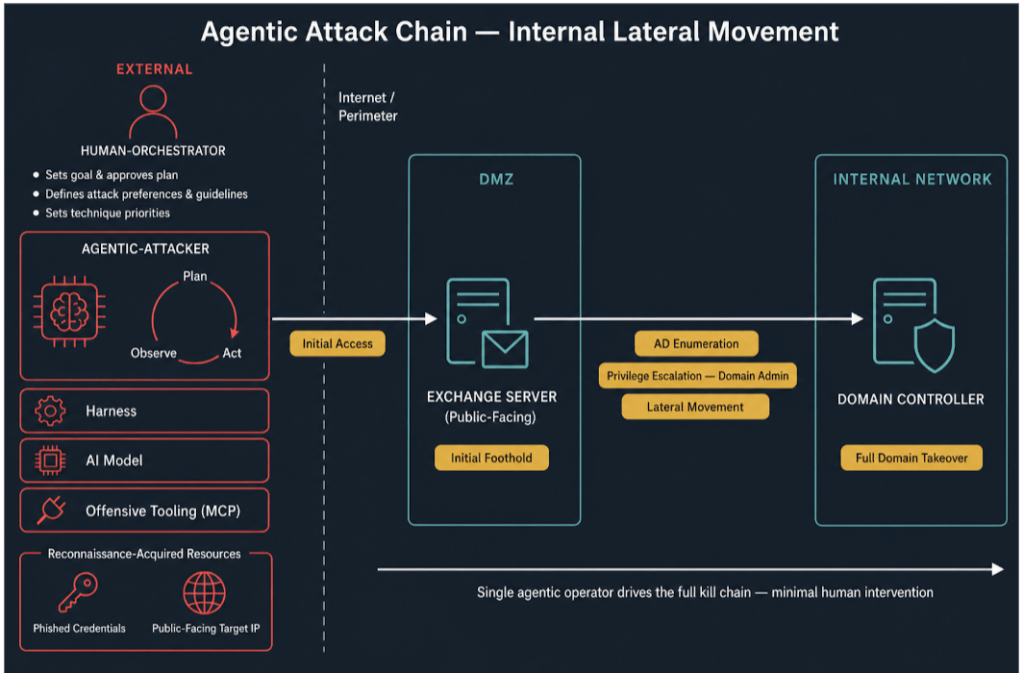
Mandia’s company Armadin has built AI agents capable of autonomous network penetration that he said would be devastating if deployed maliciously. Unlike human attackers who must manually type commands and wait for results, AI agents operate across hundreds of threads simultaneously, interpolating command outputs before they arrive and launching follow-on actions in microseconds.

“The scale and scope and total recall of an AI agent compromising you and swarming you is not humanly comprehensible,” said Mandia, who founded Mandiant and served as CEO from 2016 to 2024. “If the old way was a red team that would get in, there’s a human on a keyboard typing commands. That’s a joke compared to” what AI agents can do.

Those agents can evade endpoint detection and response systems in under an hour, he said, and operate at human speed to avoid rate-limiting detection mechanisms. Once inside a network, an AI agent can analyze documentation, packet captures and technical manuals faster than humans can read them, designing attacks tailored to specific control systems on the fly.

“When you build the offense, it scares the heck out of you,” Mandia said. “If we let the animal out of the cage today, nobody’s ready for it.”

He said Armadin recently tested a Fortune 150 company with a strong security team and found either remote code execution vulnerabilities or data leakage paths in every application tested. “Both of us were shocked,” he said.

The shift changes the fundamental question boards ask after penetration tests. Historically, directors wanted to know the probability a demonstrated attack would occur in the real world. “In the age of humans, you could never really answer,” Mandia said. “But with AI, it’s 100 percent. It’s coming and it’s going to get cheaper and more effective at the same time.”

Defenders face impossible timelines

The compression of attack timelines is colliding with organizational realities that are moving in the opposite direction. Adamski, who is now the U.S. lead for PwC’s Cyber, Data & Technology Risk business, said chief information security officers face pressure from boards to adopt AI rapidly, often with explicit goals of reducing headcount, even as compliance requirements remain unchanged and the threat landscape accelerates.

“CISOs are getting squeezed in that they cannot stop adoption because of demand from the board, from the CEO,” Adamski said. “None of the SOC 2 requirements have changed. ISO 27000, anything that helps people get through from a compliance perspective, all those rules are exactly the same.”

Stamos said patch cycles illustrate the mismatch. Where previously only sophisticated adversaries could reverse-engineer Microsoft’s Patch Tuesday updates to develop exploits, AI will democratize that capability. “You’re going to be able to drop the patch into Ghidra, driven by an agent, and come up with [an exploit],” he said. “Patch Tuesday, exploit Wednesday.”

Many CISOs are trying to bolt AI capabilities onto existing security operations, an approach the executives said is insufficient. “They’re not stepping back and looking at the bigger picture, that we have a fundamental, much more holistic problem in terms of how to reimagine and redo an entire cyber defense ecosystem that is solely driven by AI machine to machine,” Adamski said.

Avoiding Pandora’s box

The national security implications compound the problem. While other former government leaders talked at the conference about what they saw as the United States’ slipping in offensive cybersecurity, the three industry leaders spoke to what they believe nation-states have developed with the use of AI.

“I think we’re seeing less than 50 percent of the AI capability from modern nation-states right now,” Mandia said. “They’re not pressing. Nobody wants to be the first one to open that door.”

Stamos said the operational tempo favors U.S. adversaries. Russian intelligence services can observe and record data from the hundreds of businesses hit by ransomware daily, using that operational experience to train offensive AI models. “We don’t have that kind of operational pace in the U.S.,” he said.

Adamski said any AI capability the United States develops for offensive cyber operations carries inherent risks. “Anything you introduce, you’re introducing it to an ecosystem that they can use back at us,” she said.

Stamos said AI’s impact on cybersecurity will likely produce harmful consequences before other domains because the threshold for cyber operations is already low. “We allow on a Tuesday to happen in the cyber world what we would consider an act of war if it was in any other context,” he said. “I think this is where AI will be used first to hurt people, will be in cyber.”

Two years, maybe

The executives offered limited optimism that AI could also accelerate defensive capabilities, primarily by making security testing affordable at scale and enabling autonomous response systems. But the timeline for when defensive capabilities might catch up depends on immediate action. 

“Two years if we’re good,” Stamos said. “Two years is the minimum if we actually start really fixing code and refactoring stuff into type-safe languages using formal methods.”

Mandia offered optimism “a few years out” if offensive AI built by defenders successfully trains autonomous defensive systems. But he acknowledged the current state is dire. Organizations will need autonomous systems capable of immediately quarantining anomalous behavior, he said, because traditional detection and response timelines will collapse.

“You’re not going to have time to call Mandiant on a Thursday afternoon, get people in, sign a contract,” Mandia said. “You’re going to have to be able to respond at machine speed.”

Stamos said defenders must assume they cannot patch their way out of the problem and focus instead on defense in depth, particularly around lateral movement and persistence, which remain more difficult for AI to automate than initial exploitation.

But even that assumes organizations have time to prepare. The executives suggested that window is closing rapidly, if it hasn’t already shut for good.

Adamski summed up the reckoning facing the industry: “AI is going to potentially make us pay for the sins of yesterday.”

The post Security leaders say the next two years are going to be ‘insane’ appeared first on CyberScoop.

❌