Reading view

There are new articles available, click to refresh the page.

Industry’s message on CIRCIA: Please ask us fewer questions about cyberattacks

Industry groups who spoke at town halls hosted by the Cybersecurity and Infrastructure Security Agency about a pending cyber incident notification regulation had a few consistent messages:

We want this to apply to fewer of us. We don’t want to report to you on as many incidents. We want to give you less information when we do. 

CISA last week published transcripts from the town halls, where the agency sought feedback on the delayed rule for the 2022 Cyber Incident Reporting for Critical Infrastructure Act — perhaps the most significant cyber legislation Congress has ever passed. That law required critical infrastructure owners to report major cyberattacks to the federal government within 72 hours, and ransomware payments within 24 hours.

The law was designed to let the feds share information about significant incidents more widely to prepare other would-be victims. CISA published a proposed rule on the law in 2024 to define terms like “covered cyber incident” and more, and industry groups have persistently registered their objections since then.

CISA missed the October 2025 deadline for finalizing the rule, then missed a May reset target date, and now the administration says the rule will be completed in September.

Some industry sources told CyberScoop they consider that unlikely. Most also haven’t received any indications from CISA about how much of the town hall feedback it intends to embrace, they said.

Companies, incidents, information 

Those town hall comments over the course of four June dates were often very direct.

“The rule includes too many companies,” said Grant MacIntyre, director of regulatory affairs and senior attorney at the Auto Care Association. CISA estimated that more than 300,000 entities will be subject to its requirements.

Some industries advocated for their removal entirely, such as two different groups representing elements of the insurance sector. Some sought to reduce the number affected within their sector, such as the Nuclear Energy Institute wanting the list cut down to those already subject to Nuclear Regulatory Commission cybersecurity reporting requirements.

While CISA wrote the regulation with the intention to avoid overburdening small businesses, some feared it wouldn’t work that way in practice.

“The current approach where an entity qualifies either by size or by sector effectively negates the intended limitation on small businesses,” said Douglas Leigh, vice president of legislative affairs for the Alliance for Chemical Distribution. “In chemical distribution, even small entities could be swept in under multiple cyber categories.”

Where the rule specifies what kind of data organizations should report in a major incident, CISA should “seek to collect the least amount of information possible in the easiest to report fashion to facilitate information accuracy and reporting speed,” said Samantha Burch, vice president of technology public policy at government affairs at AHIP, a health insurance industry trade association.

Many, for instance, argued the report should not include information on the affected entities’ security measures.

Others worried about what kind of incidents would trigger reporting requirements.

“My big concern is that you’re going to be asking us to report incidents on every time some foreign entity tickles our firewall, whether they do anything or not, if they just do a ping or a search,” said Tim Pospisil, chief security officer for Nebraska Public Power District. “And that could be extremely burdensome.”

Industry Expectations

One industry representative told CyberScoop that CISA’s willingness to hold town halls, combined with the Trump administration strategy emphasizing “common sense regulation,” was a good sign about where the rule might be heading.

‘They are not picking up on the Biden administration’s approach and tweaking it. They’re thinking, ‘What are the specific pieces of information we need during a cyber incident to help critical infrastructure companies respond?’” said Henry Young, senior director of policy for the Business Software Alliance. “In general, industry is optimistic that what we’ll end up with are a few of the most important pieces of information, so that in the emergency, companies can act quickly and actually respond to an incident rather than completing lots of paperwork.”

But multiple industry sources said they haven’t gotten many indications about CISA’s intentions. Nor are they optimistic CISA can meet the September target date in the Unified Agenda of Regulatory and Deregulatory Actions.

“It could slip,” one said. “But I think they’re going to try.”

That industry source said they’d like to see a proposal from CISA before it cements anything forever.

Another industry source said it’s hard to trust the September date given past CISA delays, some of which aren’t CISA’s fault, such as dealing with multiple government shutdowns. Some of the delays trace to the Trump administration, given the massive cuts to CISA’s personnel.

Congress is also getting impatient.

The House Appropriations Committee “is concerned about delays in publishing the final CIRCIA rule and urges CISA to finalize it promptly following stakeholder review and feedback,” the panel wrote in the committee report for its fiscal 2027 Department of Homeland Security spending bill.

It’s a much different world than when CISA began writing the rule, something the agency also has to take into account now.

“AI has fundamentally changed the playing field,” the source said. “When this was set up, we didn’t even have the first generation of ChatGPT. We’re now in a mythos class environment.” That’s changed “how quickly we can identify threats, mitigate them, the level of human intervention, potential machine engagement.”

While CISA might have good intentions, past interactions give cause for skepticism about how capable it is of working collaboratively with industry, the source said.

Another industry source said conversations with CISA suggest the agency will look to simplify the regulation to keep it smaller and narrower, then potentially build upon it later.

From CISA’s mouth

Nick Andersen, the acting director of CISA, talked about his overarching intentions with CIRCIA at the town halls.

“CISA does not view CIRCIA as simply a check-the-box compliance exercise,” Andersen said at one. “CIRCIA will enhance visibility into the cyberthreat landscape to enable a robust national early warning capability for critical infrastructure. By quickly reporting covered cyber incidents and ransom payments to CISA, we will be able to provide timely and actionable defensive and eviction measures to your network defenders.”

Asked by CyberScoop about next steps for CIRCIA, and how it might incorporate the industry feedback, a spokesperson provided a statement.

“CISA recognizes the importance of CIRCIA, however, multiple funding lapses impacted CISA’s ability to conduct rulemaking activity for CIRCIA. CISA continues to work on the final rule,” the spokesperson said, adding that 1,200 critical infrastructure stakeholders attended the town halls.  “CISA will continue to communicate updates on the CIRCIA rulemaking process and timeline through CISA.gov/CIRCIA and the Office of Information and Regulatory Affairs’ Unified Agenda of Regulatory and Deregulatory Actions.”

The post Industry’s message on CIRCIA: Please ask us fewer questions about cyberattacks appeared first on CyberScoop.

Trump budget boss Russell Vought open to re-staffing CISA

Trump administration budget chief Russell Vought told lawmakers Tuesday that he’s willing to work with Department of Homeland Security Secretary Markwayne Mullin on re-staffing up the Cybersecurity and Infrastructure Security Agency, following deep personnel cuts and further proposed reductions in the fiscal 2027 budget blueprint.

Mullin said last week at a House Appropriations Subcommittee on Homeland Security hearing that he would like to hire 600 more people at CISA, similar to remarks he made earlier this month at another House hearing. President Donald Trump has cut or lost more than 1,000 from an agency that stood around 3,400-strong at the end of the Biden administration — cuts criticized by lawmakers in both parties.

At a House Appropriations Subcommittee on Financial Services and General Government   hearing Tuesday, Rep. Mark Amodei, R-Nev., asked Vought about Mullin’s CISA remarks.

“You don’t just flip a light switch on, and you got 600 folks over in CISA now. What’s the plan for getting CISA fully operational?” Amodei, who chairs the panel’s Subcommittee on Homeland Security, asked. “How do we make sure we have a robust, effective, cost-effective CISA force? Because I don’t think anybody thinks we have it now.”

Vought, director of the Office of Management and Budget, said he hasn’t received a formal request from Mullin to increase CISA’s number of full-time employees, but knows that hiring isn’t instantaneous.

“He was not here when we developed this budget, so if he feels the need to have additional resources, we will work through that internally, and at the appropriate time, come up and brief you,” he answered Amodei. “I do think he’s in the process still of getting his arms wrapped around the department,” he said. Mullen became DHS secretary in late March.

“This is probably one of those things, particularly in the cyber world, you now have a year and a half of a new administration,” Vought continued, and referred to conservative complaints about how CISA handled election security and disinformation under Biden. “We saw this agency had major concerns with it in our four years outside of government and with new management, I think it’s now an agency, or could be an agency, that plays a very valuable part for DHS’s portfolio.”

Bringing hundreds of new CISA personnel on board could prove challenging for reasons beyond the usual bureaucratic hurdles and security clearance processes that slow any federal hires in the national security space. Past CISA employees and agency observers have said the way the Trump administration has purged personnel and treated those who have stayed could prove a further disincentive to future hires.

Acting CISA director Nick Andersen recently said that the agency has begun the process of hiring new CISA staffers, and expected to have nearly 200 job offers out by the end of this month.

The post Trump budget boss Russell Vought open to re-staffing CISA appeared first on CyberScoop.

Open-source security is posing challenges governments can’t easily solve

An epidemic of cyberattacks on open-source software has mounted in recent months, making clear how uniquely difficult it is to protect the publicly available code, from both a policy and a technical perspective, that serves as the foundation for so much of the digital world.

While open-source software security got a boost in attention under President Joe Biden — whose administration grappled with the fallout from the potentially catastrophic Log4j flaw that emerged in 2021 — a number of open-source experts say that government protection efforts have suffered setbacks under President Donald Trump. Many also say companies that heavily rely on open-source software, which is basically all of them, haven’t shouldered enough of the responsibility for safeguarding it.

“What we’re seeing is years of lack of investment sustainment in open-source software that is finally starting to catch up to us, where it seems like every week there’s a new supply chain compromise,” said Jack Cable, who held a role at the Cybersecurity and Infrastructure Security Agency where he worked on open-source security before departing under Trump.

The advancements of frontier artificial intelligence models stand to exacerbate the risk further, while simultaneously illustrating what makes defending open source difficult: Project Glasswing said shortly after its announcement that it had uncovered 6,202 high- or critical-severity vulnerabilities in a scan of more than 1,000 open-source projects, but that it had disclosed only 502 of them to open-source project maintainers and only 75 had been patched as of May 22 (albeit some due to typical patching lagtimes).

At the same time, there are questions about how much the government can help, even as overseas governments seek to focus on open-source security.

The evolution of open-source risk 

There are a series of factors contributing to the current threat to open-source software, experts say.

One is simply that attackers go to the area where they can get the highest return on their work. Compromising open-source software gives them the chance to get into the supply chain and exploit additional targets.

“Twenty years ago, open source was still fairly niche,” said Æva Black, who also worked on open-source security at CISA but left when Trump came back into power. “The potential blast radius if you managed to compromise open source was relatively small, because back then the world didn’t run on open source. Now almost everything runs on open source,” she said, from modern cars to satellites.

Another part is the nature of open-source software itself.

“It’s a symptom [of having] lots of open source [that] is a little bit under-maintained or not cared for enough, so that we spend too little effort and money and infrastructure on them,” said Daniel Stenberg, who is the creator and maintainer of cURL, a popular open-source project. “Lots of open source is being maintained by small teams, lots of volunteers, and I think that that’s a tough situation.”

That doesn’t mean the maintainers are to blame, Stenberg said. The companies that rely on open-source need to be diligent about using it, Black said.

“What we’re seeing in that realm right now is not new; it is more advanced and far more widespread,” she said. “The problem remains that companies who use open source — because open source is by far the most efficient way to collaborate on non-product value features — most companies are not implementing a responsible and safe utilization pathway.”

Open-source projects lack a systematic way to handle coordinated vulnerability disclosures, unlike companies or industry groups with formal processes, said Dan Lorenc, CEO and co-founder of Chainguard. Project maintainers sometimes aren’t reachable, and those who are available are flooded with reports, many of them unverified findings from AI tools that waste their time without adding value..

Of course, some of those vulnerability reports turn out to be legitimate. “Mythos and AI models have contributed to an uptick in the number of vulnerabilities and things that we’re able to find” in open-source software, said Alex Zenla, chief technology officer for the cybersecurity company Edera.

All of that leaves more room for companies, non-profits and world governments to improve open-source security.

A moment of momentum

While open-source software security isn’t a new issue, the 2021 discovery of the Log4j flaw sounded alarms within the cybersecurity community. Jen Easterly, then the director of CISA, called it “one of the most serious I’ve seen in my entire career, if not the most serious,” with the potential to affect hundreds of millions of devices given the ubiquitous nature of the popular open-source logging library.

A year later, the Cyber Safety Review Board released its report on the incident, concluding that swift action from industry and government averted a disaster. But the incident “called attention to security risks unique to the thinly-resourced, volunteer-based open source community,” it wrote. “This community is not adequately resourced to ensure that code is developed pursuant to industry-recognized secure coding practices and audited by experts.”

The U.S. government actions after included some steps focused specifically on open-source software such as creation of the Open-Source Software Security Initiative and hires of well-regarded open-source security experts at CISA such as Black, but also some steps that could be applied more generally and still help with open-source security, such as greater promotion of secure-by-design, memory-safe languages and software bills of materials (SBOMs).

Some of the Biden administration work on open-source security started before Log4j, such as provisions from an executive order he issued in 2021 that directed CISA along with the Office of Management and Budget and General Services Administration to issue guidance to agencies. 

The administration’s 2023 cybersecurity strategy also stepped into the long, thorny discussions over software liability, with a mention of open-source security: “Responsibility must be placed on the stakeholders most capable of taking action to prevent bad outcomes, not on the end-users that often bear the consequences of insecure software nor on the open-source developer of a component that is integrated into a commercial product.“ The Biden administration always indicated that addressing software liability would take a prolonged battle ahead.

Under Trump, many of the Biden administration’s efforts have languished. CISA’s splashy hires on open-source are gone, including Black, Tim Pepper and Anjana Rajan. Also departed are leading figures on secure-by-design and SBOMs, with CISA personnel cutbacks slicing deep. 

No one has seen any sign that the national cyber director-led Open-Source Software Security Initiative is active, with few participants remaining in government today. The Trump administration cyber strategy doesn’t mention open-source.

“The loss of open-source experts at CISA “is unfortunate, and it will be hard for the government to try to rebuild capacity, but I do think now more than ever CISA has a core role to play to secure open source software,” Cable said.

The pressure is mounting

It’s not that the issue is getting zero attention from those in a position to make a difference. Nick Andersen, the acting director of CISA, said last month that open-source security was an area of particular concern for him.

Andersen responded to concerns about CISA staffing levels on open-source security and spoke more broadly on the topic in a statement to CyberScoop.

“As artificial intelligence and other technologies have the power to transform how vulnerabilities are discovered and exploited, CISA recognizes that the open source software (OSS) that underpins much of the nation’s critical infrastructure will need to be hardened,” he said. “CISA actively collaborates with our partners on shared priorities, including OSS security, to ensure time and resources are spent where they matter the most.  We have an immensely talented team, but are also accelerating our hiring in critical areas, to strengthen the nation’s defenses against cyber threats.”

The Office of the National Cyber Director did not respond to requests for comment.

There’s been some activity on Capitol Hill, too. The Securing Open Source Software Act, which Cable worked on during a stint as a Senate staffer, would direct CISA and other agencies to take actions to mitigate open-source software security risks, but the legislation has stalled since its introduction in 2022. A portion of the bill, however, was included in the Department of Homeland Security funding law Trump signed in April, directing CISA to brief Congress on the value of establishing something like an open source program office, which some companies use to manage open source within a given firm.

Senate Intelligence Committee Chairman Tom Cotton, R-Ark., has pushed the executive branch to improve its awareness of foreign adversaries playing roles in open-source software used by national security-focused agencies.

The annual defense policy bill in the House calls on the Defense Department’s chief information officer to report to Congress on a plan to secure open-source software supply chains, saying lawmakers are “concerned that the Department lacks sufficient visibility into the origins, maintenance, and security of OSS applications and software dependencies.”

That defense authorization bill language is “really beneficial, and I think it signals acknowledgement of this changing of culture” around open-source security risks, said Hayden Smith, founder of HuntedLabs, whose company won a contract with the Space Development Agency on supply chain security — agency work that the defense bill singled out.

“The report language is the first time the Hill is trying to get a true handle on foreign influence in open source code where they have oversight,” he said, saying it was a “piece of the puzzle” along with Cotton’s letter and a memo from Secretary of Defense Pete Hegseth last year about foreign influence in the Pentagon supply chain. “It’s good and would trickle down into everyone who provides software to the department.”

Zenla, though, believes trying to isolate China from open-source systems isn’t in and of itself a good idea. 

“I don’t think that that makes a lot of sense, because they’re actually pretty good things that people contribute to open source,” she said. “Not everyone is malicious, and what are we going to do, spy on every single open source maintainer?” It’s more about doing things like making sure that highly-classified systems are set up in a separate way, she said.

Europe is also taking action to secure open-source software that the United States doesn’t seem ready or willing to do right now. Germany, for instance, devotes grants to the security of open-source projects, although Stenberg pointed out that sometimes money doesn’t equate to maintainers being able to fix flaws more quickly, depending on the project’s size.

The Cyber Resilience Act (CRA) adopted by the Council of the European Union in 2024 could offer another road on open-source security. The CRA requires those who use open-source software products as part of any commercial activity to take certain security measures. 

Black said that when she was at CISA, there were discussions between the agency and European counterparts about finding compatible ideas on open-source security, but that momentum died with the Trump administration.

But “Europe kept rolling, and now has in place a new legal framework that is set to really reshape open-source security for potentially the whole world, but certainly for anyone who wants to work with Europe on open source,” she said.

Lorenc recently wrote that “open source isn’t governable.” He said an organization like a neutral nonprofit, possibly using some government funding, should take responsibility for things like coordinating vulnerability disclosure into one pipeline. He also said there needs to be one authority in charge of “forking” — that is, taking a project and assigning stewardship elsewhere — when a maintainer isn’t responsive to vulnerabilities. 

There are differing opinions on how much past government warnings, advisories and guidance have helped. Smith gave some credit to government agencies that “have all responded to open source attacks using the means they have.”

Stenberg said that “I don’t think they make any big dent at all in the big scheme of things.” They might get some attention initially, “then two years later we all forgot about them, and they actually didn’t change much.”

Ideally, everyone could get on the same page, Zenla said. “The best way to do this is if people actually collaborated on a global scale on some sort of regulation around this, but that seems nearly impossible at the current moment,” she said. (The United Nations’ Open Source Week runs all this week.)

But if there’s an upside to the spate of attacks on open-source software, it’s the energy it gives to how better to secure it, Lorenc said, invoking the political saying to never let a good crisis go to waste.

“Everyone knows the industry has to change,” he said. “This is a really good crisis, and the right things are happening in the right places, and organizations are rethinking their culture around software development, and they know what they have to do. It’s just something that’s never been top of the priority list for the last 10 years. Now it is, and they’re doing it, and it’s, ‘Can we do it fast enough?’”

The post Open-source security is posing challenges governments can’t easily solve appeared first on CyberScoop.

CISA directive orders agencies to prioritize vulnerability patching in a new way

The Cybersecurity and Infrastructure Security Agency on Wednesday ordered federal agencies to prioritize vulnerabilities based on four criteria, as part of push to “patch smarter, not harder.”

Federal agencies should emphasize patches for vulnerabilities that affect a publicly exposed asset, allow an attacker to fully automate exploitation, give attackers the ability to take over control of a system or relate to evidence of active, real-world exploitation, CISA declared.

CISA acting director Nick Andersen previewed the binding operational directive (BOD) Tuesday, framing it as a rethinking of vulnerability management more broadly.

“This Directive provides clear definitions, timelines and criteria that enhances transparency, predictability and agencies’ resource planning to execute more effective vulnerability remediation,” Andersen said in a statement. “CISA is leading and collaborating with federal civilian agencies to stay ahead of our adversaries as tactics, technologies and vulnerabilities change.”

BOD 26-04 sets forth timelines for how quickly agencies must fix a vulnerability based on how many of the four criteria it meets. If it meets all four, for example, agencies need to fix it within three days and carry out a “forensic triage” to assess whether their systems were compromised. 

More generally, agencies must immediately update their vulnerability management policies, including establishing a process for ongoing remediation of known, exploited vulnerabilities (KEVs) on CISA’s “must-patch” list. Within 60 days, agencies need to update their processes for remediating common vulnerabilities, and within 180 days, agencies must meet the order’s remediation timelines.

The directive is motivated in part by how artificial intelligence is shifting the window from vulnerability discovery to weaponization, and CISA said it reflects priorities in an executive order on AI that President Donald Trump signed last week.

BODs aren’t mandatory for anyone outside of federal agencies, but CISA encourages the private sector to embrace them. CISA officials said in a blog post about the need to “patch smarter, not harder” that “defenders are already struggling to keep up.”

“Artificial intelligence is assisting both researchers and adversaries in identifying flaws in software, vastly increasing the pace at which new vulnerabilities are discovered,” wrote Chris Butera, acting executive assistant director for cybersecurity, and Jonathan Spring , senior technical adviser. “Per Verizon’s 2026 Data Breach Investigations Report, only 26% of vulnerabilities on CISA’s Known Exploited Vulnerabilities (KEV) Catalog were fully remediated by organizations in 2025, a drop from the previous year’s 38%. The median time for full resolution rose to 43 days.”

The move from weeks to days for agencies to patch the most urgent vulnerabilities is something CISA has discussed with some agencies to see if it’s doable, Butera told reporters Wednesday. At one large agency CISA analyzed, just 1% of vulnerabilities fell into the 3-day window, while 60% could be deferred to the next system upgrade.

“We’ve engaged with a few federal agencies ahead of this directive and tried to socialize some of these new time frames,” he said. “We really believe we should be able to free up some time to patch the most urgent vulnerabilities faster, while allowing for more regular patch cycles for some of the lower risk vulnerabilities.”

Patrick Garrity, a security researcher at VulnCheck, said the CISA directive joins similar guidance out of India and the United Kingdom.

“It’s clear the momentum is growing and pushing in the right direction,” he told CyberScoop. “The new directive aligns exactly with the approach we’ve been taking with customers for years, leveraging exploit intelligence to focus on the subset of vulnerabilities that enterprises, governments and vendors really need to address. While it’s mandated for federal organizations, it’s something the private sector should pay attention to as well.”

Tod Beardsley, vice president of security research at runZero and former KEV section chief at CISA, wrote on LinkedIn that there are several noteworthy potential impacts of the BOD, among them that he thinks three-day deadlines will end up being frequent.

“I remain dubious that a three day deadline spread across more than a hundred agencies is an achievable patch cadence today, but we’ll all find out together,” he said.

Updated 6/10/26: Includes Chris Butera comments on timelines, and comments from Patrick Garrity and Tod Beardsley.

The post CISA directive orders agencies to prioritize vulnerability patching in a new way appeared first on CyberScoop.

CISA is rethinking how it prioritizes risks and vulnerabilities for feds, private sector

The Cybersecurity and Infrastructure Agency wants to fundamentally reevaluate how it prioritizes risks and vulnerabilities, both for privately-owned critical infrastructure and within the federal government, acting director Nick Andersen said Tuesday.

The plans include a binding operational directive for federal agencies set to be published Wednesday and getting more specific with critical infrastructure owners and operators about which assets they need to protect most and how, Andersen said while speaking at an event hosted by Axonius in Washington, D.C. and talking with reporters afterwards.

The binding operational directive looks to revise how federal agencies do vulnerability management, he said. “Overall, our approach to date has been ‘A patch is released, apply this patch as quickly as you can,’” he said.

“We’re really asking people to take more of a focus on risk associated with each vulnerability. Is it with an asset that is internet-exposed? Does it align to a KEV entry?” he said, referring to CISA’s list of known exploited vulnerabilities. “Is it automatable in its exploitation? Really, we need to be able to highlight that some patches just aren’t as important as others, and plugging the holes for some vulnerabilities is simply not as important as others.”

Andersen said he has made setting the right priorities the focus of his tenure.

“We have to be okay with saying there are some systems that are less important than others, there are some elements of critical infrastructure that are less important than others,” he said. “Those things are very easy for us to rationalize [for] physical crises, but we need to start wrapping our minds around how we’re going to do that during cyber crises.”

Andersen said artificial intelligence-enhanced threats have fueled the directive in part, based on “a recognition that we’re a different dynamic environment with the shorter timeline to weaponization and exploitation,” but the discussions on the directive have been going on for months, before the splashy announcements about frontier AI models and the risks they might deepen. Wednesday’s directive is unrelated to the AI-focused executive order released by the Trump administration last week.

The idea of prioritizing certain potential hacking targets over others isn’t a new one in critical infrastructure, with concepts like “Section 9” designations under a 2013 executive order for entities whom an attack upon could have catastrophic effects; “systemically important critical infrastructure” designations, as recommended by the Cyberspace Solarium Commission; or the creation of the National Risk Management Center established during President Donald Trump’s first term but now the subject of proposed budget cuts.

Andersen said past concepts haven’t worked well, citing Section 9 designations as an example.

“We would sit here and say, ‘Congratulations, you’re with this company, and you’re a Section 9 entity, isn’t that fantastic?’” he said. “That’s really not the level of fidelity that we have to be able to get to to have a real measurable conversation about risk. I need to be able to go to a company and say, ‘Here’s the specific function you’re supporting that makes you more critical. Let’s have a conversation about the specific assets that support that function, and how do we get to a measurable level of resilience for those assets?’”

Those discussions need to get down to a “fine grain,” Andersen said.

“If I’ve got a major bank that I’m talking to, is it as important to me that the bank’s process that supports the bulk payment system is resilient, or is it just as important to me that the branch location two blocks away is continuing to operate?” he said. “Those things just are apples and oranges, even though it’s the same entity that might be affected.”

CISA’s capabilities under the Trump administration have drawn considerable scrutiny, given deep budget cuts at the agency, with more planned. The administration is now making moves to hire back personnel.

Andersen said the agency is working to hire 329 people, and will have job offers out to 182 of them by the end of June. He said the emphasis of the first tranche of hires under the hiring sprint is operational capabilities, meaning areas like emergency communications, infrastructure security and regional personnel.

The agency also has had some of its work hampered by the government shutdowns, such as the delay in plans for town-hall meetings about implementation of the Cyber Incident Reporting for Critical Infrastructure Act of 2022, which will require key owners and operators to report major incidents within 72 hours.

Andersen said he couldn’t set a date for finalization of regulations related to the law — which had already been delayed prior to any funding lapses — with those town halls now scheduled to begin next week.

“We could have a lot of comments that come to us and really radically change our way of thinking about what the need is here,” he said. “But our focus is just on what’s the original congressional intent behind CIRCIA. what is the greatest need that we’re going to be able to serve, and how it’s going to be able to further the mission that we have for the nation.”

The post CISA is rethinking how it prioritizes risks and vulnerabilities for feds, private sector appeared first on CyberScoop.

DHS Secretary Markwayne Mullin pinpoints optimal CISA staffing levels

Department of Homeland Security Secretary Markwayne Mullin told Congress Wednesday that the Cybersecurity and Infrastructure Security Agency would ideally have 2,800 personnel, up from approximately 2,200 now and down from 3,400 before the second Trump administration began.

President Donald Trump has pushed to dramatically reduce personnel numbers at the agency, something that has drawn criticism from both Democrats and Republicans on the Hill. Trump has proposed hundreds of millions more in cuts for fiscal 2027.

House Homeland Security Committee Chairman Andrew Garbarino, R-N.Y., asked Mullin at a hearing Wednesday about further proposed CISA budget cuts, saying he was “concerned” about personnel numbers and funding for education programs and whether the fiscal 2027 blueprint would “negatively impact those efforts.”

Mullin said DHS funding lapses have made the department rethink CISA, although the deep CISA personnel reductions predate the recent spate of government shutdowns. 

“We had to readjust the way we’re looking at CISA and better lean on public partnerships,” he said. The agency can work well with 2,800 people “If we can actually have the partnerships we need with states and be able to use the grants, the monies that [we] saved with CISA to be able to invest with local and state municipalities. … We’re not going to fail on the mission we have in front of us.”

CISA personnel figures are in a constant state of flux. The CISA staff figure of 2,200 Mullin gave is down even from December. In March, acting director Nick Andersen said CISA was looking to hire 300 people.

There’s been no proposal from the Trump administration to-date to take funds formerly allocated to CISA and shift them to state governments for cybersecurity. State officials have said CISA budget cuts have made their jobs harder, and most experts have said the Trump administration’s approach to shift cyber responsibilities to states is badly misguided.

Congress has yet to permanently reauthorize the State and Local Cybersecurity Grant Program that expired last year before it got a temporary extension and is due to expire again in September.

CISA has gone without a Senate-confirmed director for the entirety of the second Trump administration. Mullin said “we’ve got a person soon to be nominated that will be running CISA that has the ability to recruit and focus on the authorities we have.”

Mullin said CISA has “unique” authorities that haven’t “been completely utilized.” 

“We want CISA to be the leader in cybersecurity,” he said. “They should be and they will be.”

A House Appropriations subcommittee is set to consider a DHS funding bill Friday.

The post DHS Secretary Markwayne Mullin pinpoints optimal CISA staffing levels appeared first on CyberScoop.

Lawmakers Demand Answers as CISA Tries to Contain Data Leak

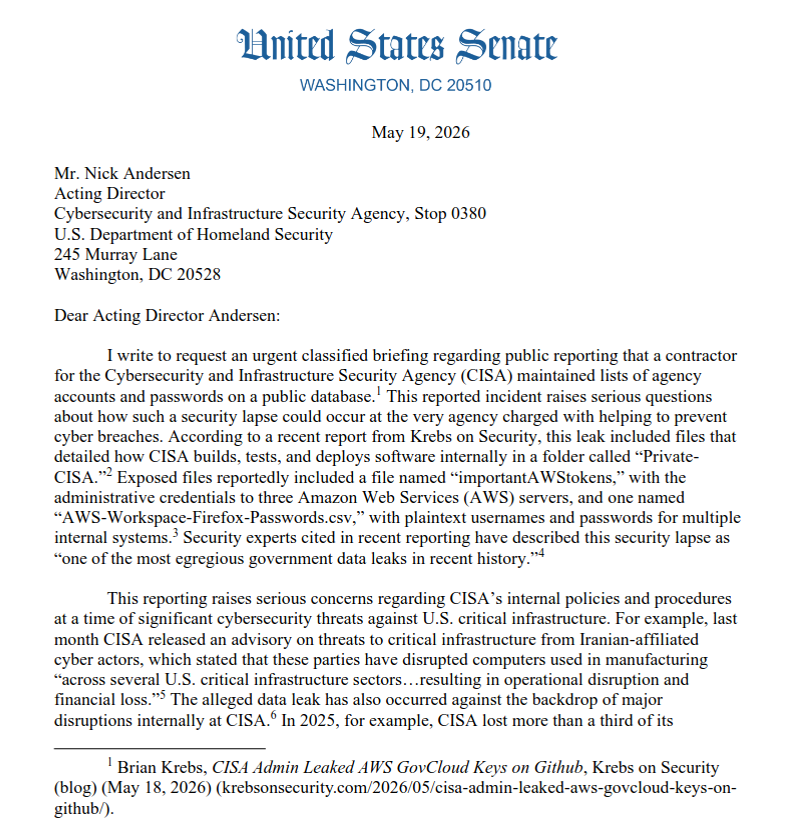
Lawmakers in both houses of Congress are demanding answers from the U.S. Cybersecurity & Infrastructure Security Agency (CISA) after KrebsOnSecurity reported this week that a CISA contractor intentionally published AWS GovCloud keys and a vast trove of other agency secrets on a public GitHub account. The inquiry comes as CISA is still struggling to contain the breach and invalidate the leaked credentials.

On May 18, KrebsOnSecurity reported that a CISA contractor with administrative access to the agency’s code development platform had created a public GitHub profile called “Private-CISA” that included plaintext credentials to dozens of internal CISA systems. Experts who reviewed the exposed secrets said the commit logs for the code repository showed the CISA contractor disabled GitHub’s built-in protection against publishing sensitive credentials in public repos.

CISA acknowledged the leak but has not responded to questions about the duration of the data exposure. However, experts who reviewed the now-defunct Private-CISA archive said it was originally created in November 2025, and that it exhibits a pattern consistent with an individual operator using the repository as a working scratchpad or synchronization mechanism rather than a curated project repository.

In a written statement, CISA said “there is no indication that any sensitive data was compromised as a result of the incident.” But in a May 19 a letter (PDF) to CISA’s Acting Director Nick Andersen, Sen. Maggie Hassan (D-NH) said the credential leak raises serious questions about how such a security lapse could occur at the very agency charged with helping to prevent cyber breaches.

“This reporting raises serious concerns regarding CISA’s internal policies and procedures at a time of significant cybersecurity threats against U.S. critical infrastructure,” Sen. Hassan wrote.

A May 19 letter from Sen. Margaret Hassan (D-NH) to the acting director of CISA demanded answers to a dozen questions about the breach.

Sen. Hassan noted that the incident occurred against the backdrop of major disruptions internally at CISA, which lost more than a third of it workforce and almost all of its senior leaders after the Trump administration forced a series of early retirements, buyouts, and resignations across the agency’s various divisions.

Rep. Bennie Thompson (D-MS), the ranking member on the House Homeland Security Committee, echoed the senator’s concerns.

“We are concerned that this incident reflects a diminished security culture and/or an inability for CISA to adequately manage its contract support,” Thompson wrote in a May 19 letter to the acting CISA chief that was co-signed by Rep. Delia Ramirez (D-Ill), the ranking member of the panel’s Subcommittee on Cybersecurity and Infrastructure Protection. “It’s no secret that our adversaries — like China, Russia, and Iran — seek to gain access to and persistence on federal networks. The files contained in the ‘Private-CISA’ repository provided the information, access, and roadmap to do just that.”

KrebsOnSecurity has learned that more a week after CISA was first notified of the data leak by the security firm GitGuardian, the agency is still working to invalidate and replace many of the exposed keys and secrets.

On May 20, KrebsOnSecurity heard from Dylan Ayrey, the creator of TruffleHog, an open-source tool for discovering private keys and other secrets buried in code hosted at GitHub and other public platforms. Ayrey said CISA still hadn’t invalidated an RSA private key exposed in the Private-CISA repo that granted access to a GitHub app which is owned by the CISA enterprise account and installed on the CISA-IT GitHub organization with full access to all code repositories.

“An attacker with this key can read source code from every repository in the CISA-IT organization, including private repos, register rogue self-hosted runners to hijack CI/CD pipelines and access repository secrets, and modify repository admin settings including branch protection rules, webhooks, and deploy keys,” Ayrey told KrebsOnSecurity. CI/CD stands for Continuous Integration and Continuous Delivery, and it refers to a set of practices used to automate the building, testing and deployment of software.

KrebsOnSecurity notified CISA about Ayrey’s findings on May 20. Ayrey said CISA appears to have invalidated the exposed RSA private key sometime after that notification. But he noted that CISA still hasn’t rotated leaked credentials tied to other critical security technologies that are deployed across the agency’s technology portfolio (KrebsOnSecurity is not naming those technologies publicly for the time being).

CISA responded with a brief written statement in response to questions about Ayrey’s findings, saying “CISA is actively responding and coordinating with the appropriate parties and vendors to ensure any identified leaked credentials are rotated and rendered invalid and will continue to take appropriate steps to protect the security of our systems.”

Ayrey said his company Truffle Security monitors GitHub and a number of other code platforms for exposed keys, and attempts to alert affected accounts to the sensitive data exposure(s). They can do this easily on GitHub because the platform publishes a live feed which includes a record of all commits and changes to public code repositories. But he said cybercriminal actors also monitor these public feeds, and are often quick to pounce on API or SSH keys that get inadvertently published in code commits.

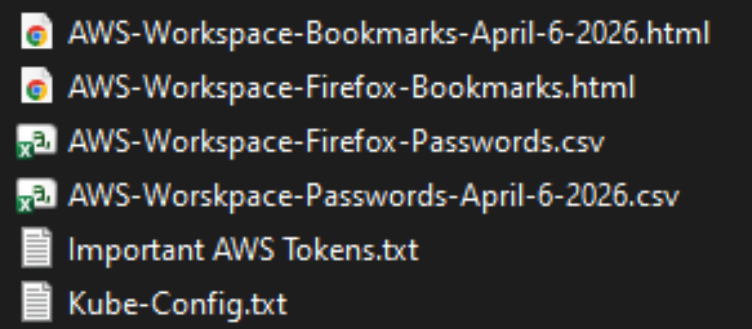
The Private CISA GitHub repo exposed dozens of plaintext credentials to important CISA GovCloud resources. The filenames include AWS-Workspace-Bookmarks-April-6-2026.html, AWS-Workspace-Firefox-Passwords.csv, Important AWS Tokens.txt, kube-config.txt, etc.

The Private-CISA GitHub repo exposed dozens of plaintext credentials to important CISA GovCloud resources.

In practical terms, it is likely that cybercrime groups or foreign adversaries also noticed the publication of these CISA secrets, the most egregious of which appears to have happened in late April 2026, Ayrey said.

“We monitor that firehose of data for keys, and we have tools to try to figure out whose they are,” he said. “We have evidence attackers monitor that firehose as well. Anyone monitoring GitHub events could be sitting on this information.”

James Wilson, the enterprise technology editor for the Risky Business security podcast, said organizations using GitHub to manage code projects can set top-down policies that prevent employees from disabling GitHub’s protections against publishing secret keys and credentials. But Wilson’s co-host Adam Boileau said it’s not clear that any technology could stop employees from opening their own personal GitHub account and using it to store sensitive and proprietary information.

“Ultimately, this is a thing you can’t solve with a technical control,” Boileau said on this week’s podcast. “This is a human problem where you’ve hired a contractor to do this work and they have decided of their own volition to use GitHub to synchronize content from a work machine to a home machine. I don’t know what technical controls you could put in place given that this is being done presumably outside of anything CISA managed or even had visibility on.”

Update, 3:05 p.m. ET: Added statement from CISA. Corrected a date in the story (Truffle Security said it found the repo gained some of its most sensitive secrets in late April 2026, not 2025).

CISA chief frets about open-source vulnerabilities, delayed security improvements

Securing some of the open-source technology that serves as the backbone for all modern digital infrastructure is going to require some “hard decisions” amid a wave of malware attacks, the leader of the Cybersecurity and Infrastructure Security Agency said Thursday.

“The open-source community is one that I’m particularly worried about when we start to think about rapid escalation of vulnerability discovery,” acting director Nick Andersen said, referencing a cartoon about how key technologies that underpin the internet are often maintained by a single person. 

In one recent attack, a hacker hijacked an account of a single open-source project maintainer to  publish malicious updates for axios, popular with software developers, raising the potential for attacks that could spread more widely. TeamPCP, a suspected North Korean hacking group, has been on a sweeping spree of open-source attacks.

“There’s tremendous opportunity here to re-architect areas … to make investments in areas where we know that we’ve been lacking, and to just force some hard security decisions to be made… where people thought that their risk profile was different than what it is,” Andersen said.  “We see the escalation in terms of speed, scale and velocity of vulnerability discovery to weaponization and exploitation.”

CISA has been working with industry and others “to modify our approach to vulnerability management, modify our approach to coordinated vulnerability disclosure, modify our approach to remediation, with the explicit understanding that we’re just not going to be able to keep up using traditional mechanisms,” Andersen said, speaking at the National Cyber Innovation Forum in Washington, D.C.

The government and private sector can work together to identify the biggest threats and then give them the right level of attention, he said. On the federal government side, that means working to get a full picture of the extent of reliance on open-source technologies.

Overall, the United States has put off too many necessary security improvements, Andersen said.

“Whether you look at the private sector or you look at our governments and public sector networks and systems that we’re supporting, there’s just a tremendous amount of technical debt that’s out there,” he said. We’ve not made the right level of investment required in order to be able to readily secure ourselves for the future.”

The post CISA chief frets about open-source vulnerabilities, delayed security improvements appeared first on CyberScoop.

CISA credential leak raises alarms, and Capitol Hill demands answers

Congress wants answers from the Cybersecurity and Infrastructure Security Agency about the reported public exposure of sensitive agency credential data on GitHub in an incident that the security researcher who discovered it called one of the worst leaks he’s ever seen.

Other security professionals also voiced concern Tuesday about the leak and the potential for abuse by any malicious parties who got a hold of the information.

Security firm GitGuardian said it discovered a public GitHub repository last week that exposed credentials for privileged AWS GovCloud accounts and internal CISA systems dating back to November. The repository, apparently maintained by a contractor, was named “Private-CISA.” 

Krebs on Security first reported the incident.

“My main fear … is that a state actor will get the data and might be able to do bad stuff,” GitGuardian security researcher Guillaume Valadon told CyberScoop that he thought to himself upon discovering the leak, after concluding it was real; he initially thought it looked fake.

State-based attackers who obtained the credentials “might be able to gain persistence,” Valadon said, “so for me it’s even worse than an attacker destroying everything, having someone in a governmental system — it’s really, really bad.”

A House Homeland Security Committee aide said the panel is seeking a staff-level briefing from CISA on the matter.

Mississippi Rep. Bennie Thompson, the top Democrat on the Homeland Security Committee, and Delia Ramirez, the top Democrat on the panel’s cyber subcommittee, had separately demanded a briefing Tuesday in a letter to CISA’s acting director, Nick Andersen. 

They said they wanted to learn “how this serious security lapse occurred, any potential security consequences, remediation activities, corrective actions related to the contractor personnel involved, and efforts to monitor for and prevent similar activity from occurring in the future.”

Sen. Maggie Hassan, D-N.H., also sent a letter Tuesday to Andersen, seeking a classified briefing to answer questions about which systems were exposed, what forensic work CISA did to evaluate potential damage and what corrective action it has taken.

“This reported incident raises serious questions about how such a security lapse could occur at the very agency charged with helping to prevent cyber breaches,” Hassan wrote in the missive first reported by Axios, particularly “regarding CISA’s internal policies and procedures at a time of significant cybersecurity threats against U.S. critical infrastructure.”

Both letters pointed to personnel and budget cutbacks at the agency as a potential contributor to the incident.

CISA said it was looking into what happened.

“The Cybersecurity and Infrastructure Security Agency is aware of the reported exposure and is continuing to investigate the situation,” a spokesperson said. “Currently, there is no indication that any sensitive data was compromised as a result of this incident. While we hold our team members to the highest standards of integrity and operational awareness, we are working to ensure additional safeguards are implemented to prevent future occurrences.” 

The repository was reportedly maintained by a contractor at Nightwing. A Nightwing spokesperson referred questions to CISA.

The kind of exposure that happened for CISA “is an unfortunately painful, but common and repeated, if not relentless, way that we see organizations inadvertently leak very sensitive credentials to the wider web,” said Ben Harris, founder of WatchTowr, a company that helps organizations detect such exposures.

Harris told CyberScoop he didn’t want to speculate on what attackers who obtained the credentials might be able to do with it, but he said that it would be “terrifying” if the contractor was transferring information from work to home, as one researcher theorized.

Dave Mitchell, senior director of threat intelligence at Infoblox, told CyberScoop the incident showed the importance of teams having controls and audits in place across their repositories.

“Of all the things that keep me up at night, misconfigurations in GitHub are a recurring nightmare. It’s critical for so many organizations — all it takes is one accidental upload or misconfiguration and you’ve signed yourself up for a major incident,” he said in a written statement. “No need for a threat actor to use advanced techniques to compromise you if the keys are already sitting on the counter.”

Travis Rosiek, public sector chief technology officer at Rubrik, noted that the timing of the issue aligned with the government shutdown that only recently resolved for DHS. He said the incident showed the federal government needs to prioritize resilience.

“A persistent shortage of cybersecurity talent, combined with funding lapses, high workforce turnover, and an increasingly complex threat landscape, created the perfect storm for this scenario,” he said in a written statement to CyberScoop. “No organization is immune, and we must ensure that the federal government, which is responsible for helping protect the nation’s critical infrastructure and enhancing our cybersecurity posture, remains fully operational 24-7, 365 days a year.”

Without minimizing the severity of the incident, some researchers who have looked at the leak said there are mitigating circumstances that make elements of it defensible or, at least, understandable.

CISA acted very swiftly to remove the repository, Valadon said, once he alerted them to the leak.

And even if CISA has the right policies in place, human error still can make it difficult to entirely avoid incidents like this, Harris said.

“The reality is this happens every single day to different organizations, including cybersecurity companies,” he said, noting it would be different if it was a pattern. “This is not exclusive to CISA. I don’t really think it reflects well if we saw this every single day with CISA. … It’s not ideal that it’s even happened once, but the reality is that cybersecurity is people, process, technology.”

CISA has had other security incidents in the past, including recently. The former acting director of the agency endured criticism for uploading sensitive contract data to ChatGPT last year. In 2024 the agency notified Congress of a breach of a chemical plant security tool.

Updated 5/20/26: to include more information on a House Homeland Security Committee briefing request.

The post CISA credential leak raises alarms, and Capitol Hill demands answers appeared first on CyberScoop.

❌